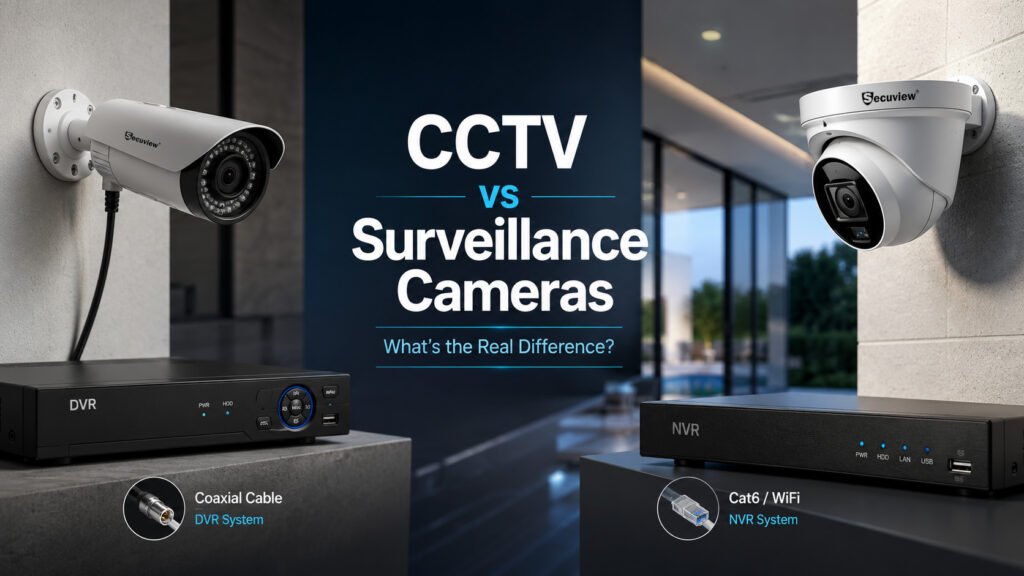
If you have ever asked for a ‘CCTV system’ and been shown IP cameras, or described your ‘surveillance cameras’ and received an analogue DVR kit, the confusion around these two terms is real, and it comes with a cost. Choosing the wrong system means incompatible hardware, limited remote access, or unnecessary expense.
This guide explains what each term means technically, how the two systems differ at the architectural level, where they overlap in modern usage, and which suits different Qatar property types: villas, apartments, and commercial buildings. Each represented query is answered directly in its own section.
What Is a CCTV System?
A CCTV system (Closed Circuit Television system) is a video surveillance setup where analogue cameras transmit electrical video signals over coaxial cable to a DVR (Digital Video Recorder). The ‘closed circuit’ is specific to the signal flows only within a physically contained network of cables and recording units. It does not transmit over a public network, and it does not broadcast openly.
CCTV technology originated in the 1940s for industrial monitoring and became the global standard for security camera systems through the 1980s and 1990s. The majority of systems installed across Qatar’s older villas, compounds, and commercial buildings over the past two decades are CCTV, analogue cameras on coaxial cable connected to a local DVR.
Three characteristics define a CCTV system architecturally:
- Coaxial cable transmission: Video signal travels over RG59 or RG6 coaxial cable with BNC connectors, the same cable type used in television aerials.
- DVR recording unit: The Digital Video Recorder receives the analogue signal, converts it to digital format using H.264 or H.265 compression, and stores footage on a local hard drive.
- Closed local network: Footage is stored and accessed locally. Remote viewing requires additional router configuration; it is not native to the analogue architecture.
How Does a CCTV System Work?
A CCTV system works in three stages: capture, transmit, and record. The camera’s image sensor captures light and converts it to an analogue electrical signal. That signal travels through coaxial cable to the DVR. The DVR converts the analogue signal to digital format, compresses it, and writes it to a local hard drive for storage and playback.
Modern AHD (Analogue High Definition) cameras, the current standard for CCTV systems, support resolutions from 2MP (1080p) up to 8MP (4K). Despite the higher resolution, the transmission remains analogue over coaxial cable. This is why a 4K AHD camera is still technically a CCTV camera, with analogue transmission, DVR recording, and a closed-circuit architecture.
What Is a Surveillance Camera System?
A surveillance camera system is the broader category covering all video security technologies, traditional CCTV, IP cameras, WiFi cameras, and 4G cameras. Where ‘CCTV’ describes a specific technical architecture (analogue, coaxial cable, DVR), ‘surveillance camera’ describes the function: monitoring a space for security purposes, regardless of the technology used.
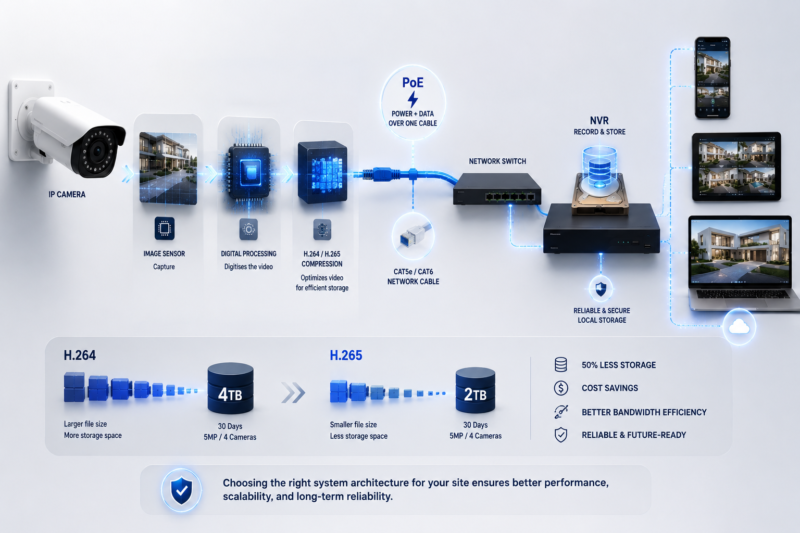
Modern surveillance systems beyond traditional CCTV use digital IP cameras that compress video at the camera itself and transmit a digital data stream over Cat5e or Cat6 network cable to an NVR (Network Video Recorder). This architectural shift, from analogue signal to digital stream, coaxial to network cable, DVR to NVR, is what separates IP surveillance from CCTV at the system level.
The three main types of modern surveillance cameras beyond traditional CCTV are:
- IP cameras (PoE): Powered and connected through a single Cat6 network cable. Connect to an NVR. Support smart motion detection zones, two-way audio, and native remote access via mobile app.
- WiFi cameras: Transmit video wirelessly over a home or business WiFi network. No cable required at the camera position. Suited to apartments and rental properties where running cable is impractical.
- 4G cameras: Use a mobile SIM card to transmit footage, no local network infrastructure required. Used in remote sites, outdoor gates, and temporary locations without available WiFi.
How Does an IP Surveillance Camera Work?
CCTV vs surveillance camera system comparison in Qatar
An IP camera digitises and compresses video at the camera itself, using H.265 or H.264 compression, then transmits a digital data stream over Cat5e or Cat6 network cable to an NVR. PoE (Power over Ethernet) cameras receive both power and data through this single cable, eliminating the need for a separate power supply at each camera position.
H.265 compression reduces storage file sizes by approximately 50% compared to H.264 at equivalent image quality. On a 4-camera system recording continuously at 5MP resolution, the difference between H.264 and H.265 means needing a 2TB hard drive instead of a 4TB drive for the same 30-day retention period, a meaningful cost saving at any scale.
According to the CISA video surveillance resource guide, matching the camera system architecture to the specific infrastructure and monitoring requirements of the installation site is as important as the hardware specification itself.
CCTV vs Surveillance Cameras: Key Differences
CCTV and Surveillance Cameras the main differences between CCTV and IP surveillance cameras are: transmission method, cable type, recording unit, remote access capability, smart feature support, and installation flexibility. Understanding these differences at the system level, not just the product label, is what allows you to choose the right architecture for your specific property and budget.
| Specification | CCTV — Analogue / AHD | IP Surveillance Camera |
| Transmission | Analogue signal, coaxial cable (RG59/RG6) | Digital stream, Cat5e/Cat6 or wireless |
| Recording unit | DVR (Digital Video Recorder) | NVR (Network Video Recorder) |
| Power method | Separate the power cable at each camera | PoE, power + data in one Cat6 cable |
| Resolution | Up to 8MP (4K) via AHD | Up to 8MP (4K) with higher per-pixel detail |
| Remote access | Requires router port forwarding setup | Native, built into NVR and camera firmware |
| Smart features | Basic motion detection | Person/vehicle AI · smart zones · 2-way audio |
| Storage compression | H.264 / H.265 | H.265 standard, 50% less storage than H.264 |
| Best suited for | Upgrading existing coaxial infrastructure | New builds · smart features · scalable systems |
Are CCTV and Surveillance Cameras the Same Thing?
No — technically, they describe different architectures. But in everyday usage, the terms have become interchangeable, and most buyers, installers, and even product manufacturers use them to mean the same thing. This is not careless language; it reflects how the market actually evolved.
The shift happened as IP camera technology matured and became less expensive than analogue CCTV. When PoE IP cameras became the professional standard for new installations, offering better smart features and simpler cabling, installers continued selling ‘CCTV systems’ because that is what buyers searched for and recognised. The label stayed; the technology underneath it changed.
Today, a supplier in Qatar offering a ‘CCTV system’ might mean an AHD analogue system on a DVR, or a PoE IP system on an NVR. Both are commonly called CCTV. The more accurate question to ask any supplier is not ‘CCTV or surveillance?’ but ‘analogue or IP?’ because that distinction reveals the actual cable type, recording unit, and feature set.
As ASIS International’s security management research consistently notes, understanding the technical architecture of a security system — not just its product label- is essential for making purchasing decisions that match the system to the actual security requirement.
Which System Works Better in Qatar’s Climate?
Both CCTV and IP surveillance cameras are suitable for Qatar, but outdoor installations require specific weatherproofing standards regardless of system type. Qatar’s outdoor environment subjects cameras to three simultaneous stresses: peak summer temperatures consistently above 45°C from June through September, fine abrasive dust from shamal winds, and occasional heavy rain during winter months.
Any outdoor camera installed in Qatar, whether AHD CCTV or IP, requires a minimum IP66 rating for complete dust protection and resistance to powerful water jets from any direction. For coastal Qatar locations or areas with high rain exposure, IP67 adds short-term submersion protection. Camera housing materials must also be UV-resistant to handle direct sun exposure without degrading.
The system type choice for Qatar is driven by infrastructure, not climate. Older Qatar villas with existing coaxial cable use AHD CCTV on a DVR for cost-effective HD upgrades. New builds in Lusail, Al Rayyan, and West Bay use PoE IP systems on NVRs for native remote access and smart features. Apartments and rental properties without cable access use WiFi or 4G cameras.
Which Secuview Camera System Suits Your Property in Qatar?
Secuview manufactures both AHD CCTV systems and IP camera systems, available wholesale and retail from Qatar stock at manufacturer-direct pricing. The right choice depends on your existing infrastructure and feature requirements:
- Existing coaxial cable (older villas and compounds): Upgrade your surveillance system without replacing existing wiring. Modern AHD CCTV systems deliver HD and 4K video quality using your current coaxial infrastructure. Explore our CCTV Camera Systems in Qatar
- New builds or cable-free installations: For apartments, rental properties, gates, and locations where cabling is difficult, wireless solutions offer greater flexibility. Discover our range of WiFi & 4G Security Cameras
Choosing the right CCTV system often comes down to your property type, budget, and monitoring requirements. For a detailed comparison of AHD, IP, and WiFi cameras, learn home CCTV camera buying guide for Qatar. If you’re still researching suppliers, our surveillance camera company guide provides a practical overview of what to look for in terms of product quality, stock availability, technical support, and long-term value.
Frequently Asked Questions
What is the difference between CCTV and surveillance cameras?
CCTV refers specifically to analogue camera systems transmitting video over coaxial cable to a DVR for local closed-circuit recording. Surveillance camera is the broader term covering all security camera types, CCTV, IP cameras, WiFi cameras, and 4G cameras. In modern usage, both terms are used interchangeably, but technically they describe different transmission architectures: analogue coaxial versus digital network.
Is CCTV the same as a security camera?
Not technically — but in practice, yes. CCTV describes a specific analogue architecture. Security camera and surveillance camera are broader terms that include CCTV, IP cameras, WiFi cameras, and 4G cameras. The industry uses all three terms to mean the same thing in everyday sales and installation contexts. When precision matters, such as when specifying compatible hardware, asking whether a system is analogue (DVR) or IP (NVR) gives you the information you actually need.
Do surveillance cameras need the internet to work?
No. A surveillance camera system records and stores footage locally without any internet connection. Both CCTV (DVR) and IP camera (NVR) systems write footage to a local hard drive independently of internet connectivity. The Internet is required only for remote access features, viewing live footage on a smartphone or receiving motion alerts when away from the property. The cameras and recording continue functioning during any internet outage.
What does CCTV stand for?
CCTV stands for Closed Circuit Television. The ‘closed circuit’ refers to the original architecture, in which the video signal flows only within a physically closed network of cables, cameras, and monitors, not transmitted publicly. The term originated from 1940s industrial monitoring and became the universal label for security camera systems through the 1980s and 1990s, even as the technology shifted from purely analogue to today’s digital IP systems.
Which is cheaper, CCTV or IP cameras?
CCTV (AHD) cameras are generally 20–30% cheaper per unit than equivalent IP cameras at the same resolution. However, IP systems often cost less to install in new builds because PoE eliminates the separate power cable needed at each CCTV camera point. The total installed cost difference narrows significantly over a complete system. For upgrading an existing coaxial-cabled Qatar villa, AHD CCTV is clearly the more cost-effective choice. For a new installation starting from bare walls, the full-system cost comparison is closer than the per-camera price suggests.
What is the difference between NVR and DVR?
A DVR (Digital Video Recorder) is used with AHD and analogue cameras — receiving video over coaxial cable. An NVR (Network Video Recorder) is used with IP cameras, receiving compressed digital video over a network cable. NVRs support PoE, meaning cameras draw power and transmit data through the same Cat6 cable. For new Qatar villa installations starting without existing cable, NVR and IP cameras offer more flexibility and better long-term scalability. For properties with existing coaxial runs, DVR and AHD cameras are the practical upgrade path.