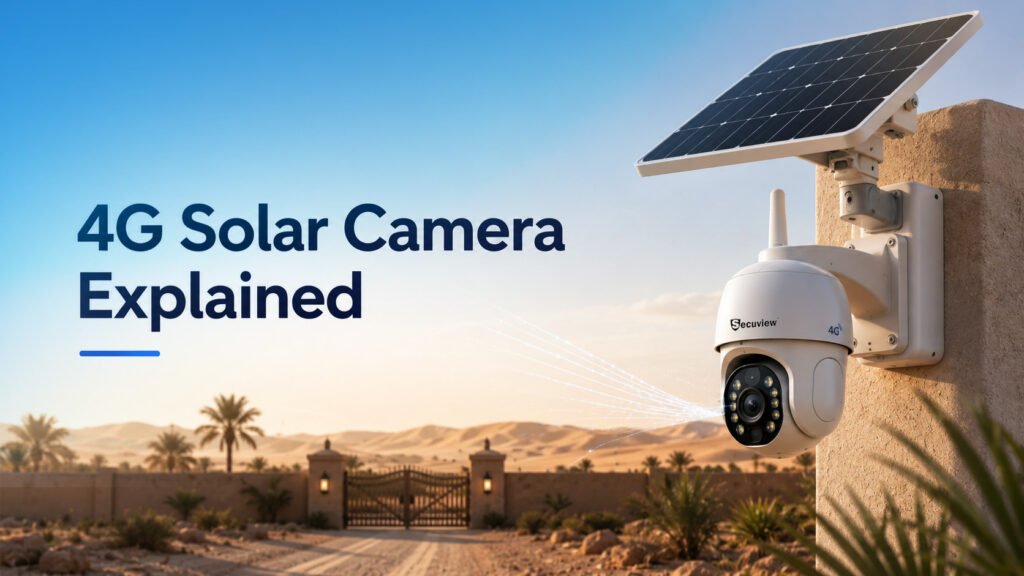
A 4G camera connects to a cellular network using a SIM card instead of relying on WiFi or a wired network connection. It works anywhere there’s mobile signal, which makes it the right choice specifically for locations where running a cable or reaching a WiFi router isn’t practical — a farm, a construction site, a remote gate. Every current Secuview 4G camera in this range is also solar-powered, solving both the connectivity problem and the power problem at once.
How Does a 4G Camera Work?
A 4G camera has a built-in cellular module and a SIM card slot, connecting directly to a mobile network the same way a phone does — no router, no WiFi signal, and no internet connection required at the camera’s location at all. It doesn’t need WiFi to record locally, since the SIM handles all data transmission independently; internet access only becomes relevant for remote viewing through the mobile app, which uses the same cellular data connection the camera already has.
What Do You Need Before Installing a 4G Camera?
A working installation needs four things in place: an active nano SIM with a mobile data plan, reasonable LTE coverage at the installation site, a power source (sunlight, for the solar models covered below), and the manufacturer’s mobile app for setup and remote viewing. Confirming signal strength at the exact mounting location before installing is worth doing — a spot 20 meters away can have meaningfully different coverage than where the camera actually ends up mounted.
Main Components of a 4G Camera
A 4G camera combines a camera sensor, a built-in 4G LTE module with a SIM card slot, a solar panel, and a rechargeable battery for power, local storage, and a mobile app for remote access. Together, these let the camera operate completely independently of both WiFi and fixed electrical wiring, recording and streaming from virtually anywhere with cellular coverage.
Types of 4G Cameras
| Type | Best for |
|---|---|
| Solar 4G camera | Remote locations with no power or network infrastructure |
| PTZ 4G camera | Larger areas needing pan/tilt/zoom coverage from one unit |
| Dual-lens 4G camera | Properties needing two simultaneous fields of view from one mounting point |
Secuview’s current range covers all three of these in combination — every model is solar-powered, and two of the three are dual-lens as well as PTZ-capable, covered in detail below.
Solar 4G Cameras Explained
Every current 4G camera runs on solar power, and this deserves real depth since it’s the core of the entire product line. A solar panel continuously charges a built-in rechargeable battery during daylight hours, and that stored charge keeps the camera running through the night and through cloudy stretches without needing a manual battery swap or a mains power connection at all. This is what makes the “install anywhere with sunlight and signal” claim genuinely practical rather than theoretical; there’s no separate maintenance schedule required beyond making sure the panel itself stays reasonably clean and unobstructed.
PTZ & Dual-Lens 4G Cameras Explained
Two distinct capabilities show up across Secuview’s 4G range, and they solve different problems. PTZ (pan-tilt-zoom) lets one camera physically rotate and zoom to cover multiple points from a single mounting position — the same mechanics covered in full in Secuview’s dedicated PTZ camera guide, just paired here with cellular connectivity instead of a wired network connection. Dual-lens is a different approach to the same underlying goal: rather than one lens physically moving between positions, two lenses capture two fields of view simultaneously, typically a wider establishing shot alongside a closer detail view, from one fixed mounting point. Between three 4G models, one is a single-lens PTZ, and two combine dual-lens with PTZ control, giving genuinely different coverage options depending on whether simultaneous dual coverage or active zoom control matters more for a given position.
Where Can You Use a 4G Camera?
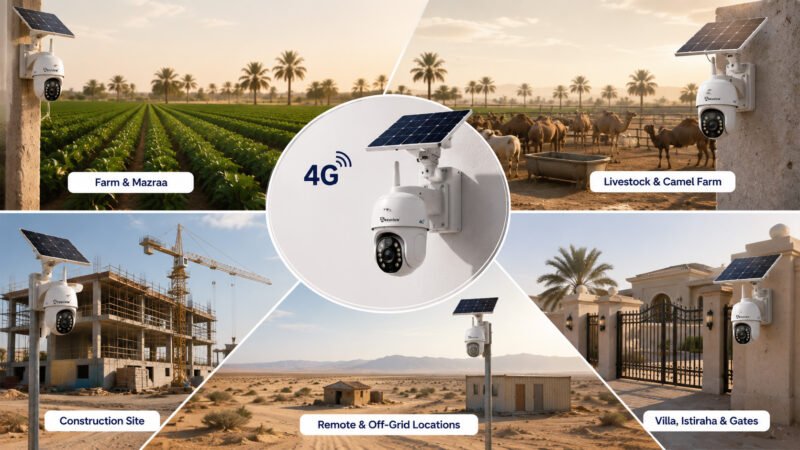
The honest answer is: anywhere in your area where a camera needs to watch something that sits away from the main building’s WiFi router and power supply, which describes a lot of real property here, from working farms to construction sites to the far end of a villa’s perimeter wall. Because every current Secuview 4G camera in this range is also solar-powered, these aren’t just “cellular camera” use cases; they’re specifically places where running both a network cable and a power cable simply isn’t realistic, and solar solves the second problem the same way 4G solves the first.
Farm and Mazraa (مزرعة) Security Cameras
Qatar’s push toward local food security over the past several years has meant more open-field and greenhouse vegetable farms, locally known as a mazraa — operating outside Doha, often across large plots where the farmhouse and its WiFi router sit far from the actual growing area, the date palm rows, or the boundary fence. A 4G solar camera mounted at the edge of a field or by an irrigation pump doesn’t need a cable run across open ground to work — it just needs cellular coverage and sunlight, both of which are usually already there. This matters for two very practical reasons: catching theft of produce or equipment overnight, and checking on irrigation systems remotely without a physical visit every time something might have gone wrong.
Livestock, Goat, and Camel Farm (Mazraat Al-Ibil) Monitoring
Livestock farming — including camel farms, sometimes referred to locally as mazraat al-ibil (مزرعة الإبل), a genuinely significant part of agricultural and cultural life in Qatar alongside goat and sheep pens — usually means animals kept some distance from any building with power or internet. A solar 4G camera on a pen gate or near a water trough lets a farm owner check on animals overnight without walking out in the dark, and the two-way audio feature most of these cameras carry is genuinely useful here — being able to speak through the camera can startle off a predator or an intruder without anyone needing to be physically present. Births, illness, and theft are the three things farm owners actually check for remotely, and all three are realistically covered by a camera that doesn’t depend on infrastructure the pen was never going to have in the first place.
Construction Site Security Cameras in Qatar
A construction site is often the clearest case for 4G specifically, not just cellular-vs-WiFi in the abstract: a new site frequently has no fixed power or network infrastructure at all yet, sometimes for months. Equipment and material theft overnight is a real, recurring cost on active sites, and a solar 4G camera can go up on day one — mounted on a temporary pole or existing structure — without waiting for any permanent utilities to be connected. As the site progresses and infrastructure eventually goes in, the camera can simply be repositioned to the next area that still lacks it.
Villa, Istiraha, and Remote Gate (Bawwaba) Monitoring in Doha
A large villa’s perimeter wall, a gate, a bawwaba (بوابة), at the far end of a property, or a chalet (istiraha, استراحة) used only on weekends are all common Qatar scenarios where the property has WiFi somewhere, but not necessarily reaching the exact point that needs watching — and in the case of a seasonal istiraha, sometimes no active internet connection at all between visits. A solar 4G camera solves both problems at once: it doesn’t need to reach the house’s WiFi signal, and it doesn’t need someone visiting regularly to keep a battery charged. For a property that sits empty for weeks between visits, that combination is the entire point.
Why Solar Specifically Matters Across All of These
Every one of these situations shares the same underlying problem: the place that needs watching is exactly the place that was never wired for power or network in the first place, a field edge, a pen gate, a half-built structure, a distant gate. Running a cable to solve that is often impractical or simply not worth the cost for one camera position. Solar removes the power side of that problem entirely, and pairing it with 4G removes the network side too, which is exactly why every current 4G camera in Secuview’s range is built this way, rather than as separate solar and plug-in product lines.
Key Features of 4G Cameras
Secuview’s 4G range typically includes remote live viewing through a mobile app, PIR motion detection with real-time alerts, multiple night vision modes (infrared, full-color, and smart switching between them), two-way audio, weatherproof housing, and multi-person sharing so more than one household or team member can access the same camera. Not every feature appears on every model; the comparison in the product section below covers what’s specific to each.
Benefits & Limitations
Benefits: no WiFi or Ethernet cable required, works anywhere with cellular coverage, solar power removes the need for mains electricity, genuinely fast installation, and suited to locations that would otherwise need expensive infrastructure just to support one camera.
Limitations: requires an active data plan and reasonably good LTE coverage at the exact installation point, generally costs more upfront than an equivalent WiFi camera, and solar charging performance depends on the panel getting consistent daily sunlight.
With the core of what a 4G camera is and how it works fully covered, one comparison question comes up often enough to answer directly.
4G Camera vs WiFi Camera
The core difference is the connection itself: a 4G camera uses a SIM card and cellular data, making it the right choice for locations without any WiFi coverage at all, while a WiFi camera depends on a nearby wireless network and generally costs less where that network already reaches. If a property already has stable WiFi at the exact point that needs monitoring, the WiFi camera guide covers that option in full; for anywhere that WiFi doesn’t reach, 4G is usually the better choice.
| Feature | 4G Camera | WiFi Camera |
| Internet Connection | Uses a SIM card with a 4G LTE mobile network | Connects to a local WiFi network |
| WiFi Required | No | Yes |
| Best Installation Location | Farms, construction sites, remote properties, warehouses, gates | Homes, offices, shops, and areas with reliable WiFi |
| Installation | Easy, no network cabling required | Requires stable WiFi coverage at the camera location |
| Remote Viewing | Through the camera’s mobile data connection | Through the property’s internet-connected WiFi |
| Ongoing Cost | Requires a mobile data plan | No additional mobile data cost |
| Network Dependency | Cellular signal strength | WiFi signal strength and router availability |
| Typical Upfront Cost | Generally higher | Usually lower |
| Best For | Off-grid and remote surveillance | Everyday residential and business security |
How to Choose the Right 4G Camera
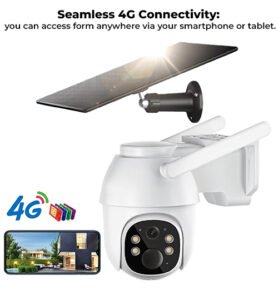
- Secuview Wireless IP Outdoor Solar-powered 4G Security CameraFor a single, straightforward outdoor position — a gate, an entrance, one clear vantage point — this covers it with 2K resolution and full pan-tilt-zoom control, letting you rotate and zoom in on activity rather than relying on one fixed angle.
secuview-wireless-ip-outdoor-solar-powered-4g-security-camera
Key Features: – 2K resolution – 355° pan, 90° tilt, with zoom – PIR motion detection with real-time alerts – Full-color night vision – Two-way audio – Weather-resistant design – Solar-powered, no wiring required
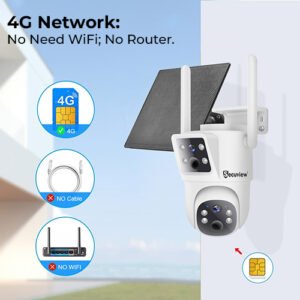
- Secuview Wireless IP Solar-powered 4G Dual Lens Security CameraFor a property needing two simultaneous viewing angles from one mounting point — a wide field alongside a closer detail view, useful for a farm entrance or a warehouse yard — this combines dual-lens coverage with pan-tilt-zoom control in a single unit.
secuview-wireless-ip-solar-powered-4g-dual-lens-security-camera
Key Features: – Dual-lens coverage (wide + detail view) – Pan-tilt-zoom control – Multiple night vision modes – Two-way audio – Weatherproof housing – Multi-person sharing – Solar-powered
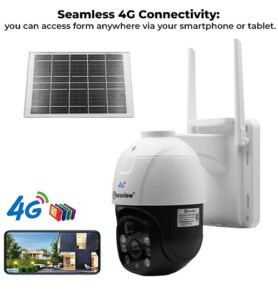
- Secuview Wireless IP Solar-powered CCTV CameraFor the same dual-lens-plus-PTZ combination at a more accessible price point, with a slightly wider tilt range and accurate human-motion detection, this is the more affordable dual-lens option in the range.
secuview-wireless-ip-solar-powered-cctv-camera
Key Features: – Dual-lens coverage – 305° pan, 100° tilt, with zoom – PIR motion detection with accurate humanoid detection – Full-color, infrared, and smart night vision modes – Two-way audio – Weatherproof design – Multi-person sharing – 2.4G/5G frequency compatible
Several of the cameras above also use pan-tilt-zoom functionality to actively cover more ground from one mounting point. If you’re interested in how that motorized system actually works, a closer look at how pan-tilt-zoom cameras work explains the technology behind pan, tilt, optical zoom, auto-tracking, and where PTZ cameras are most effective.
For a side-by-side look at the full range of wireless and cellular camera models — indoor, outdoor, WiFi, and 4G — comparing them together makes it easier to match a model to where it’ll actually be installed.
For properties that already have stable WiFi reaching the exact monitoring point, wireless camera options that connect over WiFi instead of a SIM are worth comparing against the 4G models above.
Because this article focuses specifically on 4G camera technology, it doesn’t cover every surveillance option available. If you’re deciding between 4G, WiFi, IP, AHD, or PTZ cameras, a broader comparison of CCTV camera technologies covers where each one fits, its advantages, limitations, and the environments it’s best suited for.
Frequently Asked Questions
Do 4G cameras need WiFi?
No. A 4G security camera connects to the internet using a SIM card and the mobile network, so it operates independently of any WiFi connection.
Can I use any SIM card?
The camera requires a nano SIM card with an active mobile data plan from a carrier that provides LTE coverage where the camera will be installed. Most standard mobile data SIMs are compatible, but it’s always worth confirming compatibility with your specific camera model.
Can I view my camera remotely?
Yes. You can access live video, recordings, and alerts through the manufacturer’s mobile app using the camera’s cellular data connection, regardless of your location.
Do solar 4G cameras work at night?
Yes. Solar panels charge the camera’s rechargeable battery during the day, and the stored battery power runs the camera and its night vision after dark.
Can a 4G camera record without internet?
Yes. A 4G camera records footage to local storage while using its own cellular connection rather than relying on WiFi or a home internet service.
How long does the battery last, and do solar cameras work on cloudy days?
The rechargeable battery is continually topped up by the solar panel during daylight, including on cloudy days, although charging is slower in overcast conditions. The stored battery charge powers the camera overnight and during periods without sunlight.
Can I install a 4G camera without electricity?
Yes. Solar-powered 4G security cameras are specifically designed to operate without mains electricity, making them ideal for remote locations.
Where is a 4G camera best used?
4G security cameras are ideal for locations without reliable WiFi or mains power, including farms, construction sites, remote gates, rural properties, and perimeter security applications.
Is a dual-lens camera better than a PTZ camera for my property?
It depends on your requirements. A dual-lens camera provides simultaneous wide-angle and close-up views from one mounting point, while a PTZ camera uses a single movable lens that can pan, tilt, and zoom to follow activity. Some 4G security cameras combine both technologies for greater flexibility.
Can multiple users view the same camera?
Yes. Secuview’s 4G security camera range supports multi-user sharing, allowing multiple authorised users to access the same camera through their mobile devices.
How much mobile data does a 4G camera use?
Mobile data usage depends on video resolution, live viewing time, recording settings, and how frequently motion events occur. Motion-triggered recording generally uses significantly less data than continuous live streaming.
What happens if the 4G signal is weak?
A weak mobile signal may cause slower live viewing, delayed notifications, or intermittent remote access. However, the camera can usually continue recording locally as long as it has sufficient power.
Is a solar 4G camera suitable for Qatar’s climate?
Yes. Qatar’s high levels of year-round sunlight provide excellent conditions for solar charging, while weatherproof outdoor cameras are designed to withstand heat, dust, and harsh environmental conditions.
Can a 4G camera replace multiple fixed cameras?
PTZ and dual-lens 4G cameras can monitor a much larger area than a standard fixed camera. However, while they reduce the number of cameras needed in many situations, they still cannot provide simultaneous coverage of every angle the way multiple strategically positioned fixed cameras can.