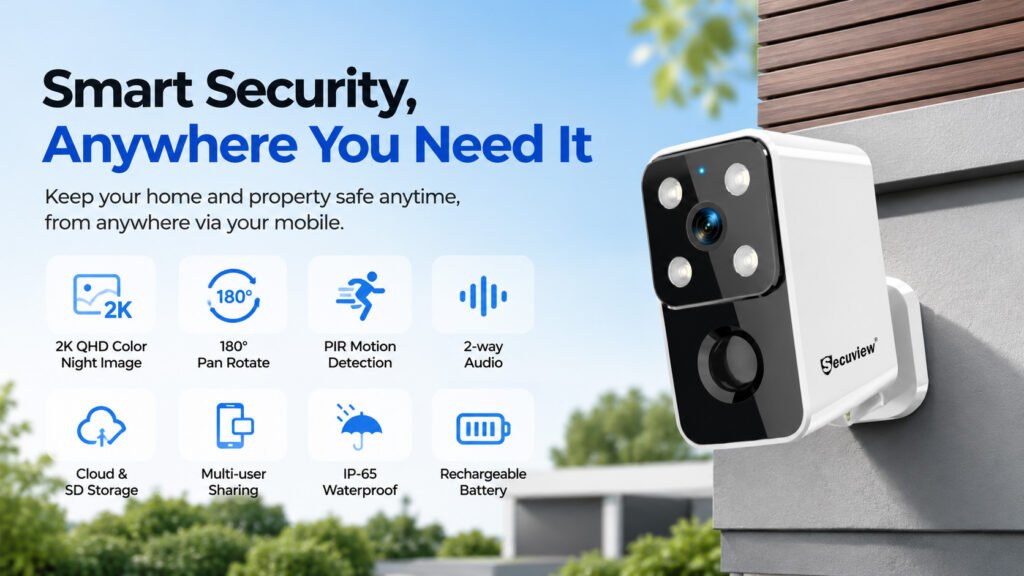
A battery-powered camera runs on a rechargeable, built-in Power source instead of a wired power connection, letting it be mounted almost anywhere without an electrician or a cable run. It’s a power-source category, not a connectivity type. A battery camera is also WiFi-connected, the same way a 4G camera can also be solar-powered. What makes it genuinely different is the installation and power pack story covered below, not the network side.
How Does a Battery Camera Work?
A battery camera runs on a rechargeable power pack and uses a PIR (passive infrared) sensor to detect motion and wake the camera into active recording, rather than recording continuously around the clock. This wake-on-motion behavior is the specific mechanism that makes long standby time possible; the camera spends most of its time in a low-power sleep state, only drawing significant power when something actually triggers it. For how the camera then gets that footage to a phone over WiFi, how WiFi cameras connect and stream video covers that connectivity layer in full; this article stays focused on the power side specifically.
Main Components
A battery camera combines a rechargeable battery pack, a camera sensor, a PIR motion sensor, a WiFi module, and a mobile app for setup and remote access. Together, these let the camera operate completely independently of any electrical wiring, drawing power only from its internal Power source and recharging periodically rather than staying permanently plugged in.
Types of Battery Cameras
| Type | Best for |
|---|---|
| Outdoor battery camera | Entrances, gates, and perimeter points without nearby wiring |
| Indoor battery camera | Rooms and interior spaces where drilling or wiring isn’t practical or allowed |
The current confirmed range covers the outdoor variant, a weatherproof, WiFi-connected battery camera built for exactly this kind of installation-flexible outdoor use.
Key Features Explained
Night Vision
battery-powered camera night vision
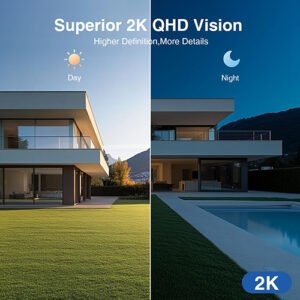
Full-color night vision uses the camera’s sensor and, typically, a built-in light source to render nighttime footage in color rather than the grainy black-and-white image traditional infrared night vision produces. This matters specifically for identification; recognizing a person’s clothing or a vehicle’s color at night is far easier in full-color footage than in standard IR black-and-white.
Two-Way Audio
A built-in microphone and speaker let whoever is viewing the live feed speak through the camera and hear what’s happening on the other end, not just watch silently. This is useful for two distinct reasons: talking to a visitor or delivery person remotely, and verbally deterring an intruder without needing to be physically present.
Real-Time Live View and Video Playback
battery-powered camera Live View
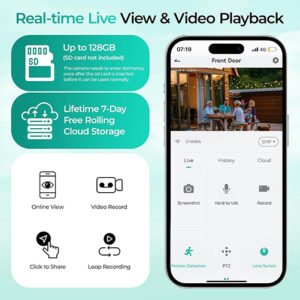
Live view streams the camera’s current feed directly to the mobile app on demand, while playback lets a user go back and review previously recorded footage tied to specific motion events. These are two separate functions: live view answers “what’s happening right now,” playback answers “what happened earlier”, and a battery camera needs both to be genuinely useful for review after the fact, not just live monitoring.
Cloud and SD Card Storage
Recorded footage is generally stored one of two ways: locally on a microSD card inside the camera, or remotely via cloud storage accessed through the app. Local storage keeps footage on-device without ongoing cost but is limited by card capacity and vulnerable if the camera itself is damaged or removed; cloud storage is accessible from anywhere and safer if the physical camera is tampered with, but often depends on a subscription.
Weatherproof Design
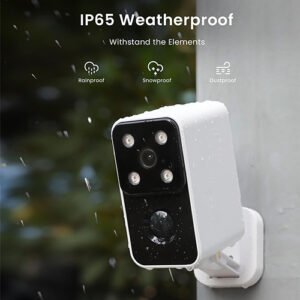
For any outdoor-rated battery camera, weatherproofing means the housing is sealed against rain, dust, and temperature swings well enough to keep operating outdoors year-round without the internal electronics being affected by moisture or heat ingress. This is a separate consideration from Power source life; a camera can have excellent standby time and still fail outdoors if the housing itself isn’t properly sealed.
Push Notifications
Distinct from motion detection itself: motion detection is the camera noticing that something moved, while push notifications are what actually alert a user’s phone the moment that happens. A camera can technically detect motion without sending a timely push notification if that feature is misconfigured or disabled; the two are related but not the same thing, and push notifications are what make motion detection actually useful in practice rather than just a recording trigger.
Battery Capacity and Charging Time
Battery capacity, typically measured in mAh for a rechargeable lithium battery, is the figure that most directly determines how long a camera can run between charges, alongside the wake-on-motion power management covered above. A larger capacity power unit generally supports longer standby time, all else being equal, though actual runtime always depends more on real-world usage patterns (motion frequency, live-view use) than the raw capacity number alone.
Charging time, how long it takes to fully recharge from empty, is a genuinely practical question that battery life alone doesn’t answer, since a camera with excellent standby time but a very slow recharge could still mean extended downtime if the battery does run out.
Battery Life Explained
A battery-powered camera is typically rated for a wide standby range, anywhere from roughly 2 weeks to 6 months on a single charge, depending heavily on the model and battery capacity, a figure that comes from the same low-power, wake-on-motion design covered above. What actually affects that number in practice: how often motion triggers recording, how much the camera gets accessed for live viewing (which draws more power than passive standby), and ambient temperature. A camera mounted somewhere with frequent passing activity will drain meaningfully faster than one watching a quiet corner. This range represents typical standby conditions across different usage patterns, not a guarantee for any specific installation.
Installation: Why It’s Genuinely Fast
This is the core of the title’s second claim, and it holds up concretely rather than as a marketing phrase. There’s no cable to run, no wall to chase, and no electrician required; mounting the camera and pairing it to WiFi through the app is the entire process. This is specifically why the camera suits situations a wired installation can’t: rental properties and tenants who aren’t able to drill into walls or make permanent changes, and positions that might need to be reconsidered or moved later. The camera can be relocated after mounting without leaving behind wiring that has to be removed or reworked, genuinely different from a wired camera, where moving the position means redoing the cable run.
Where Rechargeable Cameras Are Used
Rental properties and apartments are the strongest fit precisely because of the installation point above; a tenant can add real security without making a permanent change to a property they don’t own. Villas and gates benefit where the perimeter point needing coverage sits far from existing wiring, without justifying a full cable run for one camera. Garages, storage areas, and small shops are common cases where a business or homeowner wants coverage on a position that might change, a camera watching a temporary storage arrangement, or a shop layout still being finalized, where a wired install would be premature.
Benefits & Limitations
Benefits: no wiring or electrician needed, genuinely fast to install, fully relocatable after mounting, and well suited to rental or temporary situations a wired camera can’t serve at all.
Limitations: requires periodic recharging, battery life depends on how much activity and live viewing the camera actually gets, and it depends on WiFi coverage reaching the mounting point the same way any WiFi camera does.
With the core of what a battery-powered camera is and how it works fully covered, two comparisons come up often enough to answer directly.
Battery Camera vs Wired Camera
The real trade-off is installation simplicity against unlimited runtime. A wired camera never needs recharging and records continuously without any power budget to manage, at the cost of needing a physical cable run and, often, professional installation. A battery camera trades that unlimited runtime for the ability to mount almost anywhere in minutes, with periodic recharging as the price of that flexibility. For a permanent, always-on position with easy cable access, wired usually makes more sense; for anywhere installation flexibility matters more, battery is the better fit.
| Feature | Battery Camera | Wired Camera |
| Power Source | Rechargeable built-in battery | Continuous mains power |
| Installation | Fast, wire-free DIY installation | Requires power cables and often professional installation |
| Runtime | Limited by battery life; requires periodic recharging | Unlimited continuous operation |
| Recording Style | Typically motion-activated to conserve battery | Can record continuously 24/7 |
| Placement Flexibility | Can be installed almost anywhere within Wi-Fi range | Limited by cable routing and power availability |
| Relocation | Easy to move and reinstall | Moving requires rerouting cables and reinstalling wiring |
| Best For | Rental properties, apartments, temporary installations, and locations without nearby power | Permanent security systems where continuous monitoring is required |
| Maintenance | Requires battery charging at regular intervals | Minimal power-related maintenance after installation |
| Installation Cost | Generally lower due to no wiring | Higher because of cabling and installation work |
| Ideal Choice | When flexibility and quick installation are priorities | When uninterrupted 24/7 surveillance is the priority |
Battery Camera vs Solar Camera
Both remove the need for mains electrical wiring, but they solve the recharging problem differently. A solar camera recharges continuously from sunlight and is built for permanent, fixed outdoor placement where it never needs manual attention. A battery camera recharges manually and is built to be moved, better suited to temporary or reconsiderable positions than to a permanent remote installation. For the deeper solar-specific mechanics, how solar charging works on a 4G camera covers that in detail, since every current Secuview solar model is also a 4G camera.
Choosing the Right Battery Camera
Secuview Wireless IP Outdoor Weatherproof Security Battery Camera
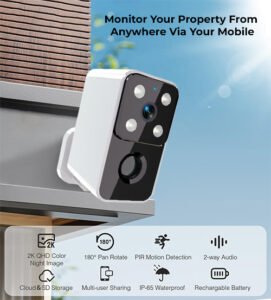
secuview-wireless-ip-outdoor-weatherproof-security-battery-camera
The Secuview Wireless IP Outdoor Weatherproof Security Battery Camera offers flexible, wire-free surveillance for homes and businesses. With 2K HD resolution, a rechargeable battery, 180° pan coverage, full-color night vision, and smart motion detection, it delivers reliable security without the need for power cables. Its weatherproof design and up to 120 days of standby time make it ideal for entrances, driveways, garages, gardens, and other outdoor areas.
Key Features:
- Wire-free rechargeable battery design
- 2K HD video resolution
- Up to 120 days of standby time
- 180° remote pan coverage
- Full-color night vision
- Smart motion detection & instant alerts
- Two-way audio communication
- Weatherproof outdoor construction
- Local & optional cloud storage
- Mobile app remote monitoring
- Easy DIY installation
This article focuses specifically on battery power as a category; it doesn’t cover every available surveillance option. For a broader comparison of CCTV camera technologies, AHD, IP, PTZ, WiFi, and 4G side by side, the complete camera types guide covers where each one fits.
Frequently Asked Questions
What is a battery-powered camera?
A battery-powered security camera runs on a rechargeable built-in battery instead of a wired power connection, allowing it to be installed without an electrician or permanent power cable.
How do battery-powered cameras work?
A passive infrared (PIR) sensor detects motion and wakes the camera to begin recording. This motion-activated design conserves power by keeping the camera in standby mode until activity is detected.
Are battery-powered cameras reliable?
Yes. Battery-powered cameras are designed for flexible installation and locations where running power cables isn’t practical. They require periodic recharging and a reliable Wi-Fi connection, but these are normal maintenance requirements rather than reliability issues.
How long do battery-powered cameras last between charges?
Depending on the model, battery-powered security cameras typically provide between two weeks and six months of standby time. Actual battery life depends on motion activity, recording frequency, and how often you access live video.
What battery capacity do these cameras use?
Battery capacity is usually measured in milliamp-hours (mAh) and is one of the main factors affecting standby time. The exact battery capacity of Secuview’s current battery-powered camera isn’t listed in the published specifications at the time of writing.
How long does it take to charge a battery-powered camera?
Charging time varies depending on the battery capacity and charging method. Secuview hasn’t published official charging times for its current battery-powered camera.
Are all battery-powered cameras wireless?
Yes, in terms of power they are wireless because they don’t require a power cable. However, most battery-powered cameras, including Secuview’s model, still use Wi-Fi for network connectivity, making power and internet connection two separate considerations.
How do I charge my battery-powered security camera?
Most battery-powered security cameras are charged using a standard charging cable connected to the camera’s built-in battery. Depending on the model, you either remove the camera from its mount or connect the charging cable directly while it’s installed.
Are battery-powered cameras suitable for outdoor use?
Yes, provided the camera has an appropriate weatherproof rating. Secuview’s outdoor battery-powered security camera is specifically designed for outdoor installations.
Do battery cameras support motion detection?
Yes. Motion detection is a core feature of battery-powered cameras. It activates recording when movement is detected while helping conserve battery life and triggering push notifications to alert users.
Can I move a battery camera after installing it?
Yes. One of the biggest advantages of a battery-powered camera is its portability. Without power cables to disconnect or reroute, you can easily relocate the camera whenever needed.
Does a battery camera keep recording during a power outage?
Yes. Since battery-powered cameras don’t rely on mains electricity, they continue operating during power outages, provided the battery still has sufficient charge.
Is a battery camera a good option for renters or apartments?
Yes. Battery-powered security cameras are ideal for renters because they typically require little or no drilling, don’t need permanent electrical wiring, and can easily be removed when moving.
What is the best battery-powered security camera from Secuview?
Secuview currently offers the Wireless IP Outdoor Weatherproof Security Battery Camera, designed specifically for flexible outdoor installation and cable-free operation.
Is there a security camera that works without Wi-Fi at all?
Yes. A 4G or cellular security camera operates independently of Wi-Fi by connecting directly to the mobile network. This is a separate feature from battery power, and many 4G cameras are also battery-powered.