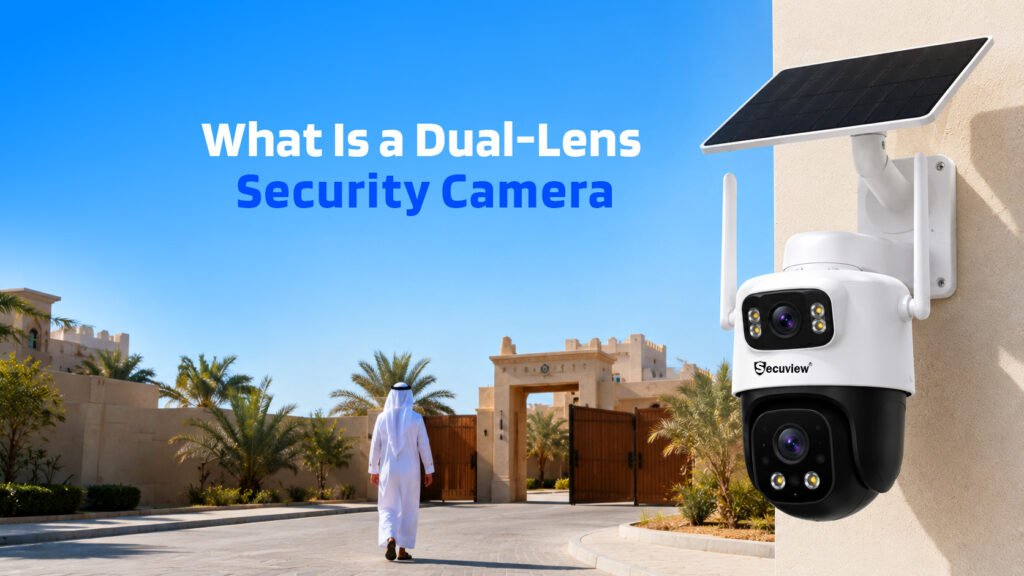
A dual-lens security camera uses two separate lenses on one unit, typically a wide-angle lens for scene coverage and a second lens for zoomed detail, capturing both views at the same time. This is a lens configuration, not a movement capability: dual-lens is a completely separate thing from PTZ, even though the two happen to be combined on most cameras that offer both. A camera can be dual-lens without PTZ, PTZ without dual-lens, or both together, the same way a camera can be WiFi or 4G independently of either.
How Does a Dual-Lens Security Camera Work?
Each lens on a dual-lens camera has its own image sensor and captures its own video stream simultaneously: a wide-angle stream covering the full field of view (FOV), and a second stream, often mounted on a motorized pan-tilt-zoom base, providing optical zoom detail within that same scene. Optical zoom physically magnifies through the lens itself, preserving resolution at higher magnification, unlike digital zoom, which just crops and enlarges the existing image and loses detail as it does. Both streams typically record in H.265 compression where supported, which keeps the combined storage load from two simultaneous streams more manageable than it would be on older compression formats. On models where the second lens is genuinely motorized, AI-driven smart detection can direct that lens to zoom in and track a subject identified in the wide view, while the wide lens continues recording the full scene independently.
Main Components of a Dual-Lens Security Camera
Main-Components-of-a-Dual-Lens-Security-Camera
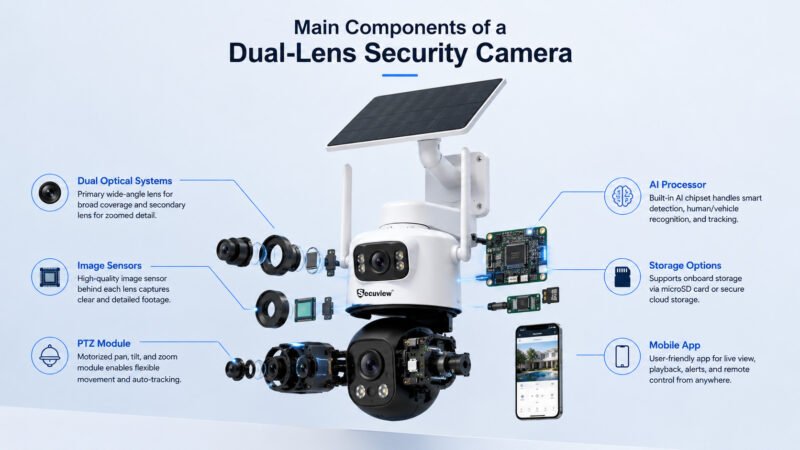
A dual-lens camera combines two distinct optical systems and the processing to run them together: a primary (wide-angle) lens for overall scene coverage, a secondary lens for zoomed or telephoto detail, an image sensor behind each lens, a PTZ module on models where the secondary lens is motorized, an AI processor handling smart detection and tracking, onboard or cloud storage for the resulting footage, and a mobile app tying live view, playback, and remote control together. Every other capability covered in this article- the dual streams, the tracking, the storage requirements- comes down to how these components work together rather than any one of them alone.
Common Misconceptions About Two-Lens Security Camera
Dual-lens does not mean two separate cameras. It’s one unit, one mounting point, and one power/network connection; the “dual” refers to the lens configuration inside a single device, not two physical cameras wired together.
Dual-lens cameras are not always PTZ cameras. As covered above, these are two independent characteristics. A dual-lens camera’s second lens can be fixed rather than motorized; the zoomed or telephoto view exists, but it doesn’t physically move to track anything.
Dual-lens cameras are not only designed for commercial properties. The wide+detail combination is just as relevant to a villa entrance or a home driveway as it is to a warehouse yard; the use case is about coverage area and detail needs, not property type or scale alone.
Types of Dual-Lens Security Cameras
| Type | Description |
|---|---|
| Indoor dual-lens camera | Built for interior spaces needing both room-wide coverage and closer detail on one point |
| Outdoor dual-lens camera | Weatherproof housing for entrances, driveways, and perimeter points |
| Fixed + PTZ dual-lens camera | Combines a fixed wide-angle lens with a motorized PTZ lens for active zoom and tracking |
Indoor dual-lens cameras suit rooms and interior spaces where one mounting point needs to see the whole area and still pick out detail on a specific point within it, a reception desk within a larger lobby, or a stockroom entrance within a wider storage area. The camera housing on indoor models generally doesn’t need to withstand weather, so the design tends to prioritize a compact profile over ruggedness.
Outdoor dual-lens cameras carry a weatherproof housing built to withstand rain, dust, and temperature swings while continuing to operate both lenses reliably, this matters more than it might seem, since a compromised housing affects both lenses at once rather than just one. Qatar’s combination of intense summer heat and periodic dust makes this housing quality a genuine, practical factor rather than a checkbox spec.
Fixed + PTZ dual-lens cameras pair a stationary wide lens with a motorized second lens, which offers a real advantage over simply installing two separate fixed lenses side by side: the PTZ lens can actively follow a moving subject on command or through automatic tracking, something two fixed lenses, however positioned, can’t do, since neither would move to keep up with anything.
The variant currently available from Secuview combines the outdoor and fixed+PTZ types described above; both real dual-lens models in the product section further down pair a fixed wide lens with a motorized PTZ lens in weatherproof outdoor housing, running on solar power and 4G connectivity. An indoor or non-PTZ fixed dual-lens option isn’t part of the range yet, though both remain genuine categories worth understanding for anyone comparing dual-lens technology more broadly.
Advantages and Disadvantages
Dual-lens cameras trade a higher unit cost for meaningfully broader coverage from a single mounting point, genuinely useful where positioning options are limited, but not automatically the right choice for every installation.
Advantages
Broader situational awareness. Seeing the wide scene and a zoomed detail at the same time gives a more complete picture than either view alone; an operator isn’t forced to choose between watching the overall area and confirming what a specific person or vehicle is actually doing.
Fewer cameras needed for the same coverage. One dual-lens unit can often do the job of two separately positioned fixed cameras, which also means one mounting point, one cable run or power source, and one entry in the NVR’s channel count instead of two.
Better evidence quality. The detail lens can capture identifying information a wide-angle lens alone would render too small to read — a face clear enough for recognition, a license plate legible enough to note down, the kind of specific detail that actually matters during an incident review rather than just confirming that something happened.
Disadvantages
Higher cost than a single-lens camera. Two lenses, two image sensors, and often a motorized mount for the second lens add real cost per unit compared to a standard fixed camera.
Larger storage requirements. Two simultaneous video streams consume roughly double the storage of a single-lens camera at equivalent settings, which affects how much recording history a given storage capacity can actually hold.
Not a substitute for coverage in a genuinely different direction. Both lenses are aimed at the same general scene from one mounting point — a dual-lens camera doesn’t replace a second camera watching an entirely separate area of a property.
Reasons to Choose a Dual-Lens Surveillance Camera
One camera covers more ground. The wide lens alone often matches what a standard fixed camera would capture; the second lens adds detail without adding a second mounting point.
Wide-angle and zoom views work together, not separately. Rather than choosing between overview and detail the way a single-lens camera forces you to, both are available from the same footage at the same time.
Motion detection triggers automatic tracking. On PTZ-equipped models, movement detected in the wide view can direct the second lens to zoom in and track it automatically, without manual control.
Night vision works across both lenses. Surveillance coverage and detail capability aren’t lost after dark; both lenses maintain their function under the camera’s night vision system.
Key Features to Consider Before Buying
key-feature-dual-lens-security-camera-for-remote-outdoor-surveillance
- Resolution: on both lenses, since a sharp wide view paired with a weak detail lens undermines the entire point of the second lens
- PTZ capability: confirm whether the second lens is motorized or fixed; these serve different needs
- AI and smart detection: human/vehicle detection quality affects how useful automatic tracking actually is in practice
- Night vision: full-color vs infrared, and whether both lenses share the same night vision quality
- Storage and remote playback: capacity needs to account for two simultaneous streams, and remote playback access matters as much as live viewing when reviewing an incident after the fact
- Connectivity: WiFi, 4G, or wired, independent of the dual-lens question itself
- Camera housing and weatherproof rating: essential for any outdoor installation, and worth checking on both the housing seal and the specific IP rating rather than assuming “outdoor” alone guarantees durability
Who Should Actually Buy a Dual-Lens Camera
The right choice comes down to coverage needs, not simply picking the most capable or most expensive option available. A dual-lens camera earns its cost specifically where one mounting point needs to cover real distance while still keeping detail readable at the far edge of that distance, a farm boundary, a warehouse yard, a wide driveway. Where a single, well-defined point is what actually needs watching, a standard single-lens camera remains the simpler, more cost-effective choice. The two Secuview models covered next reflect this same distinction at different scales, from smaller residential perimeters to larger remote properties.
With the core of what a dual-lens camera is and how it works fully covered, the comparison and buying questions come next.
Dual-Lens vs Single-Lens Camera
| Dual-Lens Camera | Single-Lens Camera | |
|---|---|---|
| Coverage | Wide view + zoomed detail simultaneously | One field of view only |
| Cost | Higher per unit | Lower per unit |
| Storage needs | Roughly double, for two streams | Standard, single stream |
| Best for | Wide areas needing both overview and detail | A single, well-defined point |
Dual-Lens Camera vs PTZ Camera
These get confused constantly because most cameras that offer one also offer the other, but they solve different problems. A PTZ camera uses one lens that physically moves between positions, covering multiple points sequentially — it can only actively watch one of those positions at any given moment, cycling through the rest on a patrol schedule. A dual-lens camera uses two lenses watching the same general area simultaneously, with no blind spot, while one position is prioritized over another the way a patrolling PTZ has. Where a property needs to cover several genuinely separate zones, PTZ’s patrol capability is the better fit; where one area needs both a wide view and zoomed detail captured at the same time without gaps, dual-lens is the better fit. Several Secuview models combine both capabilities in one unit, covering both use cases at once.
When and Where a Dual-Lens Camera Makes Sense
Large properties, wide driveways, warehouse yards, and farm perimeters are where a dual-lens camera earns its cost, anywhere one mounting point needs to cover real distance while still being able to identify who or what is actually there. This applies just as much to a villa entrance or a home driveway as it does to a warehouse loading bay or a commercial parking lot.
For Qatar specifically, this includes the same working-farm and mazraa (مزرعة) contexts covered in how 4G cameras are used across Qatar, a farm boundary or a temporary desert camp setup benefits from the same wide-plus-detail coverage a construction site or a large villa perimeter does, for the same underlying reason: one camera watching real distance, with detail still readable at the far edge of that distance.
A single-lens camera remains the better, more cost-effective choice for a specific fixed point, a doorway, a till, where wide coverage isn’t the actual need.
Best Dual-Lens Security Cameras from Secuview
Wireless IP Solar-Powered 4G Dual-Lens Security Camera
If you’re looking for a dual-lens security camera for farms, warehouses, construction sites, remote properties, or large outdoor areas, this model offers an excellent balance of intelligent monitoring and flexible installation. Its dual-lens design combines a wide-angle overview with a PTZ camera for automatic tracking, while 4G connectivity and solar power allow reliable surveillance without depending on Wi-Fi or nearby electrical outlets.
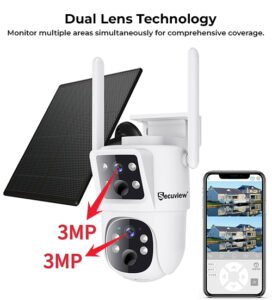
secuview-4g-solar-powered-dual-lens-security-camera-for-remote-outdoor-surveillance
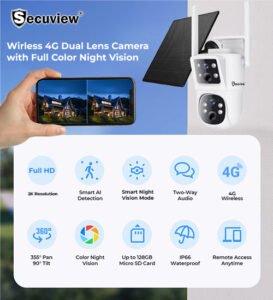
Key Features
- Dual-Lens Camera with wide-angle and PTZ monitoring
- 4G SIM Connectivity for remote locations without Wi-Fi
- Solar-Powered with rechargeable battery for off-grid operation
- AI Motion Detection with automatic human tracking
- Full-Color Night Vision and infrared night vision
- Two-Way Audio for real-time communication
- Weatherproof Design (IP66) for outdoor use
- Remote Monitoring through the mobile app
- Supports MicroSD Card and Cloud Storage
Browsing the CCTV Camera System category shows every model in this range side by side, while the WiFi & 4G camera range narrows that same comparison down to connectivity specifically, which matters if WiFi versus cellular is the deciding factor for a given installation. And since this article has stayed deliberately narrow to the dual-lens configuration itself, the complete CCTV camera types guide is the better starting point for comparing AHD, IP, PTZ, WiFi, and 4G against each other more broadly.
Frequently Asked Questions
What is a dual-lens security camera?
A dual-lens security camera has two separate lenses on one unit, typically a wide-angle lens and a second lens for zoomed detail, allowing both to capture video simultaneously from a single mounting point.
How does a dual-lens security camera work?
Each lens records its own video stream at the same time. On PTZ-equipped models, the second lens can also physically move to zoom in and automatically track a subject detected by the wide-angle lens.
Are dual-lens security cameras better than single-lens cameras?
For monitoring a large area while still capturing identifiable detail, yes. For a single, well-defined location such as a doorway, a single-lens camera is usually the more cost-effective option.
Is a dual-lens security camera worth buying?
It depends on the installation. A dual-lens camera is worthwhile when one mounting point needs to provide both broad coverage and detailed monitoring. For a fixed viewing point, a standard camera may be sufficient.
Where should I use a dual-lens security camera?
Dual-lens cameras are ideal for large properties, wide driveways, warehouse yards, farm perimeters, commercial entrances, and other locations where both wide coverage and detailed identification are important.
Can a dual-lens camera work without Wi-Fi?
Yes. If it’s a 4G-connected model, it can operate without Wi-Fi. Secuview’s current dual-lens camera range uses 4G connectivity instead of Wi-Fi.
Do dual-lens cameras support 4G connectivity?
Yes. Both of Secuview’s current dual-lens security camera models feature 4G connectivity and solar-powered operation.
Can I monitor a dual-lens camera remotely?
Yes. You can remotely monitor the camera using the manufacturer’s mobile app, allowing live viewing and access to recorded footage from almost anywhere.
Do dual-lens cameras record both lenses simultaneously?
Yes. Recording both video streams at the same time is the defining feature of a dual-lens security camera.
Do dual-lens cameras have night vision?
Yes. Both lenses typically include night vision, allowing the camera to maintain both wide coverage and detailed visibility after dark.
Do dual-lens cameras require a subscription?
That depends on the storage option you choose. Local storage generally doesn’t require a subscription, while cloud storage services often do.
Is a dual-lens camera better than installing two separate cameras?
Not necessarily. Two separately positioned cameras can monitor different directions, while a dual-lens camera provides both a wide and detailed view of the same general area from a single mounting point.
Are solar-powered dual-lens cameras suitable for remote locations?
Yes. Solar-powered 4G dual-lens cameras are specifically designed for remote locations where mains power and Wi-Fi are unavailable.
What should I consider before buying a dual-lens security camera?
Look for resolution on both lenses, PTZ capability, AI detection performance, night vision on both lenses, storage capacity for dual video streams, connectivity type, and an appropriate weatherproof rating for outdoor use.
Can dual-lens cameras reduce blind spots?
Yes. They reduce blind spots within the area both lenses cover, although they still monitor one general direction rather than multiple separate directions like individually positioned cameras.