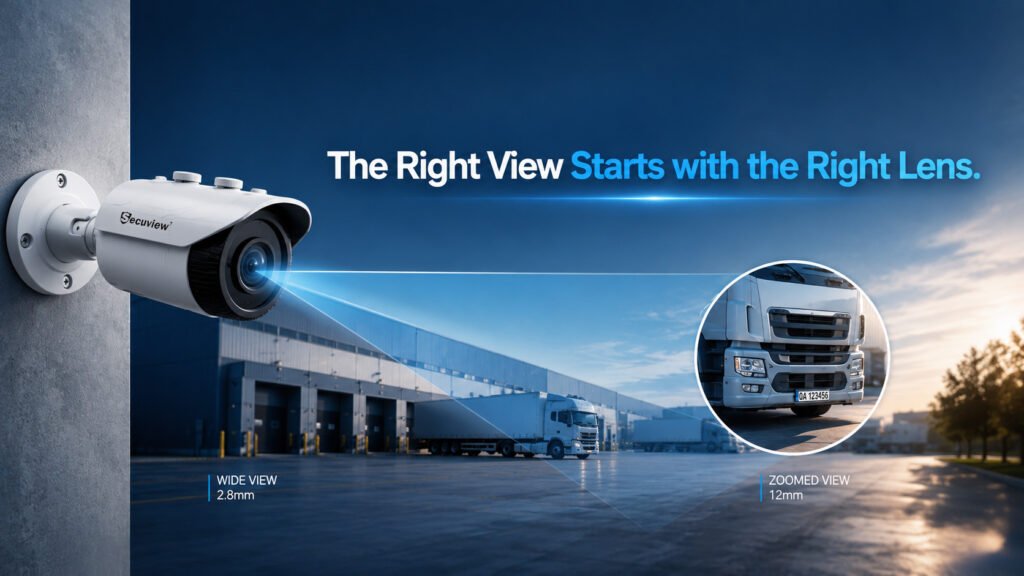
A varifocal lens camera has an adjustable focal length, letting you widen or narrow the field of view after the camera is already mounted, rather than being locked to one fixed angle from the moment it’s installed. This is a lens characteristic, separate from both movement (PTZ) and connectivity; a varifocal camera doesn’t pan or tilt on its own the way a PTZ camera does; it stays in one fixed position, just with a lens that can be tuned to the right coverage for that position.
How Does a Varifocal Lens Work?
A varifocal lens contains multiple internal optical elements that can shift relative to each other, changing the focal length across a range, commonly something like 2.8-12mm, rather than being fixed at one single focal length the way a standard lens is. Widening the focal length narrows the field of view and increases magnification on distant detail; shortening it widens the field of view at the cost of that detail. On a manual varifocal lens, this adjustment happens physically during installation, by hand. On a motorized varifocal lens, it can be adjusted electronically after mounting, without touching the camera at all, covered in more depth further down.
What Is a Fixed Lens Camera?
A fixed lens camera has one focal length set permanently at manufacture, with no ability to widen or narrow the field of view after installation. Whatever angle and coverage the lens was built for is what the camera delivers for its entire service life, simpler, generally cheaper, and with nothing to adjust or misconfigure, but with zero flexibility if the coverage need turns out to be even slightly wrong once it’s actually mounted.
Fixed Lens vs Varifocal Lens
| Fixed Lens | Varifocal Lens | |
| Focal length | Set permanently at manufacture | Adjustable across a range |
| Field of view | One fixed angle only | Adjustable wider or narrower |
| Installation | Simpler — no lens tuning needed | Requires setting (or re-setting) the focal length on-site |
| Zoom capability | None | Optical adjustment within the lens’s range |
| Image detail | Fixed, matched to the lens’s one angle | Can be tuned for detail vs. coverage depending on the position |
| Cost | Lower | Higher |
| Maintenance | None specific to the lens | Occasional re-adjustment if the coverage need changes |
| Best applications | A confirmed, unchanging point — a doorway, a specific corridor | A position where the exact coverage need isn’t fully certain until after mounting |
Worked example: a warehouse entrance might look correctly covered with a 2.8mm lens during planning, wide enough to see the whole gate. Once the camera’s actually up, though, trucks passing through appear too small in frame to read a license plate. With a fixed lens, fixing that means removing the camera and replacing it with a different model entirely. With a varifocal lens, the installer adjusts the focal length toward 8mm on-site, narrowing the view enough for plates to become legible, without swapping any hardware.
Advantages of Fixed Lens Cameras
Fixed lens cameras are simpler to install, cost less, and have nothing to adjust or get wrong during setup. For a position where the coverage need is already well understood, there’s no real benefit to paying for adjustability that will never actually get used.
Advantages of Varifocal Lens Cameras
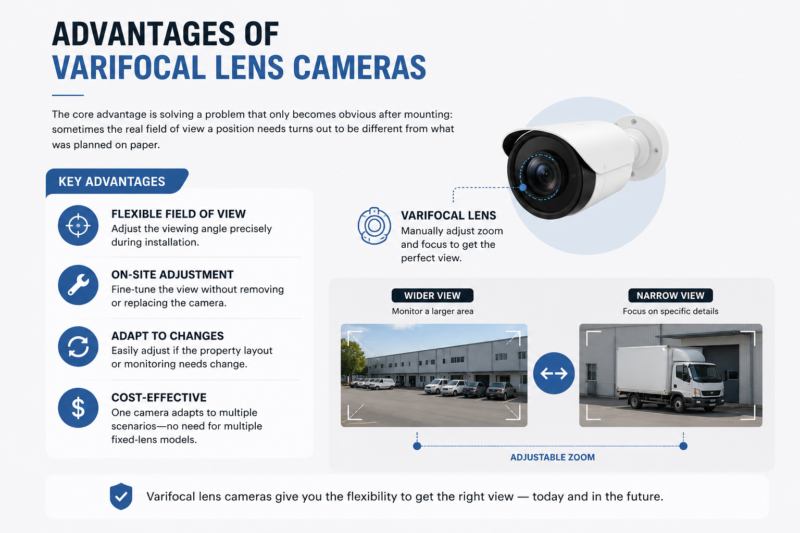
The core advantage is solving a problem that only becomes obvious after mounting: sometimes the real field of view a position needs turns out to be different from what was planned on paper, as in the warehouse example above. A varifocal lens lets that get corrected on-site, or adjusted later if the property itself changes, a new gate goes in, a parking area gets reconfigured, without removing the camera and replacing it with a different fixed-lens model entirely.
Should You Buy a Varifocal Camera? Choosing Between Fixed and Varifocal
Perfect for: warehouses, long driveways, commercial entrances, parking lots, and any environment where the layout might change or the ideal coverage angle isn’t fully certain until the camera is actually mounted, homes, small offices, reception areas, and hallways covered below fall on the other side of this same reasoning, where the space is well-defined enough that adjustability adds cost without adding real value.
Not necessary for: bedrooms, small offices, cashier counters, and narrow corridors, spaces where the coverage need is knowable in advance and unlikely to change, making a fixed lens the simpler, more cost-effective choice.
Understanding Varifocal Lens Range
Different focal lengths within a varifocal lens’s range suit genuinely different distances and coverage needs:
| Lens (mm) | Best Use |
| 2.8mm | Wide rooms, broad coverage at close range |
| 4mm | Home entrances, general-purpose coverage |
| 6mm | Parking areas, medium-distance coverage |
| 8mm | Warehouse entrances, narrower coverage with more distance detail |
| 12mm | Long-distance viewing, maximum detail at the far end of a wide area |
These are general starting points, not fixed rules; the right setting depends on the specific distance and layout of each installation. Secuview’s current varifocal model covers the full 2.8-12mm range in one lens, which is what makes on-site tuning possible in the first place rather than needing to pick one fixed value in advance.
How to Adjust a Varifocal Lens
Adjusting a varifocal lens on a manual model means physically turning the lens’s zoom ring to set the focal length, then separately adjusting focus; zoom and focus are two different adjustments, not one. Zoom sets how wide or narrow the field of view is; focus sets how sharp the image is at that zoom level. Getting both right typically means adjusting zoom first, then focus, then checking the zoom setting again, since focus can shift slightly once the zoom position changes; this iterative back-and-forth is a normal, expected part of installation, not a sign something’s wrong.
On a motorized varifocal lens, both zoom and focus can typically be adjusted electronically after mounting, often through the camera’s app or software, without a technician needing to access the unit again physically. This is the practical advantage of paying more for a motorized model: the coverage can be refined or completely reset later, not just once during the original install.
Installer tip: view the live feed while adjusting rather than adjusting blind and checking afterward; both zoom and focus are far easier to get right with real-time visual feedback than by guessing at a physical setting and testing it after the fact.
Common Mistakes
Buying varifocal when a fixed lens is enough. If the coverage need is fully certain and unlikely to change, the extra cost of varifocal adjustability doesn’t add real value.
Using maximum zoom for a wide area. Zooming in narrows the field of view; using a long focal length on a position that actually needs wide coverage defeats the purpose of the position entirely.
Ignoring lighting when setting focal length. A narrower field of view at longer focal lengths can mean less light reaching the sensor in low-light conditions, which matters for night performance.
Adjusting zoom but not focus. As covered above, these are separate adjustments; resetting zoom without rechecking focus often leaves the image visibly soft even though the framing looks correct.
Assuming varifocal means PTZ. Covered in full below, these are genuinely different capabilities, and confusing them leads to the wrong camera being chosen for the job.
Varifocal Lens vs PTZ Camera
These get confused constantly, and it’s worth being direct about why they’re not the same thing. A varifocal lens adjusts the field of view once — during installation, or occasionally afterward if a motorized model is readjusted — and then the camera stays in one fixed position, watching one fixed area. A PTZ camera does something categorically different: it continuously pans, tilts, and zooms in real time, actively moving between positions or tracking a subject, rather than being set once and left alone. A varifocal lens answers “what’s the right field of view for this one spot,” while PTZ answers “how do I actively cover several spots, or follow movement, from one unit?” Some cameras combine both — a motorized varifocal lens paired with pan-tilt movement, but the two capabilities remain conceptually separate even when they show up on the same unit.
Technologies That Often Work with Varifocal Cameras
A varifocal lens is just the optical component, most varifocal cameras pair it with several other technologies that affect how well it actually performs in practice: AI detection and smart tracking for filtering false motion alerts, PoE for combined power and data over one cable, ONVIF for third-party NVR compatibility, H.265 compression to manage storage from the higher resolutions varifocal cameras are often paired with, and WDR (wide dynamic range) and BLC (backlight compensation) for handling scenes with both bright and shadowed areas, genuinely useful outdoors, where a varifocal lens is most often deployed. For how PoE and ONVIF specifically work, Secuview’s IP camera guide covers both in full.
Best Secuview Cameras
Varifocal: the Secuview 8MP Varifocal Lens Outdoor IP Camera covers exactly the adjustable-coverage use case discussed throughout this article, a 2.8-12mm adjustable range paired with 4K resolution, IP67 weatherproofing rated for Qatar’s dust and summer heat, D-WDR and BLC for handling mixed lighting, and IEEE 802.3af PoE for power and data over a single cable.

secuview-8mp-varifocal-lens-outdoor-ip-camera-water-proof-onvif
Fixed lens: for a position where the coverage need is already well defined, the Secuview 5MP Indoor IP Camera represents the fixed-lens alternative, with no focal length to configure and straightforward installation for a confirmed, unchanging space.
PTZ: for a position that needs active movement rather than just an adjustable angle, the Secuview 6MP Outdoor IP PTZ Camera is the PTZ alternative discussed in the comparison above.
This article is one piece of Secuview’s complete camera types series, for AHD, IP, PTZ, WiFi, and 4G covered side by side; the complete CCTV camera types guide is the parent guide this piece supports.
If a warehouse, villa, parking area, or commercial property in Qatar needs coverage that can be tuned to the actual site rather than guessed at in advance, Secuview’s IP and varifocal camera range is built specifically for that kind of long-distance, adjustable monitoring.
Frequently Asked Questions
What is a varifocal lens camera?
A varifocal lens security camera has an adjustable focal length, allowing the field of view to be widened or narrowed after installation instead of being permanently fixed to one viewing angle.
How does a varifocal lens camera work?
A varifocal lens works by moving internal optical elements to change the focal length. This adjusts the camera’s viewing angle and magnification, either manually during installation or remotely on motorized models.
What is the difference between a fixed lens and a varifocal lens camera?
A fixed lens camera has a permanent focal length that cannot be changed, while a varifocal lens camera allows the focal length to be adjusted to achieve the desired field of view before or after installation.
Is a varifocal lens camera better than a fixed lens camera?
Not always. Fixed lens cameras are ideal when the required viewing angle is known in advance and offer a more affordable solution. Varifocal cameras are better when flexibility is needed or the ideal coverage area may change over time.
When should I choose a varifocal security camera?
Varifocal cameras are well suited to warehouses, parking lots, building entrances, long corridors, and other locations where the exact viewing angle is difficult to determine before installation.
Can I adjust a varifocal lens after installation?
Yes. Manual varifocal cameras require physical access to the camera for adjustments, while motorized varifocal models can usually be adjusted remotely through the camera’s software or mobile app.
Does a varifocal lens camera provide optical zoom?
Yes. Changing the focal length provides true optical zoom by adjusting the lens itself rather than enlarging the image digitally, preserving image quality.
What focal length is best for a varifocal CCTV camera?
The ideal focal length depends on the viewing distance and coverage area. Shorter focal lengths such as 2.8–4mm provide wide-angle coverage, while longer focal lengths such as 8–12mm capture greater detail over longer distances. A 2.8–12mm varifocal lens offers excellent flexibility for both applications.
What is the difference between a varifocal camera and a PTZ camera?
A varifocal camera adjusts its viewing angle but remains fixed afterward. A PTZ (Pan-Tilt-Zoom) camera can continuously pan, tilt, and zoom in real time, allowing it to monitor multiple areas or track moving objects.
Are varifocal security cameras suitable for home and business use?
Yes. Varifocal cameras are suitable for both residential and commercial properties. They are especially valuable in larger or more complex environments where the viewing angle may need to be fine-tuned after installation.