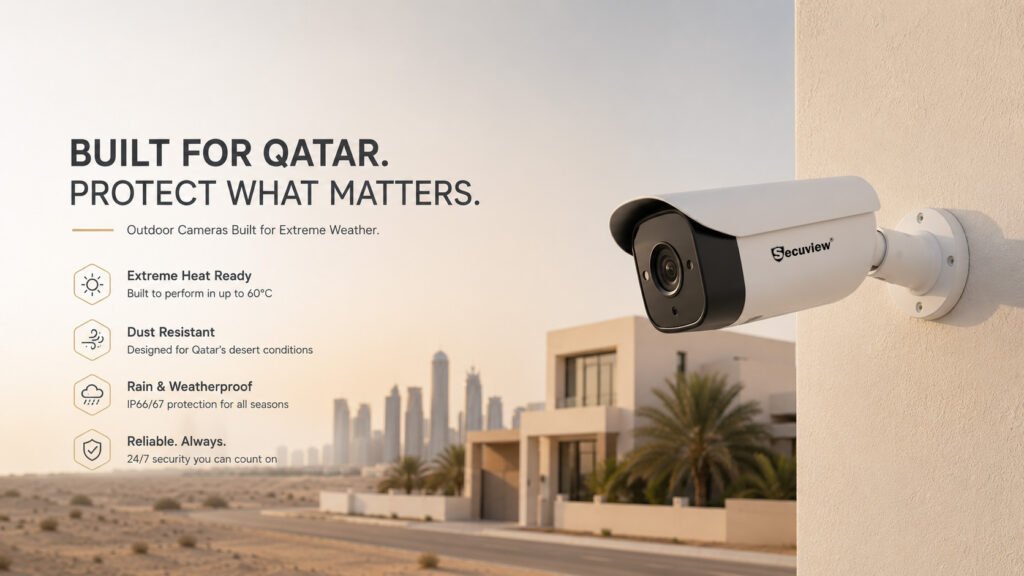
An outdoor surveillance camera in Qatar faces environmental conditions that most manufacturers test for, but few buyers account for when purchasing. Qatar’s outdoor cameras are not simply exposed to heat; they face a precise combination of four stresses simultaneously: extreme thermal load above 45°C from June through September, fine silica-rich dust carried on shamal winds that penetrates unprotected housings, intense direct UV radiation that degrades plastic components faster than in most other markets, and occasional heavy rain during winter months.
A camera that performs flawlessly in a European climate test can fail within one season in Doha. The specifications that determine whether an outdoor camera survives Qatar’s conditions are not marketing descriptions; they are measurable, verifiable technical standards. This guide explains exactly which standards matter, what each one means in practice, and how to match the right camera type to your specific outdoor installation position in Qatar.
Why Qatar’s Climate Is Harder on Cameras Than Most Markets
Qatar’s outdoor camera environment is defined by four simultaneous stress factors, and every outdoor camera must be rated to handle all four, not just heat alone. Understanding each one helps explain why the specification requirements for Qatar are stricter than general outdoor camera guidance.
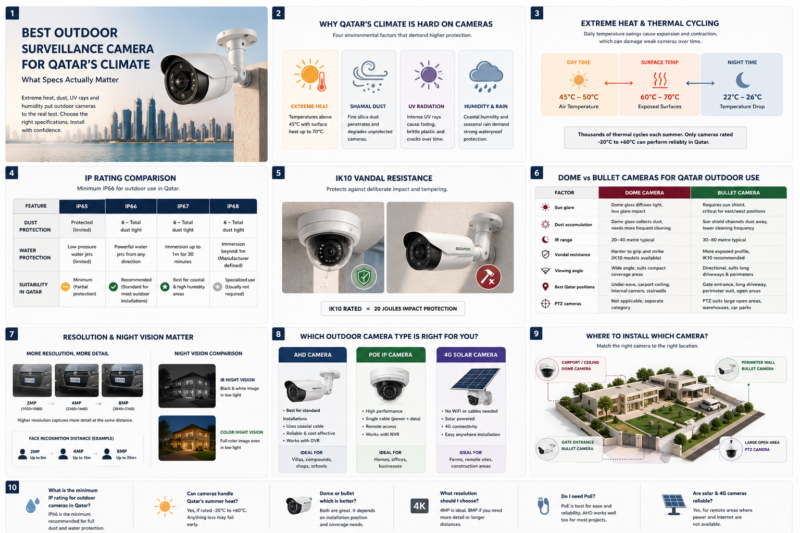
Outdoor surveillance cameras designed for Qatar’s heat, dust, and weather conditions.
1. Extreme Heat and Thermal Cycling
Qatar’s peak summer air temperature regularly exceeds 45°C in Doha, Al Rayyan, and Lusail, with ground-level surface temperatures reaching 60–70°C on exposed concrete and tarmac under direct sun. A camera mounted on an exterior wall or gate pillar in direct sunlight absorbs radiant heat on top of ambient air temperature, meaning the internal operating temperature of the camera housing can exceed 65°C even when the air temperature is 48°C.
The nightly temperature drop to 22–26°C creates a thermal cycling effect, rapid expansion and contraction of housing materials and internal components. Over a full Qatar summer, a camera experiences thousands of these thermal cycles. Housings made of low-grade ABS plastic crack under this cycling. Seals that are not rated for the full temperature range compress and fail, allowing dust and moisture entry.
The specification that addresses this is the operating temperature range, stated on every camera’s data sheet as a minimum and maximum in Celsius. For Qatar outdoor installations, the minimum acceptable operating temperature range is -20°C to +60°C. Cameras rated only to +50°C will operate near their design limit during Qatar’s peak months, reducing lifespan and increasing failure probability.
2. Shamal Wind Dust
Shamal winds carry extremely fine silica-rich dust particles, far finer than typical construction dust. These particles are small enough to penetrate housing gaps that would stop coarser dust, and abrasive enough to scratch optical glass surfaces and degrade lens coatings over time. A camera housing rated below IP66 will accumulate dust on the image sensor within months of installation in an exposed outdoor position in Qatar.
IP66 certification, which requires the housing to withstand powerful water jets from any direction for at least three minutes without ingress, also requires complete dust protection (the ‘6’ in the first digit of the IP rating). This dual protection is what makes IP66 the minimum acceptable standard for Qatar outdoor cameras, not a premium specification.
3. UV Radiation
Qatar receives some of the highest UV index readings in the world, routinely reaching UV Index 11–12 (Extreme) during summer months. Prolonged UV exposure at this intensity degrades standard ABS plastic housings, causing discolouration, brittleness, and eventual cracking within 2–3 years. Camera models with UV-stabilised polycarbonate or metal (aluminium or zinc alloy) housings maintain structural integrity significantly longer under Qatar’s UV load.
This specification is not always listed on camera data sheets, but it is identifiable by housing material. Look for: aluminium die-cast housing, zinc alloy housing, or ‘UV-stabilised PC’ in the housing material specification. Avoid cameras where the housing material is listed only as ‘ABS plastic’ without UV stabilisation.
4. Coastal Humidity and Winter Rain
Qatar’s coastal areas, including large parts of Doha and Al Wakrah, experience significant humidity, particularly overnight and during winter months (November through February). During winter, Qatar receives most of its annual rainfall, which arrives in concentrated heavy downpours rather than light continuous rain. Cameras installed without adequate drainage design can pool water at mounting points and cable entry positions, creating ingress risk even on IP66-rated units if the installation itself is not correctly sealed.
IP Ratings for Outdoor Cameras: IP65, IP66, and IP67 , What Each Means in Qatar
IP (Ingress Protection) rating is the most critical specification for any outdoor camera in Qatar , and the most commonly misunderstood. The rating follows the format IP[X][Y], where X is the dust protection level (0–6), and Y is the water protection level (0–8). For outdoor cameras, both digits matter.
| IP Rating | Dust Protection | Water Protection | IEC 60529 Test Standard | Qatar Suitability |
| IP65 | Dust-tight, complete protection | Protected against low-pressure water jets from any direction | 15cm nozzle · 30kPa · 3 min minimum | Minimum, not recommended for Shamal positions |
| IP66 | Dust-tight, complete protection | Protected against powerful water jets from any direction | 12.5mm nozzle · 100kPa · 3 min minimum | Recommended minimum for all Qatar outdoor cameras |
| IP67 | Dust-tight, complete protection | Temporary submersion, up to 1 metre depth for 30 minutes | 1m depth · 30 minutes · complete immersion | Recommended for coastal Doha, Al Wakrah, and exposed positions |
| IP68 | Dust-tight, complete protection | Continuous submersion, manufacturer-specified depth and duration | Depth/duration defined by manufacturer | Overkill for standard Qatar residential and commercial use |
According to CISA’s video surveillance resource guide, selecting the correct environmental protection rating for the specific installation site is as important as the camera’s optical specifications. A camera with excellent image quality but inadequate weatherproofing will deliver neither; once the housing is compromised, both fail together.
IK Rating, Why Vandal Resistance Matters for Qatar Gate and Wall Cameras
IK rating measures impact resistance, how much mechanical force a camera housing can withstand before failing. The IK scale runs from IK00 (no protection) to IK10 (protects against 20 joules of impact, equivalent to a 5kg object dropped from 40cm). IK rating is governed by IEC 62262.
For Qatar outdoor installations, IK10 vandal resistance is worth specifying for any camera mounted at or below wall height, particularly on compound gates, ground-floor perimeter walls, and car park positions in Doha and Al Rayyan. Cameras in these positions are accessible without ladders, making them vulnerable to opportunistic impact damage.
Dome cameras with IK10 rating are available in both AHD and IP variants and add minimal cost premium over non-rated equivalents. For cameras mounted on rooftop overhangs, high wall positions, or under eaves at height, IK rating is less critical since the position itself provides physical inaccessibility.
Dome vs Bullet Cameras for Qatar Outdoor Use: The Real Difference
The choice between dome and bullet cameras for Qatar outdoor installations is a function of installation position and sun angle, not a preference question. Both form factors perform equally well, weatherproofed to IP66 or IP67. The difference is in how each handles Qatar’s specific environmental factors.

Best Outdoor Surveillance Camera for Qatar Climate: What Specs Actually Matter
Resolution and Night Vision for Qatar Outdoor Cameras
Qatar’s outdoor lighting environment is unusual; high ambient light from street lighting and commercial signage in Doha means true darkness rarely occurs in urban areas. Night vision requirements for outdoor cameras in Qatar differ by installation context:
Resolution: What Actually Matters for Qatar Outdoor Positions
For gate cameras and entrance positions where face and number plate identification is the primary requirement, a minimum of 4MP resolution is necessary for reliable identification at distances of 5–12 metres. At 2MP (1080p), faces are identifiable at 5–8 metres in good light but become ambiguous at the distances that most Qatar villa gates require.
For perimeter overview positions where the goal is detecting movement and general activity rather than facial identification, 2MP to 4MP is sufficient. 4K (8MP) cameras are worth the additional storage cost only for fixed critical positions where specific identification is essential at distances beyond 15 metres.
H.265 compression is standard on all current IP camera models and reduces storage requirements by approximately 50% compared to H.264 at equivalent image quality, making 4K and 5MP recording practical on standard NVR hard drives at extended retention periods.
Night Vision, IR Range vs Colour Night Vision for Qatar
Standard IR (infrared) night vision produces black-and-white footage in low-light conditions using infrared LEDs invisible to the human eye. IR range for outdoor cameras is stated in metres, but as with all manufacturer specifications, the stated range represents optimal conditions. In real-world Qatar outdoor conditions, plan for 25–30% less effective range than the stated figure due to dust on the IR lens array and ambient temperature affecting LED efficiency.
For a Qatar villa gate, a camera with a stated 40 metre IR range reliably produces usable identification footage to approximately 28–30 metres in practice. For a long driveway or compound perimeter exceeding 25 metres, select cameras with stated IR ranges of 50+ metres
Colour night vision uses a wide-aperture lens and image sensor sensitivity to capture colour footage in very low ambient light, producing far more detail and usability than standard IR black-and-white footage. For front gate cameras in Doha and Al Rayyan, where street lighting provides ambient light, colour night vision is worth the premium. For truly dark positions, open desert perimeter, rural compounds in Al Wakrah, standard IR with sufficient range is more reliable than colour night vision at low ambient light levels.
Which Camera Type Is Best for Qatar Outdoor Positions?
Three camera technologies suit Qatar’s outdoor installations, and the choice between them is determined by the available cable infrastructure, not by outdoor performance capability. All three are available with IP66 or IP67 ratings, and all three perform comparably in Qatar’s climate when correctly rated.
AHD Outdoor Cameras, Best for Existing Coaxial Runs
AHD (Analogue High Definition) outdoor cameras transmit video over existing coaxial cable runs, making them the most cost-effective choice for Qatar villas and compounds where coaxial cable was installed with a previous system. Current AHD cameras support resolutions from 2MP to 8MP (4K) and are available with IP66 and IP67 ratings and IK10 vandal resistance.
The practical advantage in Qatar: many villa compounds built in the 2000s and early 2010s have existing coaxial infrastructure. AHD cameras connect directly to this wiring without rewiring, dramatically reducing installation cost and time while delivering current-generation HD or 4K resolution.
IP Outdoor Cameras (PoE), Best for New Installations
PoE IP outdoor cameras receive both power and data through a single Cat6 network cable, connecting to an NVR (Network Video Recorder). For new Qatar villa builds and commercial properties being installed from bare walls, PoE IP systems offer native remote access via mobile app, smart motion detection zones, two-way audio, and scalability without additional wiring.
For compound security offices and commercial properties in Al Rayyan and Lusail requiring centralised management of 8+ outdoor cameras with remote viewing capability, IP PoE cameras on a commercial-grade NVR represent the professional installation standard.
4G Solar Outdoor Cameras, Best for Remote and Cable-Free Positions
4G solar outdoor cameras use a mobile SIM card to transmit footage and draw power from an integrated solar panel, eliminating both power and data cable requirements. For Qatar outdoor positions where running cable is impractical, remote perimeter points, construction site monitoring, agricultural land in Al Wakrah, and temporary installation positions, 4G solar cameras provide full HD surveillance with no infrastructure requirement.
The solar panel rating must account for Qatar’s dust accumulation; solar panels require more frequent cleaning in Qatar’s dusty environment than in other markets. Look for solar panels rated for operation with up to 40% soiling reduction, and position the panel to minimise dust settlement from the prevailing shamal wind direction.
As ASIS International’s security management research notes, selecting camera systems that match the specific infrastructure constraints of each installation site, rather than defaulting to one technology for the entire property, produces better security outcomes and lower long-term maintenance costs.
Which Secuview Outdoor Camera Is Right for Your Qatar Property?
Secuview manufactures its own outdoor camera range, engineered for GCC climate conditions and available wholesale and retail from Qatar stock at manufacturer-direct pricing. Every Secuview outdoor model carries IP66 or IP67 weatherproofing with operating temperature ranges rated for Qatar’s peak summer conditions.
Secuview AHD Outdoor Range, QAR Price Guide
Secuview’s AHD outdoor cameras start at QAR 200 for a 2MP IP66-rated outdoor dome through to QAR 380 for a 5MP IP67-rated bullet camera with 40-metre IR range and IK10 vandal resistance. Complete 4-camera AHD outdoor kits with HD-DVR and 1TB storage are available from QAR 900, covering a standard Qatar villa gate, driveway, two perimeter positions, and full remote mobile viewing. Property owners looking for a cost-effective solution can explore the full range of AHD CCTV camera systems in Qatar to compare resolutions, weatherproof ratings, and installation options for residential and commercial properties.
Secuview 4G Solar Outdoor Range, QAR Price Guide
Secuview’s 4G solar outdoor cameras start at QAR 320 for a 2MP solar WiFi camera and reach QAR 580 for a 4G solar PTZ camera with 360° pan-tilt capability, colour night vision, and dual SIM support. Suited to remote Qatar positions, perimeter land, construction sites, and agricultural properties, where infrastructure is unavailable. For locations where running power or network cables is impractical, these 4G solar security cameras in Qatar provide reliable remote monitoring with flexible installation and mobile connectivity.
Frequently Asked Questions, Outdoor Cameras in Qatar
What IP rating do outdoor cameras need in Qatar?
Outdoor cameras in Qatar require a minimum IP66 rating, providing complete dust protection and resistance to powerful water jets from any direction. For coastal Doha locations, waterfront properties in Al Wakrah, and any camera position with direct rain exposure, IP67 (temporary submersion rated) is the recommended standard. Cameras rated only IP65 are not adequate for Qatar’s Shamal dust conditions.
What is the best outdoor CCTV camera for hot climates?
The best outdoor CCTV camera for hot climates combines four specifications: IP66 or IP67 rating, operating temperature range of -20°C to +60°C minimum, UV-stabilised or metal housing material, and a reputable manufacturer’s warranty that covers heat-related failure. For Qatar specifically, also verify the camera’s IR LED type; quality IR LEDs maintain performance at high housing temperatures, where cheaper LEDs degrade faster. Resolution (4MP or 5MP) and IR range (30–50 metres for standard positions) are secondary decisions once these environmental specifications are confirmed.
Are dome or bullet cameras better for outdoor use in Qatar?
Neither is universally better; the choice depends on the installation position. Dome cameras suit under-eave positions, carport ceilings, and compact coverage areas where the mounting position reduces direct sun glare. Bullet cameras suit gate entrances, long driveways, and perimeter walls where directional coverage is needed, and the integral sun shield reduces lens glare from Qatar’s direct sunlight. For any position at or below wall height, specify IK10 vandal resistance regardless of form factor.
How often do outdoor cameras need cleaning in Qatar?
Outdoor cameras in Qatar require cleaning every 4–8 weeks during the heavy shamal dust season (March to June) and every 8–12 weeks during the cooler months. The dome glass and IR lens arrays accumulate the most dust. In IP66-rated cameras, cleaning with a damp cloth and lens-safe cleaner is straightforward. Avoid high-pressure washing directly at the cable entry point, even on IP67-rated cameras, as repeated direct pressure at mounting seals accelerates seal wear over time.
Do outdoor cameras work during Qatar’s hottest months?
Yes, provided the camera is rated for the correct operating temperature range. A camera rated -20°C to +60°C operates without fault during Qatar’s peak summer months. Camera models rated only to +50°C may experience thermal shutdowns or accelerated component degradation at sustained ambient temperatures of 48–50 °C. Always verify the maximum operating temperature specification, not the storage temperature, which is different and higher, before purchasing any outdoor camera for Qatar installation.
What is the difference between outdoor AHD and IP cameras for Qatar?
Both AHD and IP cameras are available with identical Qatar-suitable weatherproofing ratings (IP66/IP67) and operating temperature ranges. The difference is in the cable type, recording unit, and feature set, not in outdoor durability. AHD uses coaxial cable and a DVR; IP cameras use Cat6 network cable and an NVR. For a complete explanation of this distinction, read the guide to the difference between CCTV and surveillance cameras.