Outdoor CCTV Camera Night Vision Range: How Far Can You See?
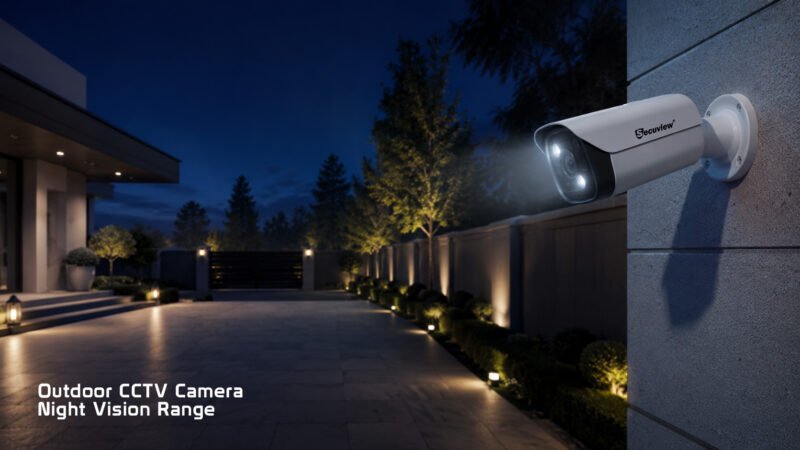
Night vision range depends on the camera lens, sensor, infrared illumination, lighting, and installation position.
If you are looking for a security camera for outdoor areas, night vision range is an important factor. A high-resolution camera does not mean it can accurately capture people or vehicles at long distances after dark. The type of lens, infrared range, image sensor, resolution, lighting, camera position, and weather conditions all affect nighttime visibility.
The night vision system you select for your home, villas, farms, parking areas, and commercial properties in Qatar should depend on the distance and type of activity you need to monitor.
Key Takeaways
- Night vision range varies by camera and installation conditions.
- IR illumination helps cameras record in dark areas.
- Color night vision needs some available light on many models.
- Lens focal length affects both viewing angle and distance.
- Higher resolution can provide more image detail.
- Heat, dust, humidity, and other conditions can affect night-time video.
- The camera’s stated IR range does not always equal its identification range.
What Is Outdoor CCTV Camera Night Vision?
Outdoor night vision is a feature that allows a surveillance camera to capture video when natural light is low or unavailable. It is useful for entrances, gates, driveways, parking areas, gardens, boundaries, and other exterior spaces.
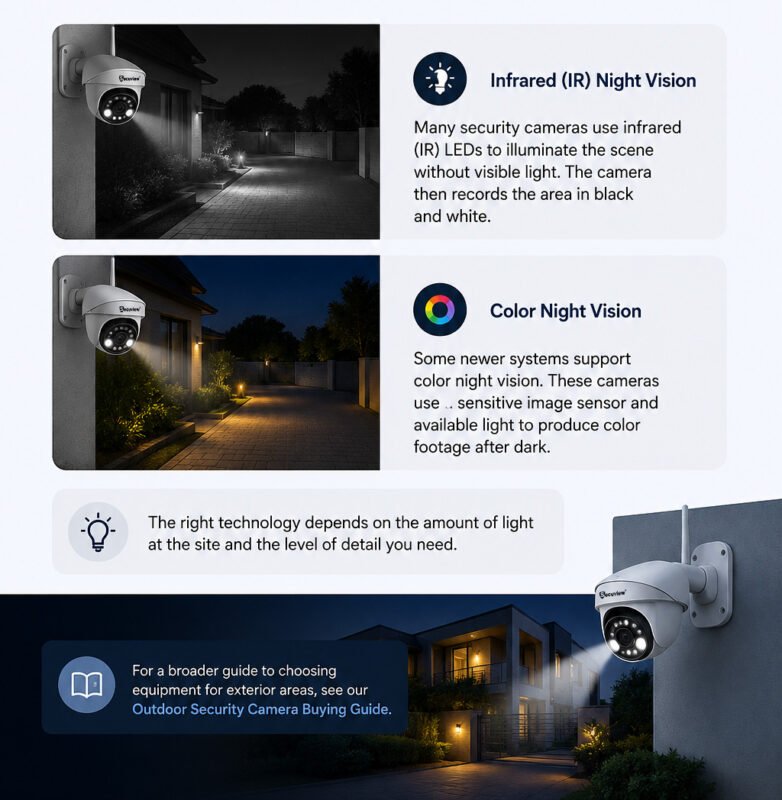
Many security cameras use infrared (IR) LEDs to illuminate the scene without visible light. The camera then records the area in black and white.
What Is Outdoor Night Vision
Some newer systems support color night vision. These cameras use a sensitive image sensor and available light to produce color footage after dark.
The right technology depends on the amount of light at the site and the level of detail you need.
For a broader guide to choosing equipment for exterior areas, see our Outdoor Security Camera Buying Guide.
How Does Outdoor Night Vision Work?
At night, a camera’s image sensor receives less light. This can make people, vehicles, and other objects harder to see.
With IR night vision, built-in infrared LEDs provide invisible illumination. The sensor captures this reflected IR light and creates a black-and-white image.
The basic process is
Low light → IR illumination → Image sensor → Video processing → Night-time footage
The usable distance depends on the camera’s IR power, lens, sensor, and scene.
Color night vision works differently. It uses available light instead of relying only on infrared illumination. A nearby streetlight, security light, or other light source can improve the result.
How Far Can an Outdoor Security Camera See at Night?
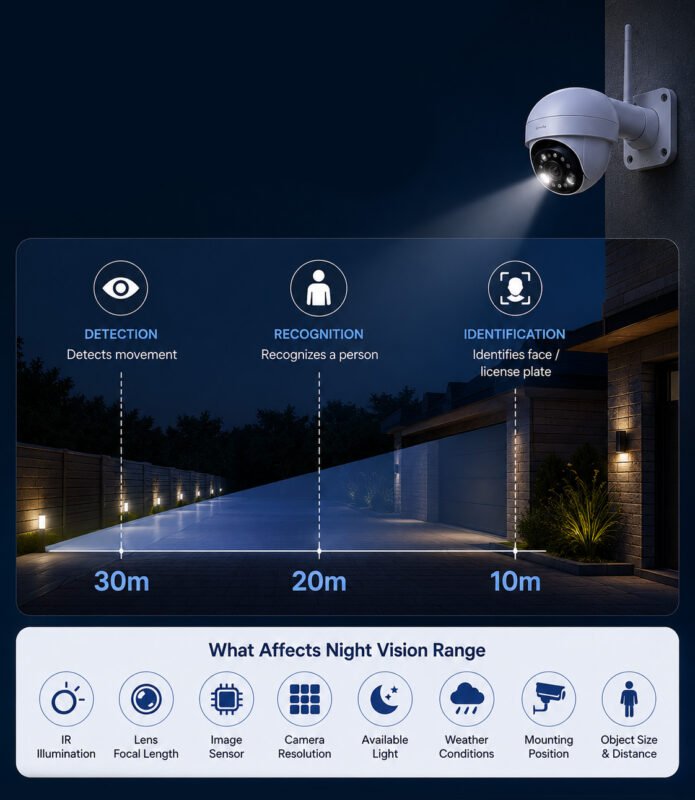
Outdoor night vision cameras can usually monitor areas about 10–30 meters away. Long-range models can cover greater distances.
However, the stated night vision range should not be treated as the exact distance for face or license plate identification. A camera may detect movement at a long distance but show less useful detail.
How Far Can an Outdoor Security Camera See at Night
The useful range depends on:
- IR illumination range
- Lens focal length
- Image sensor
- Camera resolution
- Available light
- Weather conditions
- Camera mounting position
- Object size and distance
For example, a camera may detect a person at a greater distance than it can clearly identify that person’s face.
What Affects Night Vision Range?
Focal Length and Lens
The lens affects how wide the camera can view an area and how much detail it can capture at a distance.
A wide-angle lens covers more space but may show less detail on distant subjects. A longer focal length gives a narrower view and can help with distant monitoring.
For gates, driveways, and long boundaries, lens selection is especially important.
Camera Resolution
Resolution affects the amount of image detail captured by the sensor.
Common security camera resolutions include 2MP, 4MP, 5MP, and 8MP/4K. Higher resolution can provide more detail, but it does not automatically create better night vision.
The sensor, lens, lighting, and image processing also affect the final result.
Image Sensor and Low-Light Performance
The image sensor plays a major role in night-time video quality.
A capable sensor can capture more light and produce clearer footage in low-light conditions. This is especially useful when the area has street lighting or other ambient light.
Infrared Night Vision
IR night vision is useful when the area is very dark.
The camera uses infrared LEDs to illuminate the scene. The footage normally appears in black and white.
IR range varies between models. Some cameras are designed for short-range areas, while specialized models can support longer distances.
Color Night Vision
Night-time protection may be required around entrances, loading areas, parking spaces, and perimeter zones of shops, warehouses, and business premises.
It can help users distinguish details such as clothing, vehicles, or other objects. However, performance depends on the available light and the camera’s sensor.
Camera Position
Mounting height and viewing angle can change the effective night vision range.
A camera facing a large open area may have a clearer view than one facing walls, trees, parked vehicles, or other obstacles.
Avoid placing the lens where strong lights point directly into it. Glare can reduce image quality.
Weather and Environmental Conditions
Qatar’s outdoor environment can include heat, dust, humidity, and strong sunlight. These conditions can affect equipment and image quality.
Dust on the lens or protective cover can reduce clarity. Heavy moisture, fog, or airborne particles can also reduce the useful viewing distance.
Choose equipment with suitable environmental protection and keep the lens clean.
Does IR Range Equal Identification Range?
No.
The IR range tells you how far the infrared illumination may reach. It does not guarantee that a person or vehicle will be clearly identifiable at that distance.
Think about three different levels:
Detection → Recognition → Identification
Detection: You can see that something is present.
Recognition: You can determine what the object or person is.
Identification: You can see enough detail to identify the person, vehicle, or other subject.
A camera may detect movement at 30 meters but provide useful facial detail only at a shorter distance.
How Can You Improve Night Vision Performance?
You can improve night-time monitoring by choosing the camera and installation location carefully.
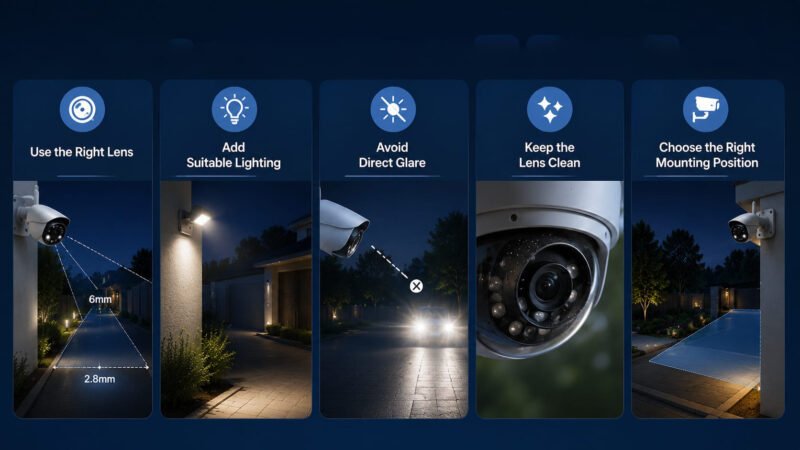
How Can You Improve Night Vision Performance
Use the Right Lens
Select the focal length according to the distance you need to monitor.
Add Suitable Lighting
A security light can improve color night vision and overall image quality.
Avoid Direct Glare
Do not point the lens directly toward bright lights. Strong glare can reduce useful detail.
Keep the Lens Clean
Dust and dirt on the lens or cover can reduce clarity, especially when IR illumination reflects from the surface.
Choose the Right Mounting Position
Place the camera where walls, trees, vehicles, and other objects do not block important areas.
Outdoor Night Vision for Different Locations
Villas and Homes
For a villa in Doha or Al Wakrah, night vision can help monitor gates, entrances, driveways, garages, and boundary areas.
Farms
Large properties around Al Shahaniya may need longer-range surveillance. Solar-powered or 4G-connected models can also help where fixed power or internet is difficult to install.
Parking Areas
Parking spaces may require a wider field of view or longer-range monitoring. Good lighting can also improve vehicle and person visibility.
Commercial Properties
Shops, warehouses, and business premises may need night-time coverage around entrances, loading areas, parking spaces, and perimeter zones.
Outdoor Security Cameras With Night Vision
When selecting a product, consider the location, power source, network connection, viewing distance, and night-time lighting.
For locations without fixed power or internet, a solar-powered 4G outdoor security camera can be useful. It combines solar power with cellular connectivity.
Secuview Wireless IP Outdoor Solar-powered 4G Security Camera
An outdoor WiFi weatherproof security camera can suit locations with reliable wireless coverage and a suitable power source.
Secuview WiFi Outdoor Weatherproof Security Camera
For areas that need a wider or more flexible setup, a solar-powered 4G dual-lens security camera can provide additional viewing coverage.
Secuview Wireless IP Solar-powered 4G Dual Lens Security Camera
Frequently Asked Questions
How far can an outdoor security camera see at night?
Many models provide useful night-time monitoring at around 10–30 meters. Long-range systems can cover farther distances, but actual detail depends on the lens, sensor, IR range, lighting, and installation.
How far can a 4K security camera see at night?
A 4K camera can capture more detail than a lower-resolution model, but resolution alone does not determine viewing distance. Lens focal length, sensor quality, IR illumination, and lighting also matter.
Can a security camera see 100 feet at night?
Yes, some cameras can monitor objects at about 100 feet, or 30 meters, at night. Whether they can clearly identify a person or license plate at that distance depends on the camera and scene.
Does optical zoom help a camera see farther?
Yes. Optical zoom changes the lens view without relying on digital enlargement. It can help capture more detail from distant subjects when the camera has a suitable sensor and lens.
What is the best night vision camera for a long driveway?
Choose a model with a suitable focal length, strong low-light performance, sufficient IR range, and the right resolution for the driveway length. A wider view may suit a short driveway, while a longer focal length can help with greater distances.
How does Qatar’s outdoor climate affect night vision?
Heat, dust, humidity, and airborne particles can affect outdoor video quality and equipment performance. Choose a camera with suitable environmental protection and an operating temperature range designed for the installation site.
Keep Reading
For more information about outdoor surveillance planning and related camera technology:
- Things to Know Before Buying Outdoor Security Cameras
- Outdoor CCTV Installation in Qatar: Cost & Setup Guide
- Outdoor Surveillance Camera for Qatar’s Climate
- Indoor CCTV Camera Resolution Guide
These resources cover camera selection, installation, Qatar-specific conditions, and image resolution in greater detail.
Conclusion
Night vision range is not determined by one specification. Lens, sensor, resolution, IR illumination, lighting, camera placement, and environmental conditions all affect what you can see after dark.
A camera may detect movement at a long distance but may need to be closer to capture clear facial or vehicle details. For this reason, choose the system based on the area, viewing distance, lighting, and monitoring goal.
For homes, villas, farms, parking areas, and commercial properties in Qatar, the right combination of night vision technology, focal length, connectivity, power, and weather protection can provide more useful night-time surveillance.