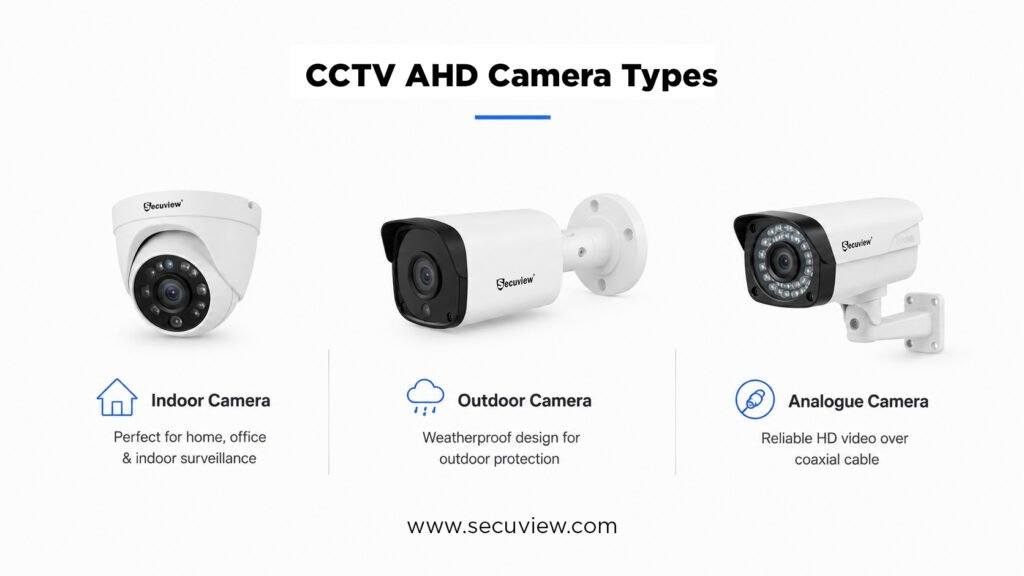
An AHD (Analog High Definition) camera captures HD video and sends it over standard coaxial cable to a DVR, without converting the signal to digital network data first. It’s the direct upgrade path for any property that already has coaxial wiring installed, and it remains one of the most cost-effective ways to run a high-resolution camera system without rebuilding your cabling.
How AHD Technology Actually Works
AHD is a specific method of pushing high-definition video down cable types that were originally built for old analog cameras — not a stripped-down or outdated format.
A traditional analog camera (CVBS) can only send low-resolution video down a coaxial cable because the cable’s bandwidth wasn’t designed for an HD signal. AHD solves this by encoding the video signal differently before it hits the cable, allowing full HD — and now up to 4K — footage to travel down the exact same RG59 or RG6 coaxial cable, terminated with a standard BNC connector, into a DVR that supports the AHD format.
The camera does the encoding. The DVR does the decoding. Nothing in between needs to understand digital networking — no IP address, no PoE, no router. That’s the entire appeal: the simplest possible signal path between camera and recorder.
Transmission distance: a quality AHD cable run reliably carries signal up to roughly 300-500 meters, depending on cable grade and resolution — well beyond what most villa or commercial cabling runs require. A typical PoE/IP cabling run, by comparison, is limited to about 100 meters without a network switch or extender in between, which makes AHD a genuine practical advantage for large single-building layouts.
Where AHD Fits Against IP and Analog
AHD sits between old analog CVBS and modern IP camera technology. It delivers real HD resolution on infrastructure that’s far cheaper to install and maintain than a full IP network, at the cost of losing IP’s smart features — motion-zone alerts, native mobile app access, two-way audio over the same cable. Both AHD and IP fall under the broader “CCTV” umbrella as recording-based systems, distinct from cloud-only surveillance cameras that store footage remotely rather than to a local DVR or NVR.
Indoor AHD Cameras – When They Make Sense
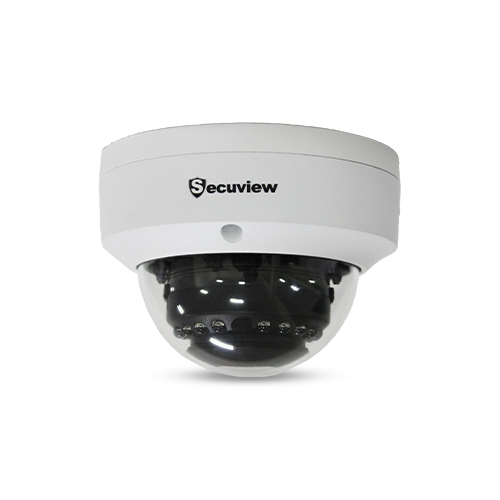
5MP indoor AHD CCTV camera for clear home and office surveillance in Qatar
Indoor AHD suits any room, hallway, reception area, or stairwell where reliable recorded footage matters more than smart alerts or remote-viewing sophistication.
For small rooms and tight budgets, a compact 1.3MP indoor AHD camera still captures usable footage for general activity monitoring — reception desks, storage rooms, entry hallways, where identifying that something happened matters more than reading fine detail.
Where clearer face and detail recognition matters — a shop counter, a server room, a villa’s main hallway — a 5MP indoor AHD camera captures sharp enough detail to matter if footage is ever reviewed after an incident.
For a mid-range option balancing image clarity against cost across multiple camera positions, a 2MP indoor AHD camera is the most commonly deployed resolution for standard indoor coverage in Qatar villas and offices.
Outdoor AHD Cameras – When They Make Sense
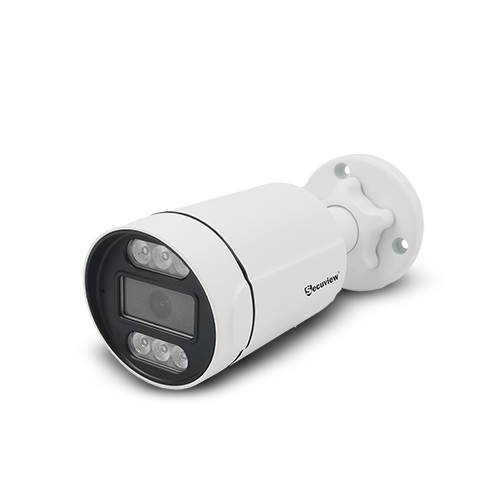
Outdoor AHD works the same way electrically as indoor; the difference is entirely in the housing and its rated tolerance for heat, dust, and moisture, which matters considerably in Qatar’s climate.
An outdoor AHD unit needs a housing rated for dust and water resistance, sealed against shamal dust exposure and Qatar’s summer heat. A 5MP outdoor AHD camera gives enough resolution to identify a face or license plate at gate or driveway distance, where indoor-grade resolution isn’t enough.
For entry points and gates specifically, where weatherproof housing quality matters as much as resolution, a 5MP outdoor AHD camera with a properly sealed IP66 waterproof housing is the safer choice, since gate positions take the most direct sun and rain exposure on most properties.
AHD Resolution Options, Explained Practically
Resolution numbers alone don’t tell you what you actually need:
- 1.3MP — general activity monitoring where identifying that something happened matters more than fine detail; budget-friendly for multi-camera indoor setups
- 2MP — the practical standard for most indoor and general outdoor coverage; enough detail for face recognition at normal room or yard distance
- 5MP — the resolution to choose for any position where you need to identify details at a distance: gates, driveways, entrances, parking areas
Cost scales with resolution, but not dramatically — a full AHD system (cameras, DVR, cable, installation) generally runs meaningfully below an equivalent IP setup for the same camera count, largely because coaxial cable and BNC connectors cost less than network-grade Cat6 and PoE switches.
When to Choose AHD vs When to Upgrade to IP
Choose AHD when: – Your property already has coaxial cable installed from a previous system – You want a straightforward recorded system without needing remote-viewing sophistication – Budget per camera matters more than smart features – You’re running long cable distances where IP’s 100m limit becomes a real constraint
Choose IP instead when: – You’re wiring a new build from scratch (Cat6 costs about the same to run as coax at that point) – You want native mobile app access, motion-zone alerts, or two-way audio – You need to scale up easily with additional cameras on the same network later
Choosing the Right AHD Camera for Your Property
Once you’ve decided that AHD CCTV is the right fit, the next step is choosing a camera based on where it will be installed and the level of detail you need.
For indoor surveillance, lower-resolution cameras are often sufficient for monitoring hallways, reception areas, storage rooms, and offices. Where sharper facial identification or object detail is important, higher-resolution models provide noticeably clearer recorded footage.
Outdoor installations require more than just higher resolution. Cameras installed at entrances, gates, parking areas, or building perimeters should also have a weatherproof housing capable of handling Qatar’s high temperatures, dust, and occasional rainfall. An IP66-rated Outdoor AHD Camera provides additional protection for these exposed locations while maintaining reliable image quality.
Secuview’s AHD CCTV Camera range includes 1.3MP, 2MP, and 5MP Indoor AHD Cameras, as well as 5MP Outdoor AHD Cameras and IP66 Waterproof Outdoor AHD Cameras, designed for residential, commercial, and industrial surveillance projects across Qatar. Selecting the appropriate resolution and housing depends on the installation environment, viewing distance, and the level of detail required in the recording, rather than simply choosing the highest available megapixel count.
To select the most suitable model, explore the complete Indoor AHD Camera and Outdoor AHD Camera collections, where you can compare cameras by resolution, installation environment, and monitoring requirements. For a broader understanding of surveillance technologies, the CCTV Camera Types Guide compares AHD, IP, WiFi, 4G, and PTZ cameras, making it easier to identify the best solution for your home or business.
Frequently Asked Questions
What is AHD in a CCTV camera?
AHD (Analog High Definition) is a video transmission format that sends HD-quality footage over standard coaxial cable to a compatible DVR, without converting the signal to a digital network format the way IP cameras do.
What is the difference between an IP camera and an AHD camera?
An IP camera converts video to digital data and sends it over a network cable (Cat6) to an NVR, enabling smart features like mobile app access and motion alerts. An AHD camera sends an encoded analog-format HD signal over coaxial cable to a DVR — simpler, cheaper per camera, but without native networking features.
How far can AHD cameras transmit video?
A properly rated AHD cable run carries signal reliably up to roughly 300-500 meters, depending on cable grade and camera resolution — considerably farther than a standard IP/PoE run without a network extender.
Which CCTV camera format is better for outdoor use — AHD or IP?
Both work outdoors, provided the housing carries an appropriate weatherproof rating for local conditions. The deciding factor is usually cable distance and whether smart remote-monitoring features are needed, not the format’s outdoor durability itself.
Is AHD wired or wireless?
AHD is a wired format — it requires a physical coaxial cable connection between the camera and the DVR. It is not compatible with WiFi transmission.