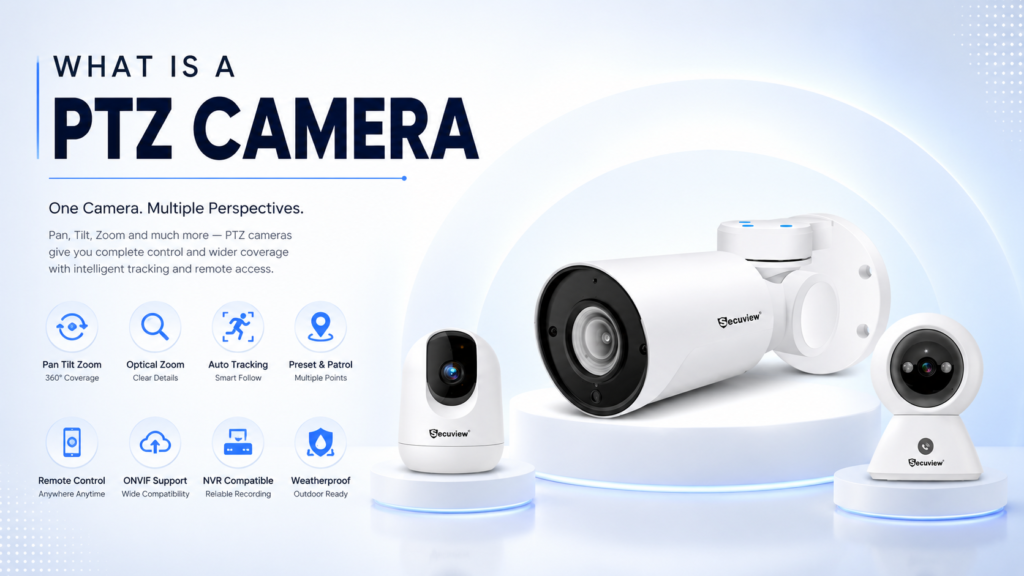
A PTZ (Pan-Tilt-Zoom) camera physically rotates and zooms to cover an area that would otherwise need several fixed cameras pointed in different directions. One PTZ unit, moving between preset positions, can do the job that three or four static cameras would need to do simultaneously — at the cost of only ever actively watching one of those positions at a time.
What Does PTZ Stand For?
PTZ stands for Pan-Tilt-Zoom— the three physical movements the camera can perform. Pan is horizontal rotation, tilt is vertical rotation, and zoom is the lens moving in or out to change magnification. A camera only qualifies as a true PTZ if it can do all three; a camera that only pans and tilts without a motorized zoom lens is a PT camera, a distinct and more limited category.
How Does a PTZ Camera Work?
Inside a PTZ camera, servomotors physically move the camera body and lens in response to commands — either from a human operator using a joystick controller, or automatically, cycling through programmed preset positions. This is a meaningful mechanical difference from a fixed camera, which has no moving parts and simply records whatever falls inside its one static field of view.
Pan, Tilt, and Optical Zoom Explained
- Pan — horizontal rotation, often covering close to 355° on a dome-style PTZ (typically falling just short of a full 360° loop to avoid cable strain)
- Tilt — vertical rotation, commonly around 90°, letting the camera angle from a level view down toward the ground
- Optical zoom — the lens itself physically moves to magnify the image without losing resolution, distinct from digital zoom, covered next
Main Features of a PTZ Camera
Optical Zoom vs Digital Zoom
Optical zoom moves actual glass elements in the lens to magnify the image, preserving detail and resolution at higher magnification. Digital zoom simply crops and enlarges the existing image digitally, which loses detail the further it zooms — a 20x optical zoom and a 20x digital zoom are not remotely comparable in real image quality at maximum zoom.
Auto Tracking
A PTZ camera’s auto-tracking physically moves the camera to follow a subject across its field of view, continuously reframing the shot. This is mechanically different from the zone-based motion detection on a fixed IP camera, where the camera stays still and simply flags that movement happened somewhere in the frame.
Preset Positions & Patrol Mode
A preset is a saved pan/tilt/zoom position the camera can return to instantly on command. Patrol mode (also called tour mode) cycles the camera automatically through a sequence of presets, pausing at each for a set duration — this is the specific mechanism that makes “one camera replacing four” operationally real, rather than requiring a person to manually steer the camera between positions.
Remote Camera Control
Most PTZ systems allow remote operators to take manual control of pan, tilt, and zoom in real time through a camera controller or a mobile/desktop app, overriding the automatic patrol when active monitoring is needed.
ONVIF & NVR Compatibility
Most modern PTZ cameras are IP-based and connect to an NVR the same way a standard IP camera does, over Cat6/PoE, and support ONVIF for interoperability with third-party recording and control software.
Types of PTZ Cameras
- Indoor PTZ cameras — for large indoor spaces like retail floors or lobbies where one camera needs to cover multiple zones
- Outdoor PTZ cameras — weatherproof housings rated for outdoor exposure, used for perimeters and open areas
- IP PTZ cameras — the modern standard, network-based, ONVIF-compatible
- WiFi PTZ cameras — wireless variants, common in smaller consumer and home-monitoring applications
- 4G PTZ cameras — cellular-connected, used where no network infrastructure exists at all
- Speed dome PTZ cameras — high-speed rotation PTZ units built for rapid repositioning, often used where fast response to an event matters more than anything else
Where Are PTZ Cameras Used?
- Homes & nurseries— on a much smaller scale, indoor baby monitor PTZ cameras use the same pan-tilt(-zoom) mechanics to let a parent remotely reposition the camera around a single room, rather than needing several fixed cameras to see every corner
- Warehouses & industrial facilities — covering long aisles and large open floor areas from a single mounting point
- Parking areas & vehicle monitoring — following vehicle movement across a wide lot
- Airports & transport hubs — large open areas needing both wide coverage and zoom-in detail on demand
- Retail stores & shopping centres — covering multiple aisles or zones from one ceiling position
- Construction sites — temporary large-area coverage where running cable to multiple fixed positions isn’t practical
- Hotels & commercial buildings — lobbies and large common areas
- Schools & universities — courtyards and large campus open spaces
- Stadiums & large public spaces — wide-area coverage with the ability to zoom in on a specific incident
Advantages of PTZ Cameras
- Large field of view — a single unit can visually cover an area that would need several fixed cameras to see in full
- Optical zoom for long-distance monitoring — reads detail at a distance that a fixed wide-angle camera physically cannot resolve
- One camera can cover multiple areas — this is the core of the title’s claim: a PTZ patrolling four preset positions is, in practical terms, doing the job four fixed cameras would do, at the cost of only actively watching one position at any given instant rather than all four simultaneously
- Intelligent motion tracking — physically follows a moving subject rather than just flagging that motion occurred
- Remote surveillance — an operator can take manual control and actively direct the camera toward a specific area of interest in real time
Limitations of PTZ Cameras
- Blind spots during camera movement — while physically repositioning between presets, a PTZ is not recording whatever it just moved away from; this is the direct trade-off against the coverage claim above
- Higher cost than fixed cameras — the motors, control board, and mechanical assembly add real cost per unit
- Mechanical wear — moving parts degrade over years of continuous operation in a way a fixed camera’s solid-state design does not
- Requires proper positioning — a poorly mounted PTZ can have its rotation blocked, or its presets rendered useless by obstructions that a fixed camera wouldn’t be affected by
PTZ Camera vs Fixed Camera
| PTZ Camera | Fixed Camera | |
|---|---|---|
| Coverage area | Wide, multiple zones via presets | One static field of view only |
| Image detail | Great detail on demand via optical zoom | Fixed detail level, no zoom flexibility |
| Installation cost | Higher per unit | Lower per unit |
| Best applications | Large open areas needing multi-zone coverage | Specific fixed points — doorways, tills, entrances |
PTZ Camera vs IP Camera vs AHD Camera
Which technology is better depends entirely on what the installation actually needs to cover, not a general ranking. A fixed IP camera is the better choice for a specific point that always needs constant coverage, a doorway or a till, since a PTZ patrolling away from that exact spot would miss it during its rotation cycle. For the underlying mechanics of how a standard fixed IP camera works- PoE, Cat6, NVR, ONVIF – the IP camera guide covers that in full; this article stays focused on what’s different about PTZ specifically.
Existing coaxial infrastructure matters less for PTZ than for a basic fixed-camera decision, since the vast majority of PTZ units on the market are IP-based rather than AHD; a property with only coaxial wiring installed will generally need new Cat6 runs for a PTZ regardless. Here, the AHD camera guide explains when sticking with a wired coaxial fixed-camera setup makes more sense than upgrading infrastructure for a PTZ.
Smart features, auto-tracking, presets, and patrol mode are unique to PTZ among these three; a fixed IP camera has zone-based motion detection but no physical movement, and AHD has neither.
Installation complexity is highest for PTZ, given the additional mechanical mounting and controller setup beyond what a fixed camera install requires.
Important Buying Considerations
- Camera resolution – same practical tiers as fixed cameras (5MP/8MP/12MP, even 2k), but combined with optical zoom, resolution determines how usable the image stays at maximum zoom
- Optical zoom level – commonly expressed as a multiplier (10x, 20x, 30x); higher isn’t automatically better if the property doesn’t have sightlines long enough to use it
- Low-light performance – matters more for PTZ than fixed cameras, since a unit patrolling toward a poorly lit zone needs to maintain image quality there too
- WDR (Wide Dynamic Range) – helps the camera handle scenes with both bright and dark areas in the same frame, common in outdoor PTZ use where direct sun and shadow both appear
- IP66/IP67 rating – required for any outdoor PTZ, same climate logic covered for AHD and IP outdoor cameras elsewhere on this site
- ONVIF support – confirms compatibility with third-party NVR and control software
- AI analytics – some PTZ units support object classification (person vs vehicle) on top of basic auto-tracking
- Storage & recording – patrol-mode PTZ footage consumes storage differently than a fixed camera, since it’s recording multiple zones sequentially rather than one zone continuously
- PoE vs separate power – most IP PTZ units run on PoE, but higher-power models with heaters or fast motors sometimes need dedicated power rather than relying on standard PoE wattage
Best Outdoor and Indoor PTZ CCTV Camera for Your Property
Now that you understand what a PTZ camera is and how it works, here are three real options from Secuview’s current range, covering both outdoor perimeter coverage and smaller indoor room monitoring.
1. Secuview 6MP Outdoor IP PTZ Camera
Built for exactly the perimeter and open-area use cases covered above — warehouses, parking lots, large outdoor grounds — this is Secuview’s dedicated outdoor PTZ unit, with a motorized auto-focus lens and IP66-rated weatherproof housing rated for Doha’s heat and dust.
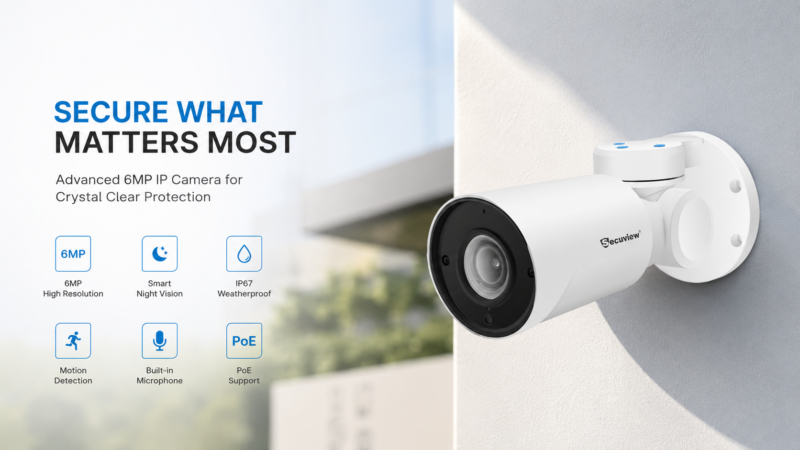
Key Features: – 6MP resolution, FHD 3840×2160 – 5x optical zoom with auto-focus motorized lens (2.7–13.5mm) – 180° pan, 55° tilt network PTZ control – IP66 weatherproof housing, 4000V lightning protection – ONVIF 2.6 and RTSP compatible, H.265/H.264 dual-stream – IR night vision up to 20–30 meters – Two-way audio
2. Secuview WiFi Indoor 2K PTZ Baby Monitor Camera
For a different priority entirely — checking on one specific indoor space like a nursery or a small office — this brings pan-tilt-zoom flexibility to a single-room setup rather than a large open area.
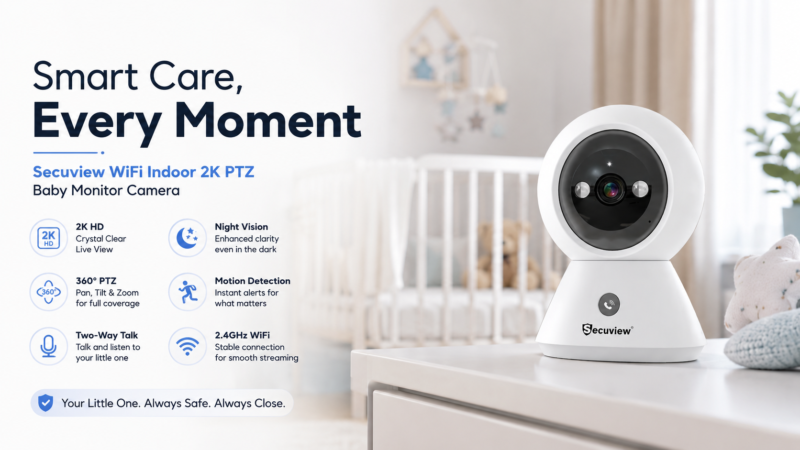
Key Features: – 2K resolution – 355° pan, 90° tilt, with zoom – Two-way audio and one-touch call – Smart motion detection with designated-zone alerts – Local TF card storage – 2.4G/5G WiFi
3. Secuview WiFi Indoor 5MP PTZ Baby Monitor Camera
A higher-resolution alternative for the same room-monitoring use case, with sharper 5MP detail for a nursery, office, or general indoor space.
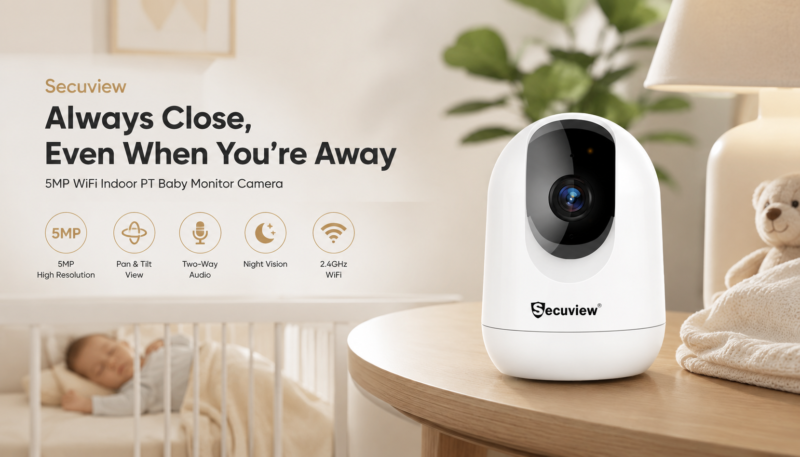
Key Features: – 5MP resolution – 355° pan, 60° tilt, with zoom – Two-way audio – Infrared night vision – Live view and video playback, multi-person sharing – 2.4G/5G WiFi
FAQ – Common PTZ Camera Questions
What is a PTZ camera used for?
PTZ cameras are used to cover large or multi-zone areas — warehouses, parking lots, retail floors, stadiums — where one moving camera can patrol several points instead of installing a fixed camera at each one.
What is the difference between an IP camera and a PTZ camera?
A standard IP camera is fixed in one position with a static field of view. A PTZ camera is a specific category that can physically pan, tilt, and zoom — most modern PTZ units are also IP cameras in terms of how they connect to the network, but not every IP camera is a PTZ.
What is the disadvantage of a PTZ camera?
The main disadvantage is that a PTZ can only actively watch one position at a time — while it’s patrolling toward or away from a zone, that zone isn’t being recorded, and PTZ units also cost more and have more mechanical parts that can wear out than fixed cameras.
What is the difference between a fixed camera and a PTZ camera?
A fixed camera has no moving parts and records one unchanging field of view continuously. A PTZ camera physically moves and zooms, trading constant single-point coverage for the ability to cover multiple zones from one unit.
Can PTZ cameras work with NVR systems?
Yes — most PTZ cameras are IP-based and connect to an NVR the same way a standard IP camera does, over Cat6/PoE, typically with ONVIF support for compatibility.
Do PTZ cameras work at night?
Yes, PTZ cameras with infrared or low-light-rated sensors work at night, though low-light performance varies by model and matters more for PTZ than fixed cameras since it needs to hold up across every position in its patrol route, not just one.
Can a single PTZ replace multiple fixed cameras?
Yes, for areas where continuous simultaneous coverage of every zone isn’t required — a PTZ patrolling between preset positions can functionally replace three or four fixed cameras watching those same points, provided occasional sequential rather than constant coverage of each zone is acceptable.
When does it make more sense to install one PTZ camera instead of several fixed ones?
When the area is large or open with multiple zones of interest, when budget favors one higher-cost unit over several separate fixed cameras plus their NVR channels and cabling, and when the specific points being watched don’t all need continuous simultaneous recording at once.