Scroll through enough camera listings and the same model sometimes gets called “4K” in one place and “8MP” in another, which raises a fair question: are these the same thing, or is one actually better? The short answer is that they’re extremely close, but not automatically identical, and the label alone doesn’t tell you as much as checking the actual specification behind it.
4K vs 8MP Security Cameras: Understanding the Difference
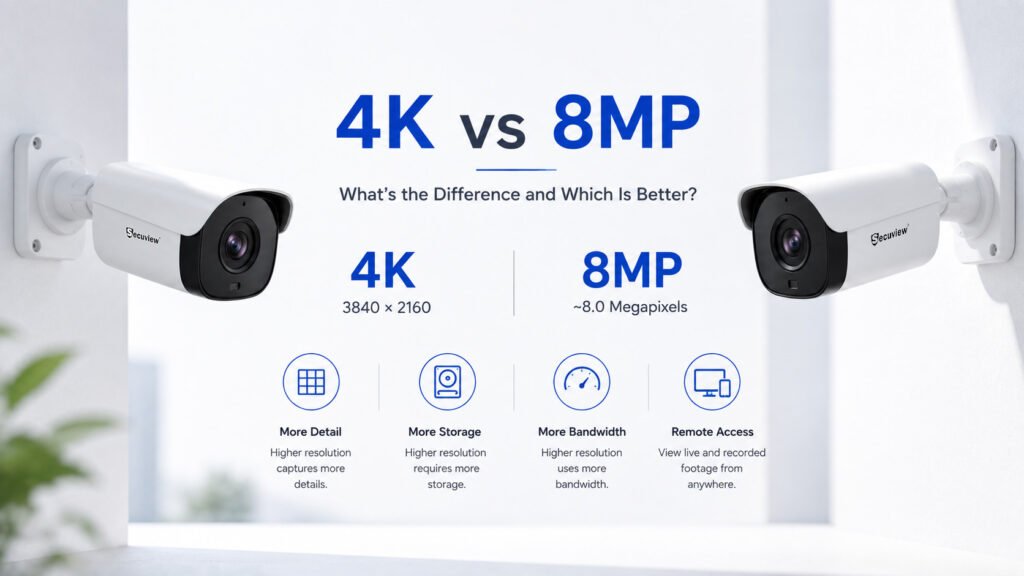
4K is a video resolution standard, specifically 3840 × 2160 pixels, a fixed 16:9 frame that the term “4K” always refers to, regardless of manufacturer. 8MP means “8 megapixels”, a raw pixel-count figure, roughly 8 million pixels total, that doesn’t by itself guarantee a specific frame shape. Here’s why the two get used interchangeably so often: 3840 × 2160 works out to exactly 8,294,400 pixels, call it 8.3 megapixels. A sensor built at that exact resolution can honestly be marketed as either “4K” or “8MP,” and most modern security cameras at this tier are built that way on purpose, specifically so both labels apply. That’s genuinely why the terminology feels confusing rather than misleading; the overlap is real, not just a marketing trick.
Is 4K the Same as 8MP?
Not automatically, and this is the detail worth checking before assuming otherwise. “4K” always means 3840 × 2160. “8MP” only means approximately 8 million pixels — a sensor could reach that pixel count at a different aspect ratio (3264 × 2448, a 4:3 shape common on some older or budget sensor designs, works out to roughly 8 megapixels too, but is not 4K and not 16:9). Manufacturers use both terms because most current 8MP security camera sensors genuinely are built at the 3840 × 2160 standard — but “8MP” on a spec sheet doesn’t guarantee that shape the way “4K” does. The practical takeaway: check the actual pixel dimensions listed, not just whichever label happens to be on the box.
4K vs 8MP Security Cameras: Key Differences
| Factor | 4K Security Camera | 8MP Security Camera |
|---|---|---|
| Meaning | A fixed resolution/video standard | An approximate pixel count |
| Typical resolution | 3840 × 2160 | Often close to 3840 × 2160, not guaranteed |
| Pixel count | ~8.3MP | ~8MP |
| Image detail | High | High |
| Storage requirement | Higher | Higher |
| Bandwidth requirement | Higher | Higher |
| Best comparison method | Actual resolution + full specification | Actual resolution + full specification |
What Actually Affects Security Camera Image Quality?
Resolution is one factor among several, and not always the deciding one. Image sensor quality, the physical size and quality of the sensor capturing light, affects real-world image quality as much as raw pixel count does; a larger, better sensor at a lower resolution can outperform a cramped, cheap sensor crammed with more pixels. Lens quality and focal length determine how sharp the image actually is before it even reaches the sensor, and how wide or narrow the coverage is. Field of view trades coverage area against per-pixel detail; a wider view spreads the same pixel count across more area, reducing detail on any one part of the frame. Bitrate and video compression (H.264 vs H.265, covered in full in the guide to how IP cameras work) determine how much of that resolution actually survives into the stored file rather than being compressed away. WDR and dynamic range affect how well the camera handles scenes with both bright and shadowed areas in the same frame. Low-light performance and night vision/infrared quality often matter more for actual usability than daytime resolution alone, since most incidents worth reviewing happen when lighting is imperfect, not in ideal daylight.
4K vs 8MP Security Cameras: Storage and Bandwidth
Higher resolution directly means more data per frame, which means more storage per hour and more network bandwidth per stream; the same underlying math covered in full, with a worked example by camera count, in Secuview’s guide to NVR storage planning. At the 4K/8MP tier specifically, that math shifts meaningfully higher than a standard 2-5MP camera would need, which makes H.265 compression (also covered in the IP camera guide) less optional and more essential at this resolution tier, since the storage savings compound directly with every additional 4K/8MP channel added to a system. Network bandwidth matters the same way multiplied across cameras; several 4K streams sharing one switch can approach the ceiling of a Fast Ethernet connection, which is exactly why Gigabit is the safer default at this resolution tier. Retention period: how many days of footage need to stay accessible is the final multiplier on top of all of this, and it’s worth planning deliberately rather than discovering the hard way that a drive filled faster than expected.
4K vs 8MP: Digital Zoom and Image Detail
Does higher resolution improve digital zoom? Yes, meaningfully, digital zoom crops into the existing image rather than adding new detail, so starting from more raw pixels means there’s more image left to crop into before quality visibly degrades. Why lens and camera placement still matter more than resolution alone: a high-resolution sensor behind a poor lens, or mounted too far from what actually needs identifying, won’t outperform a lower-resolution camera placed and lensed correctly. Identification distance vs resolution: more pixels genuinely extend the distance at which a face or plate stays legible, but that relationship isn’t linear — doubling resolution doesn’t double usable identification distance, since lens quality and lighting cap how much that extra pixel count can actually deliver.
4K vs 8MP Security Cameras for Different Properties
- Homes and villas: 4K/8MP is generally more resolution than most single-room or entrance positions need, though it’s worth it at a main gate where identification detail matters
- Apartments: similar reasoning — high value at the front door, less necessary for general interior coverage
- Offices: worth prioritizing at reception and entry points; standard resolution is usually sufficient for general interior monitoring
- Retail stores: valuable at tills and entrances specifically, for the same identification-detail reasoning
- Warehouses: high resolution earns its cost covering wide areas where a single camera needs to hold detail across real distance
- Parking areas and driveways: a strong fit — license plate legibility at distance is exactly what extra resolution is for
- Outdoor commercial properties: generally the strongest case for 4K/8MP, combining wide coverage with a genuine need for identification-level detail
4K vs 8MP Security Cameras for Outdoor Surveillance
Resolution alone doesn’t carry outdoor performance; night vision and low-light image quality matter as much or more after dark, since a high daytime resolution doesn’t automatically translate to a clear night image. Weather and environmental protection (IP and IK ratings) are resolution-independent requirements covered in full in the outdoor camera climate guide — a 4K camera with inadequate weatherproofing is still a poor outdoor choice regardless of resolution. Camera placement and viewing distance determine whether that extra resolution is actually being used for anything, and power and network connectivity — PoE range, WiFi signal, or 4G coverage depending on the installation — need to support the higher bandwidth a 4K/8MP stream actually requires, covered across Secuview’s PoE, WiFi, and 4G camera guides.
What to Consider Before Buying a 4K or 8MP Security Camera
Beyond resolution itself, the full checklist worth going through: image sensor quality, lens and field of view (including whether a varifocal lens is worth the adjustability at this resolution tier), night vision performance, WDR, frame rate, bitrate and compression, NVR compatibility and ONVIF support for multi-brand flexibility, storage capacity planning per the calculation above, PoE and network connectivity, AI detection and smart features, and whether the specific model is rated for indoor or outdoor installation.
Where to Buy 4K Security Cameras in Qatar
Before purchasing, confirm NVR and network infrastructure compatibility — a 4K camera needs a recorder and switch capable of handling its actual bandwidth and storage demands, not just enough channels — and plan storage and installation around the retention period actually needed. Secuview’s 4K and 8MP-tier cameras, including the 8MP Varifocal Lens Outdoor IP Camera and the 8MP Indoor IP Camera, are available directly through Secuview’s online store.
4K vs 8MP Security Cameras: Which Is Better?
Choose 4K/8MP for high-detail surveillance when: identification-level detail genuinely matters, the area being covered is wide enough that pixel density needs to be spread across real distance, digital cropping into footage after the fact is likely to be needed, or high-resolution recording is simply a stated priority for the installation.
Weight other specifications more heavily when: night performance matters more than daytime resolution, the camera is covering a small, well-defined area where extra pixels add little, lighting conditions are consistently difficult, or storage and bandwidth are genuinely constrained.
Conclusion
4K and 8MP describe nearly the same resolution in practice, and neither one is automatically the better choice — a sensor built at 3840 × 2160 can honestly wear either label, which is exactly why the terminology gets confusing rather than deceptive. What actually determines real-world performance is the full specification behind the label: sensor quality, lens, lighting handling, bitrate, storage planning, and correct installation. The resolution number on the box is a starting point, not the whole answer. Match the camera to what the specific position actually needs to achieve, not to whichever label sounds more impressive.
Frequently Asked Questions
Is 8MP better than 4K for security cameras?
Neither is inherently better. Most 8MP security camera sensors are built at the same 3840×2160 resolution that defines 4K, making the two effectively identical in most real-world products.
Is 4K the same as 8MP?
Very close, but not guaranteed to be identical. 4K always means 3840×2160, while “8MP” only guarantees roughly 8 million pixels, which could technically describe a different aspect ratio in some cases.
Does an 8MP security camera use more storage?
Yes. An 8MP camera generally has roughly the same higher storage demand as a 4K camera because both describe approximately the same pixel count and resulting video file size.
Is 4K CCTV worth it?
For positions needing identification-level detail across real distance, such as gates, driveways, and wide entrances, 4K can be worth it. For smaller, well-defined areas, a lower resolution is often sufficient and more storage-efficient.
What is more important than megapixels in a security camera?
Sensor quality, lens quality, low-light performance, and correct camera placement can affect real-world image quality as much as or more than raw resolution alone.
Is 4K good for outdoor security cameras?
Yes, particularly for wide-coverage outdoor positions, provided the camera also has suitable night vision performance and an appropriate weatherproof rating. Resolution alone does not determine outdoor performance.
How much storage does a 4K security camera need?
A 4K security camera generally needs more storage than a standard-resolution camera for the same retention period. The exact requirement depends on factors such as bitrate, compression, recording mode, and retention time.
Does 4K CCTV require more bandwidth?
Yes. Higher-resolution video streams require more network throughput. This is one reason Gigabit network infrastructure is a safer default for systems using multiple 4K cameras.
Is 8MP enough for home security?
Yes. For most homes, 8MP provides more than enough resolution for general security coverage. It is particularly useful at important locations such as main entrances and gates where identification-level detail matters.
Can 4K and 8MP cameras work with the same NVR?
Generally, yes, provided the NVR supports the required camera resolution and channel count. When cameras and the recorder are from different brands, compatible standards such as ONVIF can also be important for interoperability.
What is the difference between 4K and 8MP CCTV cameras?
4K is a specific resolution standard of 3840×2160 pixels, while 8MP is an approximate pixel-count specification. An 8MP camera usually uses a resolution close to 4K, but the terms do not automatically guarantee the same resolution.
Where can I buy high-resolution security cameras in Qatar?
High-resolution security cameras are available online from Secuview Ecom, which carries 4K and 8MP-tier IP cameras alongside a wider range of security and surveillance products.