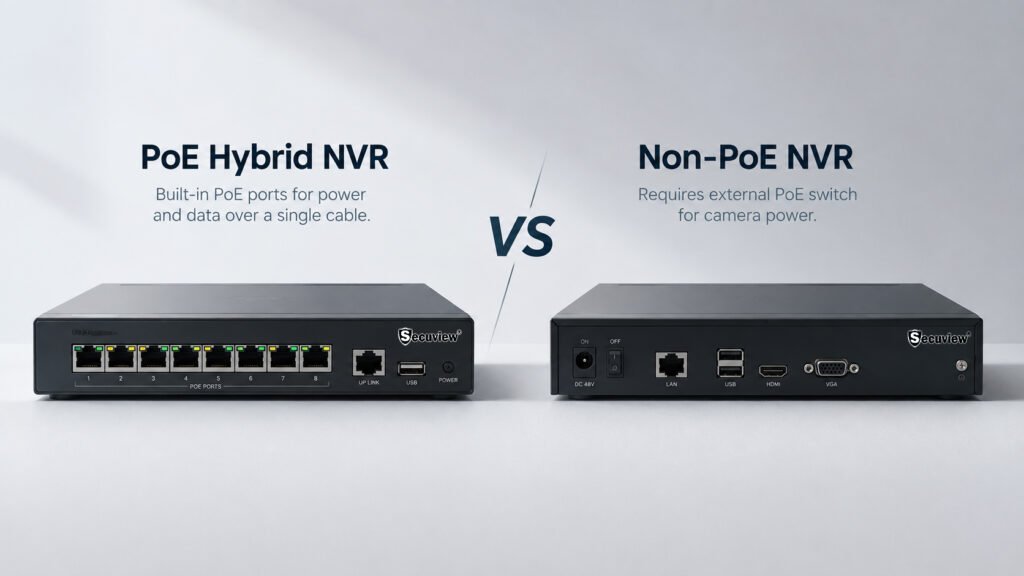
An NVR’s job in an IP camera system is straightforward: receive footage from every connected camera, record it, and make it available for live viewing and playback. Where things actually diverge is in how the cameras connected to it get their power and network access in the first place — and that single distinction is the entire difference between a PoE Hybrid NVR and a Non-PoE NVR. This guide covers PoE ports, power delivery, cabling, installation, compatibility, scalability, and cost, to make that one real difference concrete rather than abstract — relevant whether the installation is a Doha villa, an office in Lusail, or a warehouse in the Sana’iya industrial area.
What Is a PoE Hybrid NVR?
NVR stands for Network Video Recorder — the device that receives IP camera footage over the network, manages every connected camera, and handles recording and playback, covered in full in how NVR systems actually work. “Hybrid” here means the recorder supports IP/network camera input with broader compatibility across brands, typically through ONVIF and RTSP where the specific model supports them — though compatibility should always be checked model by model rather than assumed, the same caution covered in what ONVIF compatibility actually guarantees. PoE on an NVR means the unit has built-in ports that supply both power and data to connected cameras over a single Ethernet cable; the same underlying standard explained in full in why PoE matters for IP cameras.
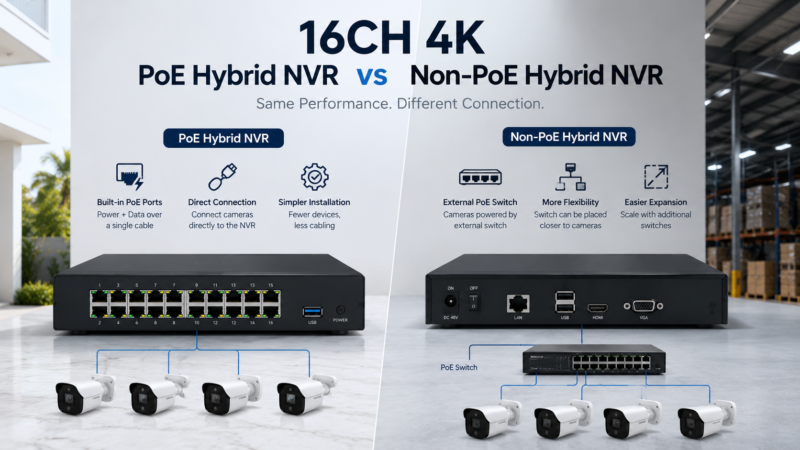
How it works, step by step: camera → Ethernet cable → PoE port → NVR → recording and network access. Power delivery and video transmission both travel down that same cable; the NVR handles camera communication and recording simultaneously, and network management for every connected camera runs through the same unit. A 16CH 4K PoE Hybrid NVR is available in the CCTV camera system range built specifically around this architecture.
What Is a Non-PoE NVR?
A Non-PoE NVR still records and manages IP cameras — it simply doesn’t supply power to them.
How it connects: IP camera → PoE switch → LAN → NVR, with the switch handling power delivery separately from the NVR’s recording function.
Why cameras still need power somehow: the NVR handles recording, but each camera still requires power from somewhere — an external PoE switch, a PoE injector, or another supported power source.
Can a Non-PoE NVR work with PoE cameras? Yes, where the network is set up to support it — the external switch supplies camera power, the NVR handles recording, and camera-to-NVR compatibility still needs confirming the same way it would on any system.
PoE Hybrid NVR vs Non-PoE NVR: What Actually Changes?
Built-in PoE ports. A PoE Hybrid NVR connects cameras directly through its own ports; a Non-PoE NVR has no such ports and depends entirely on external power infrastructure.
Camera power delivery. On a PoE model, power comes from the NVR itself, within its power budget — the same power-budget concept covered in the PoE switch guide, since the underlying math is identical whether that budget lives inside the NVR or inside a separate switch. On a Non-PoE model, power comes from wherever the external switch or injector supplies it, entirely separate from the recorder.
Network architecture. PoE Hybrid: camera → NVR PoE port → NVR, a more integrated setup. Non-PoE: camera → PoE switch → LAN → NVR, a more distributed one — and that extra step is precisely what gives a Non-PoE setup more network flexibility, since the switch can sit closer to a cluster of cameras rather than every cable running all the way back to the recorder itself.
Cabling and installation. A PoE Hybrid NVR generally means simpler, more direct installation for cameras near the recorder. A Non-PoE setup needs the additional switch as a planned part of the installation, which adds a step but also adds flexibility for cameras spread across a larger property.
Setup and configuration. Both support camera discovery and IP addressing, and plug-and-play setup where compatibility allows — a Non-PoE system simply has one more device (the switch) in that configuration chain.
Scalability and expansion. A PoE Hybrid NVR’s expansion is capped by its own built-in port count and power budget. A Non-PoE setup expands by adding external switches, which can mean more total flexibility for larger or growing systems, at the cost of more equipment to plan around.
Cost and equipment. A PoE Hybrid NVR bundles the switch function into one device. A Non-PoE NVR costs less on its own but requires a separate PoE switch purchase to actually power cameras — the real total cost comparison needs to include that switch, not just the recorder price alone.
PoE vs Non-PoE NVR: Side-by-Side Comparison
| Feature | PoE Hybrid NVR | Non-PoE NVR |
| IP camera recording | Yes, subject to compatibility | Yes, subject to compatibility |
| Built-in PoE ports | Yes | No |
| Camera power from the NVR | Through supported PoE ports | No |
| External PoE switch | May not be needed for direct connections | Often needed for PoE cameras |
| Installation | Simpler for direct connections | More flexible network architecture |
| Network architecture | More integrated | More flexible |
| Expansion | Depends on built-in PoE/network design | External switching can add flexibility |
| Best suited for | Straightforward installations | Custom or distributed networks |
Exact specifications vary by model — worth verifying against the specific unit being considered rather than assuming every PoE Hybrid or Non-PoE NVR behaves identically.
How Does a PoE NVR Power Security Cameras?
Power and data travel over the same Ethernet cable, the same principle explained in full in how Power over Ethernet actually works. The PoE power budget — the total wattage the NVR can supply across every connected port combined — determines how many cameras it can actually power, not just how many ports it physically has. A camera drawing more power than the remaining budget allows simply won’t receive full power, which is exactly why PoE standards (802.3af, 802.3at, and higher-power variants) and camera compatibility both matter before assuming a given camera count will work.
How Does a Non-PoE NVR Work With PoE Cameras?
An external PoE switch sits between the cameras and the NVR, handling power while the recorder handles video and storage — camera → switch → NVR, with IP addressing and camera discovery happening at the network level regardless of which device supplies power. This separation genuinely makes sense in a few real situations: distributed camera networks spread across a larger property, installations already built around managed switches, or anywhere avoiding the PoE port-count and power-budget limits of a single NVR matters more than installation simplicity.
Does PoE Affect 4K Security Camera Video Quality?
No — PoE provides power and network connectivity, nothing about image quality. What actually determines 4K recording quality is camera resolution, the NVR’s own recording capability, bitrate, compression, network bandwidth, and storage — all covered in full in 4K vs 8MP security camera resolution explained. This distinction matters specifically because a “4K NVR” doesn’t automatically mean every connected camera records at 4K — a 4K-capable recorder supports that resolution, but each camera still needs to actually be a 4K-resolution model itself for that channel to record at 4K.
16CH 4K PoE Hybrid NVR vs 16CH 4K Non-PoE Hybrid NVR
What 16CH means: 16 recording channels — the number of camera feeds the unit can record simultaneously, which is a separate number from how many of those connections include built-in PoE power.
What 4K support means: the recorder can accept, record, and play back 4K-resolution input — covering camera input capability, recording resolution, playback, bandwidth, and storage demand at that resolution tier.
What changes with built-in PoE: power delivery, direct camera connections, cabling requirements, network design, installation steps, and overall equipment needed.
What doesn’t change: the NVR’s core recording function, channel planning, storage requirements, camera compatibility, supported resolution, and codec requirements — these stay identical between the PoE and Non-PoE versions of the same 16CH 4K model, since both are still fundamentally the same recording device.
PoE Hybrid NVR vs Non-PoE NVR for Different Installations
- Home CCTV systems (houses, villas, small properties): entrances and driveways generally favor the simpler, more direct PoE Hybrid setup
- Offices: reception areas and entry points work well on either, with multiple rooms and restricted areas sometimes benefiting from a Non-PoE system’s distributed flexibility
- Retail stores: sales areas and entrances suit direct PoE connections; stockrooms and cashier areas depend more on actual camera positioning relative to the recorder
- Warehouses: loading zones and large coverage areas, where cameras are spread across real distance, tend to favor a Non-PoE architecture with switches positioned closer to camera clusters
- Commercial properties: larger deployments generally lean Non-PoE for the network flexibility scaling requires
- Multi-building or distributed systems: external PoE switches and centralized network architecture make Non-PoE the more natural fit almost by default
Buying a PoE or Non-PoE NVR in Qatar
For homes and villas — entrances, driveways, gates, perimeters — a straightforward PoE Hybrid setup usually covers the need without added complexity. Offices and retail in Doha typically split between employee and customer areas, where camera positioning relative to the recorder decides which architecture fits better. Warehouses and commercial properties covering loading areas, storage, and perimeters lean toward the flexibility a Non-PoE, switch-based network provides. Qatar’s environment adds its own layer regardless of architecture choice — high temperatures and dust affect outdoor camera housing and network equipment placement the same way covered in the outdoor camera climate guide, and night-time performance depends on the cameras themselves rather than the recorder’s power architecture. The full range — PoE Hybrid NVRs, Non-PoE NVRs, 4K models, and compatible IP cameras — is available through the online CCTV store.
When Should You Choose a PoE Hybrid NVR?
Choose PoE Hybrid when installation simplicity matters, direct camera connections are preferred, integrated power and data appeal over managing separate equipment, cameras sit relatively close to the recorder, fewer separate network devices is the goal, and the camera count comfortably fits available PoE ports within the power budget.
When Should You Choose a Non-PoE NVR?
Choose Non-PoE when existing network infrastructure — including an existing PoE switch — is already in place, cameras are distributed around a larger property, flexible network architecture matters more than simplicity, managed switches are already the preferred approach, or separating camera networking from the NVR itself is a deliberate design choice.
Can You Use an External PoE Switch With a PoE NVR?
Yes — and it’s a genuinely common way to expand beyond a PoE Hybrid NVR’s built-in port count, supporting distributed camera networks the built-in ports alone couldn’t reach. The main network design consideration is avoiding channel, bandwidth, or power limitations once an external switch is added into what was originally a self-contained PoE setup.
What to Check Before Buying a PoE or Non-PoE NVR
Number of recording channels, supported camera resolution, recording and playback resolution, incoming network bandwidth, PoE port count and power budget (on PoE models), ONVIF and RTSP compatibility, supported video compression (H.264, H.265, and any model-specific codecs), HDD capacity, network ports and connectivity, remote viewing and mobile access, AI and smart detection compatibility, room for future expansion, and warranty and technical support.
Common Mistakes When Choosing an NVR
Assuming 16CH means 16 PoE ports — channel count and PoE port count are two separate numbers that don’t have to match.
Assuming a 4K NVR works with every 4K camera — resolution support and actual camera compatibility are separate checks, covered above.
Ignoring the PoE power budget — enough ports doesn’t guarantee enough total wattage.
Ignoring network bandwidth — especially relevant at higher resolutions, covered in the 4K vs 8MP comparison.
Not checking ONVIF compatibility before assuming cross-brand cameras will work.
Forgetting future camera expansion, leaving no room to grow without a full replacement.
Choosing only based on price, without weighing the total system cost — including any external switch a Non-PoE model will need.
PoE Hybrid NVR vs Non-PoE NVR: Which One Is Better?
PoE Hybrid NVR is better when: simple installation is the priority, direct connections are preferred, integrated power genuinely simplifies the setup, and the system as a whole is relatively straightforward.
Non-PoE NVR is better when: infrastructure already exists, cameras are spread across a distributed layout, external switches are already the preferred approach, and network flexibility matters more than installation simplicity.
The right choice depends on property size, where cameras actually need to sit, the network architecture already in place or planned, installation requirements, expansion plans, and budget — including the full system cost, not the recorder price in isolation.
Conclusion
The biggest difference isn’t how the NVR records video — both record compatible IP cameras identically well. It’s how the cameras connect to the network and receive power. PoE means integrated power and network connectivity in one device; Non-PoE means separate camera power and network infrastructure, built around an external switch. Both are legitimate, well-established architectures, and the actual specifications of the specific model under consideration determine real capability more than the PoE/Non-PoE label alone. The right choice comes down to system architecture — how the property is laid out, and how the cameras actually need to connect — not a fixed rule that one is universally better.
Frequently Asked Questions
What is the difference between a PoE NVR and a Non-PoE NVR?
A PoE NVR has built-in ports that power connected cameras directly. A Non-PoE NVR records and manages cameras but requires a separate power source, usually an external PoE switch.
Is a PoE Hybrid NVR better than a Non-PoE NVR?
Neither is universally better. A PoE Hybrid NVR suits simpler, more direct installations, while a Non-PoE NVR suits distributed camera networks that need more network flexibility.
Can I use PoE cameras with a Non-PoE NVR?
Yes. You can use PoE cameras with a Non-PoE NVR through an external PoE switch that supplies power to the cameras while the NVR handles recording.
Do I need a PoE switch for a Non-PoE NVR?
Generally, yes, if the cameras are PoE-powered. The external PoE switch supplies power to the cameras because the Non-PoE NVR itself does not provide PoE power.
Do I need a PoE switch if my NVR already has PoE ports?
Not for cameras connecting directly to the NVR’s built-in PoE ports. An external PoE switch becomes relevant when you need to expand beyond the NVR’s available PoE port count or distribute cameras across a larger network.
Does PoE affect 4K camera quality?
No. PoE affects power and network connectivity, not the camera’s image quality. Image quality is determined by factors such as resolution, bitrate, sensor performance, lens quality, and compression settings.
Can a PoE NVR power all connected cameras?
Only if the total camera power requirements remain within the NVR’s PoE power budget. Having enough PoE ports does not necessarily mean there is enough total wattage to power every connected camera simultaneously.
What happens if the PoE power budget is exceeded?
If the total power demand exceeds the NVR’s PoE budget, additional cameras may not receive sufficient or reliable power. This can result in camera instability, disconnections, or failure on affected ports.
What does 16CH mean on an NVR?
16CH means the NVR has 16 recording channels, indicating the number of camera feeds it can record at once. The channel count is separate from the number of built-in PoE ports.
Does a 16CH NVR support 16 cameras?
Generally, yes, for recording. However, the number of cameras the NVR can directly power depends on its separate PoE port count and total PoE power budget, not the channel number alone.
Is a 4K NVR compatible with 8MP cameras?
Generally, yes. 4K and 8MP describe approximately the same resolution range, but compatibility should still be confirmed against the specific NVR and camera specifications, including supported resolution and encoding formats.
Can I connect cameras through an external network switch?
Yes. An external network or PoE switch can connect cameras to a Non-PoE NVR, and it can also be used to expand a PoE Hybrid NVR setup beyond the recorder’s built-in ports.
Is PoE easier to install than Non-PoE?
For cameras connecting directly to the recorder, PoE is generally easier because power and data can be delivered over a single Ethernet cable. A Non-PoE setup typically requires planning and installing a separate switch when using PoE cameras.
Which NVR is better for a home CCTV system?
A PoE Hybrid NVR generally suits most home CCTV installations because it provides a simpler, more direct setup for typical residential camera counts while still offering flexibility for network-connected cameras.
Which NVR is better for a business or warehouse?
A Non-PoE setup is often preferable for businesses and warehouses, particularly where cameras are distributed across a larger area and network flexibility, centralized switching, and scalable infrastructure are more important than having cameras connect directly to the recorder.
Which NVR is suitable for a villa or home in Qatar?
A PoE Hybrid NVR is suitable for most villa installations because it provides a straightforward setup for directly connected cameras. A Non-PoE, switch-based setup is worth considering for larger properties where cameras are distributed across multiple areas and greater network flexibility is required.