
Choosing an outdoor surveillance system involves more than picking a high-resolution camera. The installation site, weather, viewing distance, connectivity, power source, storage, and detection features all affect which model will work best.
Key Takeaways
- Choose equipment rated for exterior conditions.
- Match the lens and resolution to the area you need to monitor.
- Select PoE, WiFi, 4G LTE, battery, or solar power based on the site.
- Plan recording capacity before installing several cameras.
- Consider night vision and smart detection for after-dark monitoring.
- Match the system to the property, not only to the camera specifications.
What Is an Outdoor Security Camera?
An outdoor security camera is meant to monitor areas exposed to weather and changing environmental conditions. Can be used around houses, villas, shops, warehouses, construction sites, parking lots, and commercial buildings.
The indoor equipment is unaffected by the environment, but the outdoor camera is. And that’s where the enclosure and environmental rating come into play.
Some common locations for surveillance are at entrances, gates, driveways, boundary walls, gardens, car parking, and loading areas. The camera choice depends on the conditions where it is mounted.
How Does an Outdoor Surveillance Camera Work?
It is common for most modern systems to have video communication using IP connectivity from the camera to the recorder.
The basic process is
Camera → Network → Recorder or Cloud → Mobile Device / Monitor
Network cameras can capture and transmit video over Ethernet, Wi-Fi, or cellular networks. Compatible network video recorders can record multiple IP cameras simultaneously.
Some even have SD card recording.
Remote access means you can view your camera remotely from any computer. This allows authorized users to view the live or recorded videos through a mobile app or website.
Types of Outdoor Security Cameras
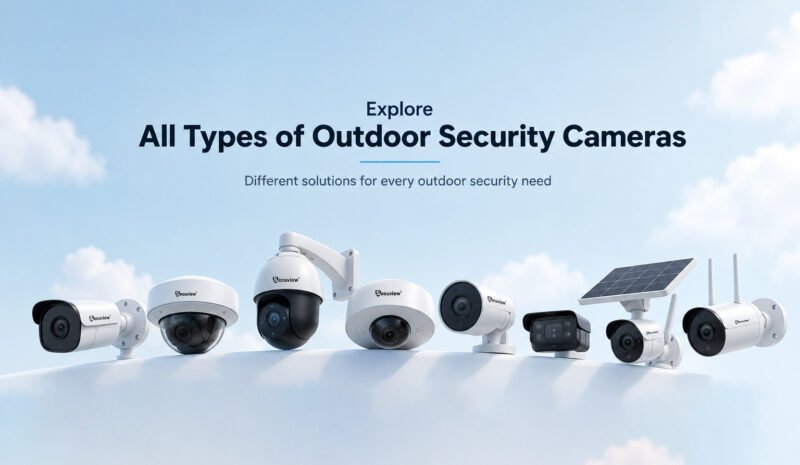
types of outdoor security cameras
Bullet Outdoor Security Cameras
The bullet type has a noticeably long casing and is mostly suitable for entrances, driveways, walls, and open spaces. Its structure may help indicate the direction in which it is monitoring.
Dome Outside Surveillance Cameras
Dome cameras use a compact, rounded housing. They can be useful where a smaller or less obvious camera design is preferred.
PTZ Exterior Monitoring Cameras
Pan-tilt-zoom cameras can move horizontally and vertically and adjust their optical zoom. PTZ models are useful for larger areas where one unit needs to monitor several directions.
Panoramic Exterior Security Cameras
Panoramic models provide a broad field of view. They can help monitor large scenes where a wide perspective is more useful than a narrow viewing angle.
Varifocal Lens Outside Cameras
A varifocal lens allows the focal length to be adjusted. This can help when the exact viewing distance is not known before installation or when a scene needs more precise framing.
License Plate Recognition Cameras
LPR cameras are designed for vehicle monitoring and license plate capture. They are a specialized option for gates, parking entrances, roads, and controlled vehicle access.
Solar-Powered Security Cameras
Solar models combine a camera with a solar panel and rechargeable battery. They can be practical where running electrical cables is difficult.
4G LTE Surveillance Cameras
A 4G camera uses a cellular network instead of a fixed broadband connection. This makes it useful for construction sites, remote properties, temporary locations, and other areas without suitable wired internet.
What Features Should You Check Before Buying?
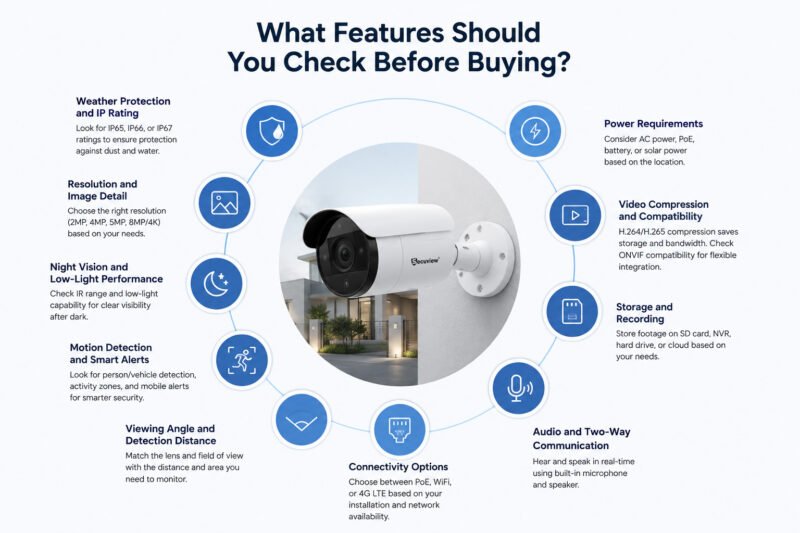
cctv camera-features-should-you-check-before-buying
Weather Protection and IP Rating
Check the camera’s IP rating before installing it outside. Ratings such as IP65, IP66, and IP67 indicate different levels of protection against dust and water.
The rating should match the exposure at the installation point. A camera placed under a roof may face different conditions from one mounted directly beside an open gate.
Resolution and Image Detail
Resolution affects how much visual detail the camera can capture. Common choices include 2MP, 4MP, 5MP, and 8MP or 4K.
Higher resolution can provide more detail, but it can also increase storage and bandwidth requirements. Resolution should therefore be matched with viewing distance, lighting, lens choice, and the purpose of monitoring.
Night Vision and Low-Light Performance
Outdoor areas can become difficult to monitor after sunset. Infrared LEDs can provide black-and-white night footage, while some cameras offer color night vision when enough light is available.
Check the stated IR range, low-light performance, nearby lighting, and the scene you need to capture. A high-resolution sensor cannot replace suitable lighting.
Motion Detection and Smart Alerts
Motion detection can help flag activity without users having to watch live video all the time.
More sophisticated systems can include person detection, vehicle detection, activity zones, and mobile alerts. These elements can reduce false alerts and help to review important events.
Viewing Angle and Detection Distance
The lens dictates the coverage and detail visibility that the camera can offer at different distances.
For example, a wide-angle lens will give a wider field of view, but a narrower view will give more detail on the distant object. How lens, field of view, coverage, and distance interact is an important consideration before choosing the camera.
Connectivity Options
Outdoor surveillance systems can use different network methods.
PoE uses one Ethernet cable to carry power and network data. WiFi can simplify installation where reliable wireless coverage is available. 4G LTE can provide connectivity in locations without a suitable fixed network.
The best choice depends on the available cables, the reliability of the network, the installation conditions, and the distance from the main recording equipment.
Audio and Two-Way Communication
Some security cameras include a microphone and speaker. One-way audio can let you hear activity near the camera, while two-way talk allows communication through the connected mobile app.
This can be useful for entrances, gates, deliveries, or communicating with people on the property.
Storage and Recording
Footage can be stored on an SD card, NVR, surveillance hard drive, cloud platform, or a combination of these options.
Continuous recording requires more storage than motion-based recording. The number of cameras, resolution, bitrate, frame rate, compression, and retention period also affect capacity.
Video Compression and Compatibility
H.264 and H.265 are common video compression standards. Efficient compression can reduce the amount of storage and network bandwidth required.
If you plan to connect cameras to an NVR, check compatibility. ONVIF support can also be useful when integrating compatible network surveillance equipment from different manufacturers.
Power Requirements
Consider how the camera will receive power before choosing a model.
Options include AC power, PoE, rechargeable batteries, and solar panels. The installation location often determines which method is most practical.
Wired vs. Wireless Outdoor Surveillance Systems
WiFi Security Cameras
WiFi models can be useful where cable installation is difficult. They work best when the camera has a stable wireless signal and a suitable power source.
PoE Security Cameras
PoE systems are useful when reliable wired networking is available. One Ethernet cable can provide both network connectivity and power to a compatible camera.
4G LTE Surveillance Cameras
Cellular models can solve connectivity problems at remote or temporary sites. They require suitable cellular coverage and normally use a SIM-based data connection.
Which Connection Method Fits Your Property?
Choose based on the actual installation conditions. Reliable Ethernet can suit permanent systems, strong WiFi can simplify smaller installations, and 4G LTE can help where fixed networking is unavailable.
How Much Storage Do Outdoor Surveillance Cameras Need?
Storage requirements depend on:
- Number of cameras
- Resolution
- Bitrate
- Frame rate
- Recording schedule
- Retention period
- Video compression
For example, several cameras recording continuously at high resolution will require much more capacity than one camera using motion-based recording.
Before buying an NVR or hard drive, use the CCTV Storage Calculator to estimate your recording requirements.
Cloud, Local, or Hybrid Recording: Which Fits Better?
Local Recording
Local storage can use an SD card, NVR, or surveillance HDD. It keeps recordings at the property and gives the user direct control over the recording equipment.
Cloud Recording
Cloud services store footage remotely and can make remote access easier. They may also provide off-site protection if equipment at the property is damaged or stolen.
Hybrid Recording
Some systems combine local recording with cloud services. This can provide an on-site copy while adding remote access or off-site backup.
The best approach depends on retention needs, internet reliability, privacy preferences, and budget.
Where Should You Install an Exterior Surveillance Camera?
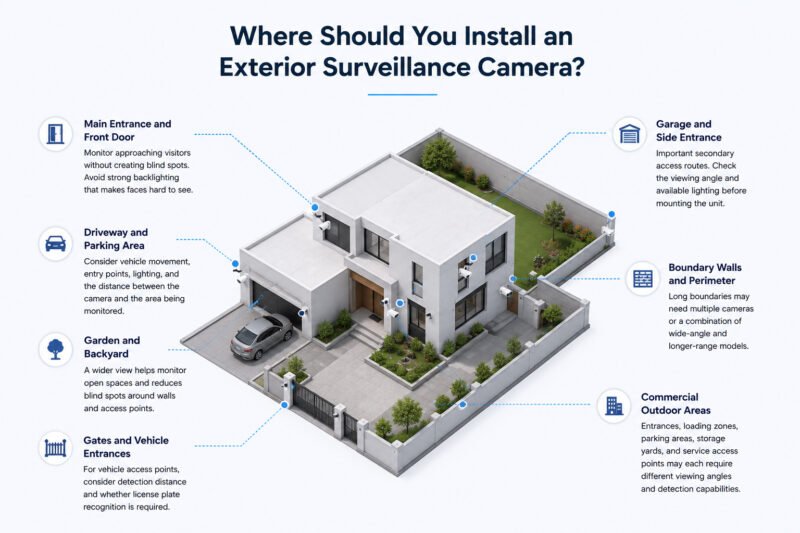
exterior-surveillance-camera
Main Entrance and Front Door
Position the camera to monitor approaching visitors without creating unnecessary blind spots. Avoid placing it where strong backlighting makes faces difficult to see.
Driveway and Parking Area
Consider vehicle movement, entry points, lighting, and the distance between the camera and the area being monitored.
Garden and Backyard
A wider view can help monitor open spaces, while careful positioning can reduce blind spots around walls and access points.
Garage and Side Entrance
These areas can be important secondary access routes. Check the viewing angle and available lighting before mounting the unit.
Gates and Vehicle Entrances
For vehicle access points, consider detection distance and whether license plate recognition is required.
Boundary Walls and Perimeter
Long boundaries may need multiple cameras or a combination of wide-angle and longer-range models.
Commercial Outdoor Areas
Entrances, loading zones, parking areas, storage yards, and service access points may each require different viewing angles and detection capabilities.
Outdoor Surveillance for Different Properties
Villas and Residential Homes
A residential system may cover the main entrance, driveway, garden, garage, gate, and boundary. Camera placement should provide useful views without unnecessary overlap.
Apartment Buildings and Residential Compounds
Shared entrances, gates, parking areas, and common outdoor spaces may require centralized monitoring and multiple cameras.
Shops and Retail Businesses
Storefronts, customer entrances, parking spaces, and delivery areas can benefit from targeted video coverage.
Offices and Commercial Buildings
External access points, parking, building entrances, and perimeter areas are common surveillance zones.
Warehouses and Distribution Centers
Large sites may need long-range views, vehicle monitoring, perimeter coverage, and centralized NVR recording.
Construction Sites
Temporary sites may benefit from battery, solar, or 4G-connected equipment when permanent power and network infrastructure are not available.
Parking Areas and Vehicle Entrances
The camera should be selected according to vehicle distance, lighting, traffic direction, and whether identification is required.
Loading and Unloading Areas
These zones often need clear views of vehicle activity and movement around delivery points.
Outdoor CCTV Installation Considerations
Mounting Height and Viewing Angle
Mount the camera high enough to reduce easy interference while keeping important areas visible. The angle should support useful facial, vehicle, or activity detail.
Power and Cable Access
Plan cable routes before installation. PoE can simplify both power and data delivery when compatible network infrastructure is available.
Network Coverage
Test WiFi strength at the actual camera position rather than relying on the signal near the router.
Protection From Heat, Dust, and Water
Qatar’s climate makes environmental protection particularly important. Choose equipment suited to the location and protect connections and cables from unnecessary exposure.
Outdoor Camera Blind Spots and Overlapping Views
Walk through the property before installation. Check gates, corners, walls, parked vehicles, and other objects that could block the view.
NVR and Recording Equipment Placement
Place the recorder in a secure and suitable location with enough ventilation, storage capacity, and network connectivity.
Future Camera Expansion
If you may add cameras later, choose an NVR and network infrastructure with enough capacity for future expansion.
How to Choose the Right Outdoor Security Camera
Start with the property rather than the camera specification.
- Where will the unit be installed?
- How large is the area?
- How far must it capture useful detail?
- Will it need to work at night?
- What resolution is appropriate?
- Is reliable WiFi available?
- Would PoE provide a better connection?
- Is 4G or solar power needed?
- How many days of footage should be retained?
- Do you need person, vehicle, or plate detection?
- Will you need remote viewing?
- What is the total installation budget?
Answering these questions will narrow the choices and help prevent paying for features that the property does not need.
Outdoor vs. Indoor Security Cameras: What Is the Difference?
Indoor as well as outdoor surveillance cameras are made for different environments.
Indoor cameras are made for an environment that is less exposed to rain, dust, and high temperatures. Outdoor cameras, on the other hand, are meant for tough environments and usually have better protection from the environment.
The viewing environment also varies. While indoor cameras are used to view rooms, hallways, offices, and houses, outdoor cameras usually view entrances, driveways, gates, parking lots, and fences.
If you are also thinking about getting an indoor camera system, here is a list of the best indoor security cameras in Qatar.
Best Outdoor Security Cameras for Different Needs
The right product depends on the installation goal rather than one universal specification.
Best Outdoor Camera for Home and Villa Monitoring
Secuview 6MP Fixed Lens Outdoor IP Camera Auto Tracking & ONVIF.
Look for weather protection, reliable night vision, motion detection, and a viewing angle that matches entrances and outdoor areas.
Best WiFi Security Camera for Outdoor Use
Choose a model with dependable wireless connectivity and a suitable power source where Ethernet cabling is difficult.
Best Solar-Powered Surveillance Camera
Secuview Wireless IP Solar-powered 4G Dual Lens Security Camera
Solar models are useful for locations where running electrical cables is impractical, provided the panel receives enough sunlight.
Best 4G Security Camera for Remote Locations
A 4G model can be suitable for sites without fixed internet, such as construction areas or remote properties.
Best Outdoor Camera for Large Areas
Secuview 8MP Full HD Outdoor IP Camera | Water-proof & ONVIF.
Large sites may benefit from PTZ, panoramic, varifocal, or multiple fixed cameras depending on the required coverage and level of detail.
Keep Reading
For related planning and camera-selection information, explore:
- Indoor CCTV camera resolution guide
- WiFi vs. PoE indoor CCTV cameras
- Cloud vs. local storage for indoor CCTV
- CCTV storage calculator
- Indoor night vision CCTV
- Outdoor Surveillance Camera for Qatar’s Climate
These guides cover related topics in greater depth without repeating the same information on this page.
FAQs About Outdoor Security Cameras
What is the best outdoor security camera?
The best model depends on the installation location, viewing distance, lighting, connectivity, storage, and detection requirements. A camera that works well for a villa may not be suitable for a warehouse or construction site.
What IP rating is best for an outdoor CCTV camera?
IP66 is a common choice for exposed outdoor installations, while IP67 provides a higher level of protection against water exposure. The correct rating depends on the actual environment.
Is 4K worth it for outdoor surveillance?
4K can be useful when you need more image detail, especially across larger areas or important monitoring points. It also creates greater storage and bandwidth requirements.
Are PoE or WiFi cameras better for outdoor use?
Neither is universally better. PoE is useful for permanent installations with Ethernet access, while WiFi can be more convenient where cable routing is difficult and wireless coverage is reliable.
Can outdoor security cameras work in Qatar’s hot weather?
Yes, but the equipment should be designed for the environmental conditions at the installation site. Check the manufacturer’s operating temperature range and environmental protection before installation.
How far can an outdoor camera see at night?
Night-time range varies by camera, lens, sensor, infrared illumination, and surrounding light. The stated IR distance should be treated as a specification to compare, not a guarantee of the same level of usable detail at every distance.
Do outdoor cameras need an NVR?
No. Some models can record to an SD card or cloud service. An NVR becomes more useful when several network cameras need centralized recording and management.
Can an outdoor security camera record without the internet?
A camera using local storage can often continue recording during an internet outage. Cloud recording and remote viewing normally depend on an active internet connection.
How much does outdoor CCTV installation cost in Qatar?
The cost depends on the number of cameras, equipment, cabling, mounting conditions, recorder capacity, and installation complexity. Compare the complete system cost rather than only the camera price.
Where can I buy outdoor security cameras in Qatar?
You can compare suitable surveillance products through the Secuview e-commerce platform or visit the Secuview showroom in Doha to discuss your installation requirements.
Conclusion
Selecting the right outdoor surveillance system begins with the environment and the specific property where it will be applied. Weatherproofing, range, illumination, resolution, communication, energy sources, storage capabilities, and detection capabilities play key roles in determining the final system to choose.
For a villa, some weatherproof cameras can be considered in areas like entry points and borders. For a warehouse or a construction site, networked cameras, range, centralized recording, or 4G can be important.
Before purchasing, one needs to determine the area where the surveillance will take place, the level of detail needed, the method of recording, and finally the networks and energy available. This will make it easy to purchase a relevant system rather than overspending on non-relevant specifications.












2 thoughts on “Outdoor Security Cameras: Things to Know Before Buying”
[…] lens, weather protection, connectivity, storage, and placement should be considered together. The outdoor security camera buying guide covers these selection factors and explains how they work […]
[…] Outdoor Security Camera Buying Guide […]
You must be logged in to post a comment.