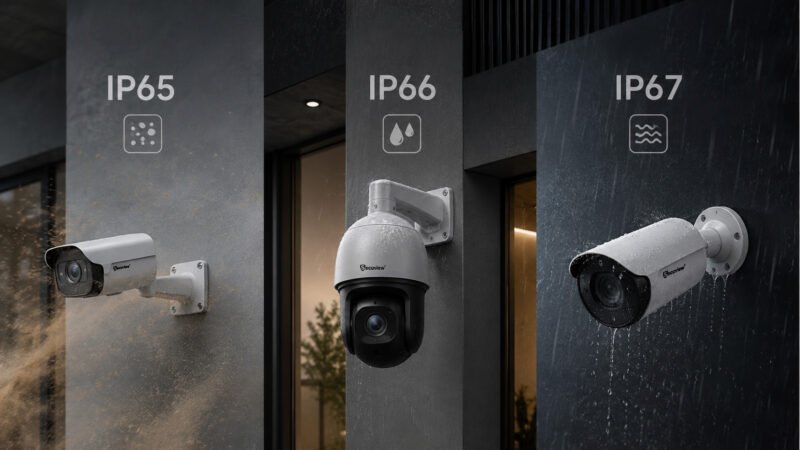
Comparison of IP65, IP66, and IP67 protection ratings for security cameras used in outdoor environments.
IP65 vs IP66 vs IP67 Security Cameras: What Do You Need Outdoors?
IP65, IP66, and IP67 all provide dust protection, but their water resistance differs. IP65 handles water jets, IP66 offers stronger water-jet protection, and IP67 also protects against temporary immersion. For outdoor surveillance in Qatar, choose the rating based on the camera’s location, exposure, and installation conditions.
What Does an IP Rating Mean on a Security Camera?
An IP rating, or Ingress Protection rating, shows how well a camera enclosure protects against dust and water. The first digit covers solid particles. The second covers water.
For exterior security equipment, this rating matters because cameras may face dust, rain, humidity, and water spray.
How Does an IP Rating Work?
The code has two numbers:
- First digit: protection from solid particles
- Second digit: protection from water
A 6 as the first digit means the enclosure is dust-tight. The second number is what separates IP65, IP66, and IP67.
IP65 vs IP66 vs IP67: What’s the Difference?
| Rating | Dust | Water protection | Typical outdoor use |
|---|---|---|---|
| IP65 | Dust-tight | Water jets | Covered exterior areas |
| IP66 | Dust-tight | Powerful water jets | Exposed outdoor locations |
| IP67 | Dust-tight | Temporary immersion | Areas with greater water exposure |
IP65 Security Cameras
An IP65 security camera is protected against dust and water jets. It can work well in many exterior locations when the mounting point has some protection from direct weather.
IP66 Security Cameras
IP66 surveillance cameras provide stronger water-jet protection while maintaining dust-tight protection. This makes the rating useful for exposed gates, walls, driveways, and commercial areas.
IP67 Security Cameras
An IP67 camera adds protection against temporary immersion under the applicable test conditions. It can suit locations where greater water exposure is possible.
IP67 does not mean a camera is designed for permanent underwater use.
Which IP Rating Is Best for Outdoor Use in Qatar?
The right rating depends on the site.
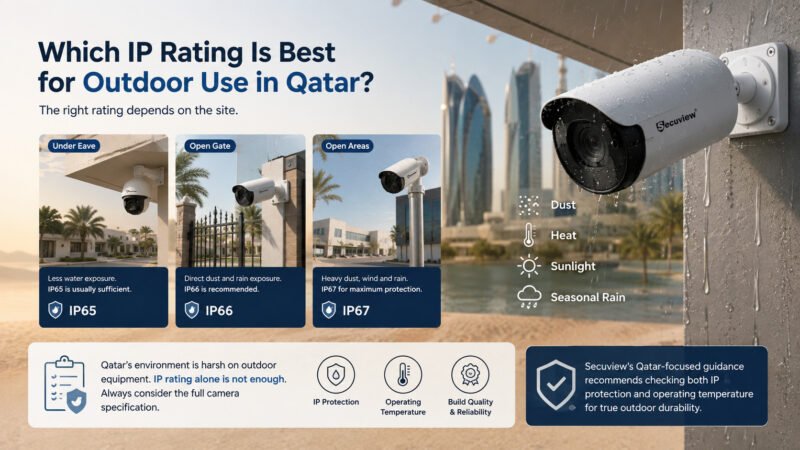
Which IP Rating Is Best for Outdoor Use in Qatar
A camera under an eave may face less water than one installed on an open gate. Farms around Al Shahaniya, exposed properties in Al Wakrah, and open commercial areas can have different environmental demands.
Qatar’s dust, heat, sunlight, and seasonal rain also make the complete camera specification important. Secuview’s Qatar-focused guidance notes that outdoor equipment should be checked for IP protection and operating temperature, not IP rating alone.
Does a Higher IP Rating Mean a Better Camera?
No. A higher water-protection rating does not improve image quality.
Before buying, also check:
- Resolution and lens
- Night vision range
- Operating temperature
- PoE, WiFi, or 4G connectivity
- Storage options
- Person or vehicle detection
- Housing and mounting position
For example, a camera with excellent image detail may still be a poor choice if its environmental rating does not match the installation site.
IP Rating vs. Other Outdoor Camera Specifications
IP protection covers the enclosure. It does not measure impact resistance, image quality, or night performance.
For exposed gates and accessible walls, an IK-rated vandal-resistant housing may also be useful. For Qatar installations, the manufacturer’s operating-temperature range should be checked separately because an IP code does not indicate heat tolerance.
What Should You Check Before Buying?
1. Confirm the exact IP rating. Check the specification for the model you plan to install.
2. Check the mounting position. A covered entrance has different exposure from an open perimeter wall.
3. Check the temperature range. This is especially relevant for direct-sun installations in Qatar.
4. Check cable protection. Poorly sealed cable entries can create problems even when the camera itself has a high IP rating.
Find the Right Outdoor Surveillance Camera for Qatar
Secuview’s outdoor range includes models designed for different residential, commercial, and remote monitoring needs. The available specifications include IP66/IP67 protection, different resolutions, night vision options, and connectivity choices.
For a wider comparison of camera types, placement, weather protection, night vision, storage, and connectivity, see the guide to choosing an outdoor security camera.
Keep Reading
FAQs About IP65, IP66, and IP67 Cameras
What is the best IP rating for an outdoor security camera?
IP66 or IP67 can suit exposed outdoor locations. IP65 may be enough for a more sheltered installation.
Is IP65 good enough for outdoor use?
Yes, IP65 can work for many outdoor positions. Always consider direct rain, water spray, dust, and camera placement.
Is IP67 better than IP66?
IP67 provides temporary immersion protection in addition to dust protection. That does not mean every outdoor installation needs IP67.
Can IP67 cameras be submerged?
IP67 covers temporary immersion under specified test conditions. It is not a rating for permanent underwater operation.
Does IP67 improve night vision?
No. Night performance depends on the sensor, lens, infrared illumination, available light, and image processing.
Can outdoor cameras handle Qatar’s heat?
Yes, when the model has a suitable operating-temperature range. Check the manufacturer’s specifications because IP65, IP66, or IP67 does not define heat resistance.
Where can I buy IP65, IP66, or IP67 security cameras in Qatar?
You can check Secuview’s available surveillance equipment online or visit their showroom. Confirm the exact IP rating and operating-temperature specification for the model before purchase.
Conclusion
IP65, IP66, and IP67 differ mainly in water protection. IP65 handles water jets, IP66 handles stronger water jets, and IP67 adds temporary immersion protection.
For Qatar, choose the enclosure rating together with temperature tolerance, mounting position, night vision, image quality, connectivity, and power requirements. This gives you a camera that fits the actual installation environment, not just a higher number on the specification sheet.