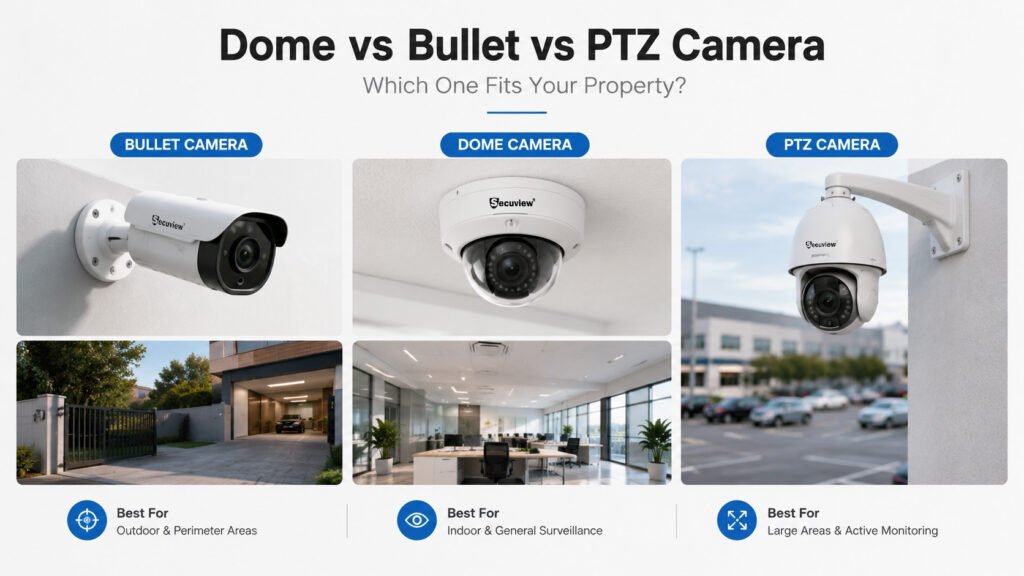
Three camera shapes dominate almost every CCTV catalog, and the right choice isn’t about which looks more professional; it’s about coverage area, viewing distance, installation environment, whether you need active zoom and tracking, durability, and budget. The short answer: bullet cameras suit directional outdoor coverage, dome cameras suit discreet general-purpose surveillance, and PTZ cameras suit wide-area monitoring with active zoom and tracking. The rest of this guide covers exactly when each one is actually the right call.
Bullet, Dome, and PTZ Cameras at a Glance
| Camera Type | Best For | Main Advantage | Typical Limitation |
|---|---|---|---|
| Bullet Camera | Outdoor and perimeter areas | Directional, long-range viewing | More visible form factor |
| Dome Camera | Indoor and general surveillance | Discreet, compact design | Usually fixed coverage |
| PTZ Camera | Large or open areas | Pan, tilt, optical zoom, and tracking | Higher cost and complexity |
What Is a Bullet Camera?
A bullet camera is a cylindrical, long-body camera housing designed to point in one fixed direction with a clearly visible presence, the shape itself signals exactly where it’s aimed. Bullet cameras are predominantly an outdoor form factor, built for long-range viewing down a specific sightline: a driveway, a perimeter fence line, a gate. Most carry strong infrared night vision suited to that longer range, and many outdoor models are available with a varifocal lens option for tuning the exact field of view on-site
When Is a Bullet Camera a Good Choice?
Outdoor perimeters, driveways, gates, parking lots, and any position where long-distance identification, reading a face or a license plate at real distance, matters more than blending into the environment.
Advantages and Disadvantages of Bullet Cameras
Advantages: long-range viewing performance, a visible housing that itself deters, built-in sun shields well suited to Qatar’s high ambient daylight, and generally strong outdoor durability ratings.
Disadvantages: the visible form factor is a downside where discretion matters, and a bullet camera’s fixed direction means it only ever covers the one sightline it’s aimed at.
What Is a Dome Camera?
A dome camera houses its lens inside a compact, dome-shaped enclosure, giving it a low, unobtrusive profile compared to a bullet’s clearly directional shape. This design works both indoors and outdoors, mounting flush to a ceiling or wall, and the dome’s smoked or tinted cover makes it genuinely harder to tell exactly which direction the lens is pointed — a real, practical form of discretion, not just a marketing claim. Outdoor dome models carry the same weatherproofing outdoor use requires, and higher-grade vandal-resistant dome housings are rated to withstand physical impact, relevant for any position within easy reach.
When Is a Dome Camera a Good Choice?
Homes, offices, retail stores, indoor corridors, and any position where discreet surveillance is preferred over an obviously visible camera.
Advantages and Disadvantages of Dome Cameras
Advantages: a compact, discreet design that blends into a ceiling or wall, genuine vandal-resistant housing options, and a form factor that doesn’t announce exactly where it’s pointed.
Disadvantages: most dome models are fixed-coverage rather than long-range, and dome housings can be more complex to service than a bullet’s simpler open design.
What Is a PTZ Camera?
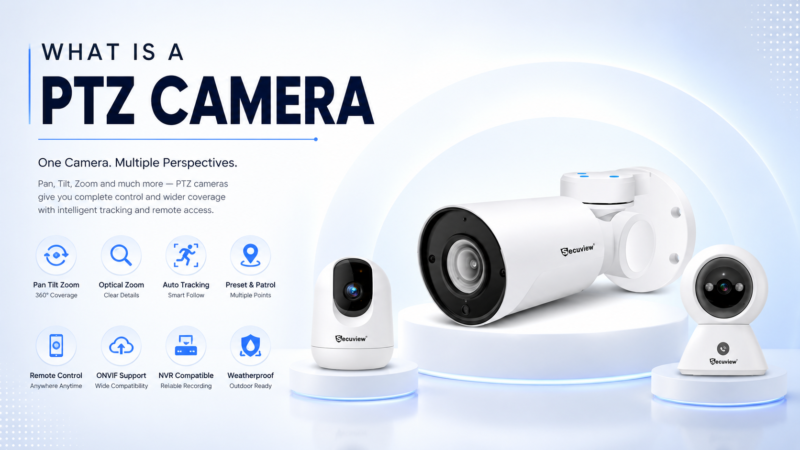
A PTZ camera physically pans, tilts, and optically zooms, actively moving to cover multiple points from a single mounting position, with remote control and preset positions allowing an operator or an automated patrol schedule to direct it. This is a genuinely different category from both dome and bullet, since those are fixed-coverage housings while PTZ is defined by movement. The full mechanics of how pan-tilt-zoom actually works, auto-tracking, and the coverage math behind “one PTZ replacing several fixed cameras
When Is a PTZ Camera a Good Choice?
Large properties, warehouses, parking areas, industrial sites, and any large outdoor space where one camera covering multiple zones is more practical than several fixed cameras.
Advantages and Disadvantages of PTZ Cameras
Advantages: active coverage of multiple zones from a single unit, real optical zoom for identifying details at a distance, and remote control for directing attention to a specific area in real time.
Disadvantages: meaningfully higher cost and installation complexity than either dome or bullet, and, as covered honestly in the dedicated PTZ guide, a PTZ camera only actively watches one position at a time while patrolling between others.
Bullet vs Dome vs PTZ Camera: Key Differences Explained
Bullet vs Dome Camera
The core trade-off is visibility against range. A bullet camera works outdoors specifically, with a visible form factor and longer viewing distance; a dome camera works both indoors and outdoors, with a discreet form factor and generally shorter, wider coverage. Bullet cameras mount to walls, poles, and eaves; dome cameras flush-mount to ceilings and walls. Vandal resistance is more commonly a dome-specific feature, since dome housings are built with that impact rating in mind more often than standard bullet housings.
Dome vs PTZ Camera
This is fixed coverage against active movement. A dome camera watches one field of view continuously and doesn’t move; a PTZ camera actively repositions and zooms, at a genuinely higher cost. Optical zoom and tracking exist only on PTZ; a dome offers neither. Coverage area on a dome is fixed at installation; PTZ can adjust that coverage on demand or via automated patrol.
Bullet vs PTZ Camera
Fixed directional viewing against movable, active coverage, the same core distinction as dome vs PTZ, but from the outdoor, long-range bullet side. A bullet camera gives strong long-range viewing down one fixed line; a PTZ camera trades some of that per-shot detail for the ability to redirect toward whatever needs attention. PTZ costs more and installs with more complexity, given the motorized mount and controller setup involved.
Bullet vs Dome vs PTZ: Which Is Better?
None of the three is universally better — the right answer depends entirely on what a specific position actually needs. A driveway needing long-range identification down one fixed line calls for bullet. A reception area needing discreet, always-on coverage calls for dome. A warehouse yard needing to cover several zones from one mounting point calls for PTZ. Treating this as “which camera is best” rather than “which camera fits this specific position” is the most common mistake in choosing between them.
How to Choose Between Bullet, Dome, and PTZ Cameras
What do you want the camera to achieve? Detection (knowing something happened), recognition (telling what it was), or identification (reading enough detail to be certain who or what it was) each demand different resolution and range; identification generally needs either a bullet’s long-range clarity or a PTZ’s optical zoom, while general detection is well served by a fixed dome.
Which areas need coverage? Indoor areas, outdoor perimeters, entrances, parking areas, and warehouses each lean toward a different default — indoor and reception areas toward dome, outdoor perimeters toward bullet, and large open areas toward PTZ.
What surveillance range do you need? Short-range coverage suits a dome; medium-to-long range suits a bullet; anywhere optical zoom is genuinely required points toward PTZ specifically.
Do you need pan, tilt, or optical zoom? If the honest answer is yes — if a fixed field of view genuinely won’t cover what’s needed — that’s what justifies PTZ’s added cost. If not, a fixed dome or bullet does the same job for less.
Do you need vandal or weather protection? IP ratings (dust and water resistance) and IK ratings (impact resistance) both matter here — Secuview’s outdoor bullet range carries a confirmed IK10 rating, meaning the housing withstands 20 joules of impact, relevant for any camera mounted within easy reach. Full climate-specific guidance for Qatar’s heat and dust is covered in Secuview’s outdoor camera climate guide.
What is your installation environment? Ceiling, wall, pole, or eave mounting, and whether the position is indoor or outdoor, narrows the choice before cost or features even enter the decision.
What is your budget? Camera cost is only part of it — installation, cabling, the NVR or VMS the cameras connect to, and ongoing maintenance all factor in, and PTZ carries the highest total cost across all of these, not just the camera itself.
What to Look for in a Bullet, Dome, or PTZ Camera
Across all three form factors, the same core feature set matters: resolution (1080p, 2K, or 4K, depending on how much detail a position needs), field of view and lens type (wide-angle, fixed, or varifocal — covered in full in Secuview’s varifocal lens guide), night vision performance (infrared, smart IR, or full-color night vision), and WDR/backlight handling for scenes with both bright and shadowed areas. Motion detection and AI analytics, PoE and network connectivity, and ONVIF/NVR/VMS compatibility are genuinely important but already covered in dedicated depth elsewhere — see how PoE powers IP cameras, what ONVIF actually does, and how NVR systems record and store footage rather than repeated here. Weatherproof and vandal-resistant protection — IP and IK ratings — apply differently across the three shapes, as covered in the decision section above.
Where Should You Use Each Camera Type?
Homes: dome cameras indoors for discretion, bullet cameras outdoors at the gate and driveway.
Offices: dome cameras for reception and corridors — a lower visual profile than bullet, matching guidance already established in Secuview’s CCTV camera types guide — with PTZ reserved for larger open floor areas if needed.
Retail stores: dome cameras for a less obtrusive in-store presence, bullet cameras covering parking and entrances outside.
Warehouses: PTZ for large open floor areas, bullet for loading bays and perimeter fencing.
Parking lots: bullet cameras for fixed sightlines down rows, PTZ where active coverage of a larger lot is worth the added cost.
Gates and entrances: bullet cameras for long-range identification of approaching vehicles or visitors.
Large outdoor properties: PTZ for genuinely wide-area coverage, supplemented by bullet cameras at fixed high-priority points like a main gate.
Special Cases That Can Change Your Camera Choice
When a bullet camera may be better than a dome: any position where the visible deterrent effect of an obviously aimed camera matters as much as the footage itself.
When a dome camera may be better than a bullet: anywhere staff or visitor comfort with an obviously aimed camera is a real concern, such as a reception desk or a waiting area.
When a PTZ camera is worth the extra cost: genuinely large or irregular areas where fixed cameras would require several units to achieve the same coverage, the specific math behind this trade-off is covered in Secuview’s PTZ camera guide.
When a specialized camera is the better option: properties needing dual-lens simultaneous wide-and-detail coverage from one point, or a fully wireless/cellular installation, aren’t well served by any of these three alone; see Secuview’s dual-lens camera guide and 4G camera guide respectively.
When optical zoom matters more than camera shape: if the deciding factor is genuinely “can this camera read detail at distance,” that question points toward PTZ or a long-range bullet with the right lens, regardless of which shape otherwise seems like the better fit.
Which Camera Should You Choose?
Choose Bullet if: you need directional, outdoor, long-range coverage.
Choose Dome if: you want discreet, compact, general-purpose surveillance.
Choose PTZ if: you need remote movement, optical zoom, tracking, and wide-area monitoring.
Frequently Asked Questions
What is the difference between bullet, dome, and PTZ cameras?
A bullet camera is a fixed-direction camera typically designed for long-range outdoor coverage. A dome camera has a fixed, discreet housing suited to indoor and general-purpose surveillance. A PTZ camera can actively pan, tilt, and zoom, allowing it to cover multiple areas from one unit.
Is a bullet camera better than a dome camera for outdoor surveillance?
For long-range, directional outdoor coverage, a bullet camera is generally the better choice. However, outdoor-rated dome cameras can also provide effective outdoor surveillance when a more discreet housing is preferred.
What is the difference between a PTZ and dome camera?
A dome camera provides fixed coverage and does not move, while a PTZ camera can pan, tilt, and zoom to cover multiple positions from one unit. PTZ cameras generally cost more because of their active movement and optical zoom capabilities.
Which camera is best for a driveway or gate?
A bullet camera is often the best choice for a driveway or gate because its directional design and typical lens options provide long-range viewing along a fixed sightline.
Which camera is best for indoor surveillance?
A dome camera is often well suited to indoor surveillance because of its compact and discreet design. It works particularly well in reception areas, corridors, offices, and other general indoor spaces.
When should I choose a PTZ camera instead of a fixed camera?
Choose a PTZ camera when one mounting position needs to cover multiple zones or when active optical zoom is important. PTZ cameras are particularly useful for larger properties where operators need to change the viewing direction or zoom in on specific areas.
Are dome cameras better for vandal-resistant installations?
Often, yes. Vandal-resistant and impact-rated housings are commonly available in dome camera designs, making them a practical choice for locations where the camera may be exposed to tampering or physical impact.
Are bullet cameras better for long-distance viewing?
Yes. Bullet cameras are generally designed for directional, longer-distance viewing, with lens options that are well suited to monitoring driveways, gates, entrances, boundaries, and other fixed sightlines.
Do PTZ cameras have better zoom than bullet and dome cameras?
Yes. PTZ cameras provide active optical zoom that can be adjusted while the camera is operating. Standard bullet and dome cameras have a fixed field of view after installation, although varifocal models allow the lens to be adjusted during installation.
Can bullet, dome, and PTZ cameras use PoE?
Yes. Bullet, dome, and PTZ cameras are all available as PoE-powered IP cameras. PoE allows power and network data to be delivered through a single Ethernet cable.
Can these cameras work with an NVR or VMS?
Yes. Bullet, dome, and PTZ IP cameras can work with compatible NVRs and video management systems (VMS), provided the camera and recording system support compatible standards such as ONVIF.
How do I choose the right security camera for my property in Qatar?
Start by identifying what each camera position needs most: long-range coverage, a discreet installation, or active coverage across multiple areas. Choose a bullet, dome, or PTZ camera accordingly, then consider factors such as Qatar’s climate, weatherproofing, heat resistance, and vandal-resistance requirements.
Consolation
Bullet cameras mean directional outdoor coverage. Dome cameras mean discreet, general-purpose coverage. PTZ cameras mean active, wide-area monitoring and zoom. Most real installations end up using more than one: a dome at reception, a bullet at the gate, a PTZ over the parking lot, rather than standardizing on a single shape across an entire property. According to Security.org’s home security industry guide, remote mobile access, configurable motion alerts, and smart system integration have become baseline expectations across all three camera types now, not a differentiator specific to any one shape, which makes the shape decision genuinely about coverage and positioning, not which one has “better” smart features.