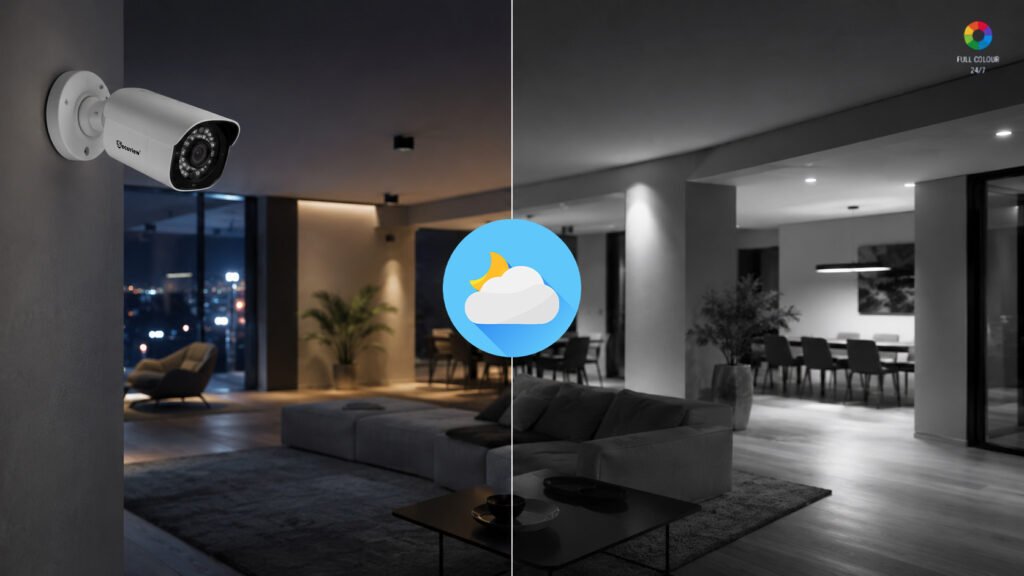
Indoor night vision CCTV helps a security camera record useful footage when normal room lighting is low or completely off. The camera may use infrared light, a sensitive image sensor, or other low-light technology to capture the scene. The final image depends on the camera, lens, light level, distance, and room conditions.
If you are checking CCTV footage at night, the key question is not simply whether the camera has night vision. You also need to know how that night vision works and how clearly it can capture the area you need to monitor.
Key Takeaways
- Indoor night vision allows CCTV cameras to monitor areas with little or no visible light.
- Infrared night vision is one of the most common technologies used in indoor cameras.
- Some cameras use available light to produce a color image at night.
- Thermal cameras detect heat rather than visible light.
- Night vision range does not always mean clear identification at that distance.
- Room size, camera position, lens, reflections, and ambient light affect night footage.
- Glass and reflective surfaces can cause glare when infrared LEDs are active.
- Resolution, image sensor quality, and smart detection also affect the usefulness of night footage.
- The right camera depends on the room, lighting conditions, viewing distance, and security purpose.
What Is an Indoor Night Vision CCTV Camera?
An indoor night vision CCTV camera is designed to record video when there is not enough visible light for normal color footage.
During the day, a camera can use natural or artificial light to capture a color image. At night, the available light may fall below the level needed for a clear image. Night vision technology helps the camera continue recording in these conditions.
The most common approach is infrared night vision. Infrared LEDs produce light that people normally cannot see. The camera sensor can detect this light and use it to create an image.
Other cameras use sensitive image sensors and available ambient light. These cameras may produce color footage in low-light conditions.
Thermal cameras work differently. Instead of depending on visible or infrared illumination, they detect differences in heat.
So, when choosing an indoor CCTV camera for night use, look beyond the term “night vision.” Check the technology behind it and how it suits your room.
How Does Indoor Night Vision CCTV Work?
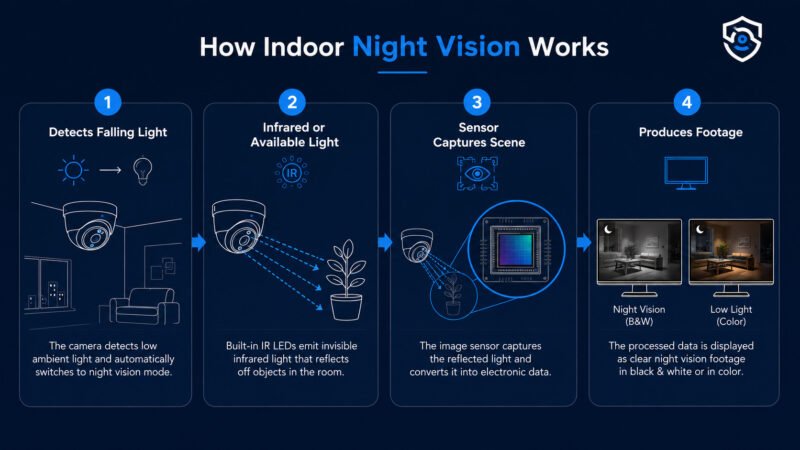
How indoor night vision CCTV cameras detect low light, emit infrared rays, and process video footage.
Indoor night vision works through a combination of the image sensor, lens, infrared illumination, available light, and image processing. The exact process depends on the camera model.
1. The Camera Detects Falling Light Levels
A CCTV camera continuously receives light through its lens. When the room becomes darker, the camera detects the change in available light. Many cameras then switch automatically from normal daytime operation to night mode.
For example, an indoor camera may operate in color during the day. When the room becomes dark, it can activate infrared illumination and change the way the sensor processes the image.
2. The Camera Uses Infrared or Available Light
With infrared night vision, built-in infrared LEDs provide additional light for the camera sensor. People usually cannot see this infrared light, but the camera sensor can detect it and use the reflected rays to form an image.
Low-light cameras take a different approach: they use a sensitive image sensor to make better use of light already present in the room (such as a small glow from a hallway, window, lamp, or nearby room).
3. The Image Sensor Captures the Scene
The image sensor converts incoming light into an electronic image. Sensor performance matters because two cameras with similar resolution can produce drastically different results at night.
A larger or more sensitive sensor performs significantly better in difficult lighting. Resolution is therefore only one part of night-time image quality.
4. The Camera Produces Night-Time Footage
After capturing the available light or infrared information, the camera processes the image and sends the video to the recording system or network. Depending on the camera, footage may be:
- Black and white with infrared night vision
- Color in low-light conditions
- Full color with additional illumination
- Heat-based imagery with thermal technology
Why Does Night Vision Matter for Indoor CCTV?
Indoor activity does not stop when the lights are turned off. Homes, offices, shops, restaurants, storage rooms, and other properties still need monitoring after normal working hours.
Monitoring Dark Rooms
Storage rooms, corridors, stairways, and closed offices become pitch black after business hours. Infrared helps keep a continuous record.
After-Hours Security
Commercial properties stay empty overnight, but CCTV systems continue recording entrances, counters, and high-value areas.
Low-Light Areas
Hallways and windows often bleed small ambient light. Low-light cameras utilize this light to output higher-clarity images.
Continuous 24/7 Operation
Automated day/night switching eliminates the need to keep room lights running constantly just for surveillance.
What Types of Night Vision Are Used in Indoor CCTV?
Indoor CCTV cameras use several approaches to nighttime imaging. Each works differently and suits specific environmental conditions.
1. Infrared (IR) Night Vision
Uses built-in IR LEDs to illuminate the scene invisibly. The sensor converts this into monochrome footage.
Advantages:
- Works in pitch-black conditions
- Does not require visible room lighting
- Cost-effective and widely available
Limitations:
- Footage is strictly black & white
- Glass surfaces cause IR reflection/glare
2. Low-Light or Starlight Night Vision
Equipped with hyper-sensitive sensors designed to capture color footage using minimal ambient room light (like a street lamp outside a window or a hallway standby light).
3. Full-Color Night Vision
Combines ultra-low-light sensors with warm supplemental LED white lights, guaranteeing color monitoring around the clock even in pitch darkness.
4. Thermal Imaging
Detects heat signatures rather than light. Mostly reserved for industrial, perimeter, or high-security commercial applications rather than typical residential CCTV.
What Affects Indoor CCTV Night Vision Quality?
Performance depends on much more than the advertised night vision distance. Several core environmental and physical factors dictate final quality:
- Image Sensor & Lens Aperture: Dictates the volume of physical light reaching the digital processing chip.
- Infrared Illumination & Distance: LED output limits determine how far illumination travels before falling off into shadow.
- Camera Position & Reflections: Mounting near walls, glossy tiles, or behind glass windows bounces IR rays straight into the lens, blinding night mode.
- Viewing Angle vs. Identification: An ultra-wide field of view covers more floor area but distributes pixel density thinly, making distant facial recognition harder at night.
What Should You Check Before Buying an Indoor Night Vision Camera?
The best indoor night vision camera depends on the room and the reason for surveillance. Check the following specifications before making a decision:
1. Night Image Quality
Look at sample footage captured in low-light conditions when possible. A high-resolution camera can still produce poor night footage if the sensor, lens, or exposure control is not suitable for the environment.
2. Night Vision Range
Check the manufacturer’s stated night vision distance. Then consider the actual size of your room. A long advertised range may not be useful if you only need to monitor a small bedroom, office, or corridor.
3. Camera Resolution
Higher resolution can provide more image detail. However, resolution does not automatically improve night vision. Sensor quality, lighting, lens selection, and image processing remain important.
4. Field of View
A wide field of view can cover more of a room, while a narrower field of view may provide more detail on a specific doorway or access point.
Choose the viewing angle based on the area you need to monitor.
5. Low-Light Performance
If the room has some ambient light at night, check whether the camera can use it effectively. This is especially useful for offices, reception areas, living rooms, and other spaces that are not completely dark.
6. Smart Detection
Modern indoor CCTV cameras may include features such as:
- Human detection
- Motion detection
- Auto tracking
- Area alerts
- Mobile notifications
These features can make recorded footage easier to review. They should support the surveillance goal rather than replace good camera placement.
7. Connection Type
Indoor CCTV cameras can use different connection methods. Common options include:
- PoE
- Ethernet
- WiFi
- AHD or other wired CCTV connections
Your choice should match the existing network, recording system, cable routes, and installation requirements.
8. Two-Way Audio
Two-way audio can be useful for some indoor applications. It allows people to communicate through the camera when the feature is supported. This may be useful for home monitoring, reception areas, offices, and baby monitoring.
Best Indoor Night Vision Cameras in Qatar
Secuview provides targeted indoor cameras engineered for residential and commercial layouts. Consider your connection infrastructure, room size, and viewing requirements when selecting a model:
12MP PoE IP
Secuview 12MP Indoor PoE IP Camera
Designed for high-detail, expansive indoor spaces requiring auto-tracking, ONVIF support, and extreme digital zoom clarity.
5MP AHD Wired
Secuview 5MP Indoor AHD CCTV Camera
Secuview 5MP Indoor AHD CCTV | Sharp Detail & High-Performance Monitoring.
The ideal direct-wired replacement or expansion option for existing coax-cable indoor DVR installations.
5MP IP Smart
Secuview 5MP Indoor IP Camera
Secuview 5Mp Indoor Ip Camera | Two-Way Audio, Auto Tracking & ONVIF.
Features two-way audio interaction, smart motion tracking, and standard network compatibility for office and home reception spaces.
1.3 MP Standard
Secuview Indoor 1.3MP AHD Camera
Secuview Indoor 1.3MP AHD Camera Compact & Clear Monitoring.
A simple, budget-conscious camera for small room coverage where basic continuous monitoring is required.
2K WiFi PT
Secuview WiFi Indoor 2K PT Camera
Ideal as a nursery or baby monitor, featuring pan/tilt controls and full-color low-light night mode capabilities.
5MP WiFi PT
Secuview WiFi Indoor 5MP PT Camera
Offers enhanced resolution and motorized pan-tilt flexibility across open residential areas via wireless setup.
If you are comparing cameras for a small workplace, read our detailed guide on indoor security cameras for small businesses.
Common Indoor CCTV Night Vision Problems & Solutions
Why is my CCTV night vision too dark?
The subject might be outside the camera’s effective IR illumination distance. Adjust exposure settings or re-angle the lens toward closer focal planes.
Why does night vision look grainy?
Grain (digital noise) happens when light input drops below sensor thresholds. Check if clean ambient lighting can be introduced to assist the sensor.
Why does my night vision show glare?
IR light reflects off mirrors, glossy paint, and glass back into the sensor. Angle the camera away from direct reflective obstructions.
Why can’t the camera see through window glass at night?
Infrared light cannot pass through exterior glass at night; it bounces directly off the pane back into the camera lens, blinding the image. Never mount an IR camera indoors aimed directly out a window.
Related CCTV Guides
When planning a complete indoor surveillance setup in Qatar, consult our technical guides:
- CCTV Storage Calculator – Calculate hard drive capacity requirements.
- Indoor CCTV Installation Cost in Qatar – Understand setup pricing structures.
- Apartment Security Camera Guide – Essential layout planning for apartments.
- Indoor Security Cameras for Commercial Spaces – Corporate & enterprise security tips.
Conclusion
Indoor night vision CCTV ensures continuous property protection when lights are out. While infrared LEDs are the standard choice, low-light color sensors and thermal systems fit specific room environments.
When selecting a system, evaluate your room size, reflection points, camera position, mounting distance, and storage requirements rather than relying purely on advertised megapixel ratings.
Planning a security system in Qatar? Start with our definitive Best Indoor Security Cameras in Qatar guide to match specs with local support and warranty.
Frequently Asked Questions
How does an indoor security camera work at night?
An indoor security camera can use infrared LEDs, low-light sensors, or additional illumination to capture footage when normal lighting is low. The exact method depends on the camera model.
Can an indoor CCTV camera see in complete darkness?
Yes. Cameras with infrared night vision can capture images in very low or no visible light because their infrared LEDs provide light that the sensor can detect.
Why does CCTV night vision appear black and white?
Infrared cameras usually switch to black-and-white footage at night. This helps the image sensor capture infrared information without relying on normal visible color.
What is the difference between infrared and thermal night vision?
Infrared CCTV uses reflected infrared light to create an image. Thermal cameras detect heat differences. Infrared is common for indoor security, while thermal imaging is used for more specialist applications.
How far can an indoor CCTV camera see at night?
The useful night vision distance depends on the camera, infrared illumination, lens, room layout, and lighting. The stated range does not always mean clear identification at that distance.
Why does my CCTV camera show glare at night?
Glare can occur when infrared light reflects from glass, mirrors, windows, or glossy surfaces. Changing the camera position or angle can often reduce the reflection.
Where can I buy an indoor night vision camera in Qatar?
You can buy indoor night vision cameras through the Secuview e-commerce platform or visit the Secuview showroom at Retaj Building on Salwa Road, Doha, Qatar.