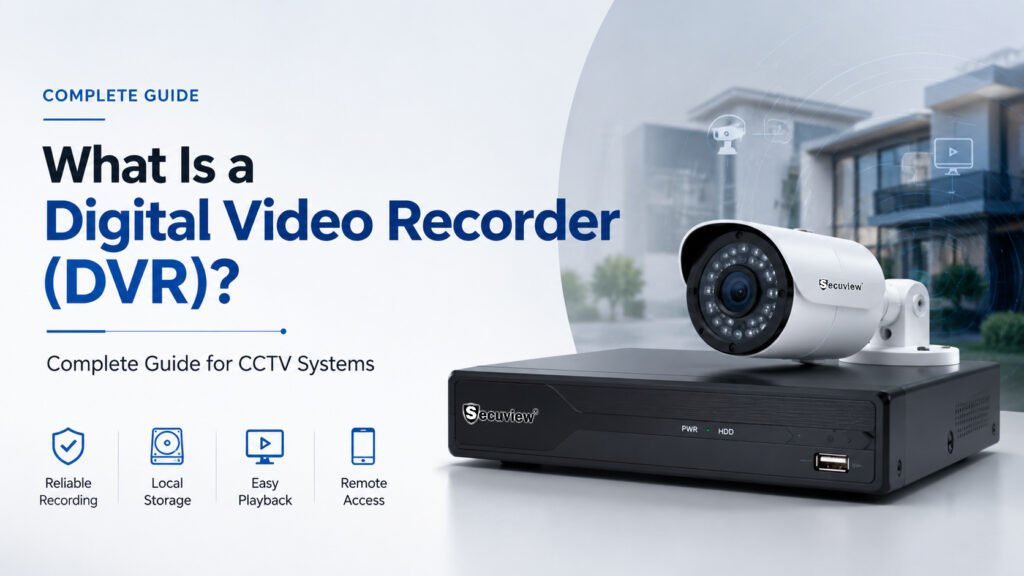
Analog and AHD cameras are still genuinely common across Qatar villas and small businesses, not as outdated leftovers, but because a DVR-based system remains one of the most cost-effective ways to record footage on infrastructure that’s often already in place. This guide covers what a DVR actually is, how it works, the types available, and when it’s still the right choice against a network-based alternative.
What Is a Digital Video Recorder (DVR)?
A DVR is a recording device that captures video from AHD or analog cameras over coaxial cable, converts that analog signal into digital data, and stores it on an internal hard drive. Its purpose is straightforward: an analog or AHD camera doesn’t process or compress its own footage the way an IP camera does, so a security video recorder on the receiving end has to do that work, capturing the raw signal, digitizing it, compressing it, and making it available for live viewing and later playback. Key components include the recording unit itself, the coaxial video inputs through which it receives footage, and the internal storage that holds the resulting digital video.
How Does a DVR Work?
The process runs through several distinct stages. Video capture happens at the camera, which sends a continuous analog or AHD signal down a coaxial cable to the recorder. Analog-to-digital conversion happens at the DVR itself; this is the fundamental difference from an NVR, where that conversion already happened at the camera before the signal was ever sent. Video compression reduces the resulting digital file size for practical storage, using formats such as H.264 or H.265, depending on the recorder. That compressed video is written to local storage, an internal hard drive, and from there, playback lets footage be reviewed by time and date through the recorder’s own interface or a connected app.
What Is a DVR Recorder Used For?
A CCTV recording device like this is common across home security, small businesses, retail stores, warehouses, schools, and offices, anywhere AHD or analog cameras are already in place, or where the lower cost of an analog-based system matters more than the smart features an IP/NVR setup offers.
Types of DVR Systems
Standalone DVR: a dedicated, purpose-built recording unit with no other function, the most common type for a typical residential or small business installation.
Hybrid DVR: supports both AHD/analog cameras and IP cameras on the same unit, useful for a property with existing AHD cameras that also wants to add IP cameras without replacing the whole system. Secuview’s own hybrid DVR range is built specifically for exactly this situation: AHD and IP inputs on one recording unit rather than running two separate systems.
PC-based DVR: software running on a general-purpose computer rather than dedicated hardware, less common in typical residential or small commercial installations but still used in some larger, custom-built systems.
DVR vs NVR: What’s the Difference?
The short version: a DVR works with AHD/analog cameras over coaxial cable and processes the video signal itself; an NVR works with IP cameras over a network cable, receiving footage the camera has already processed. This affects camera compatibility, cabling, recording method, video quality, scalability, and cost, all covered point by point in the full NVR vs DVR comparison, which goes deeper than a summary table can here.
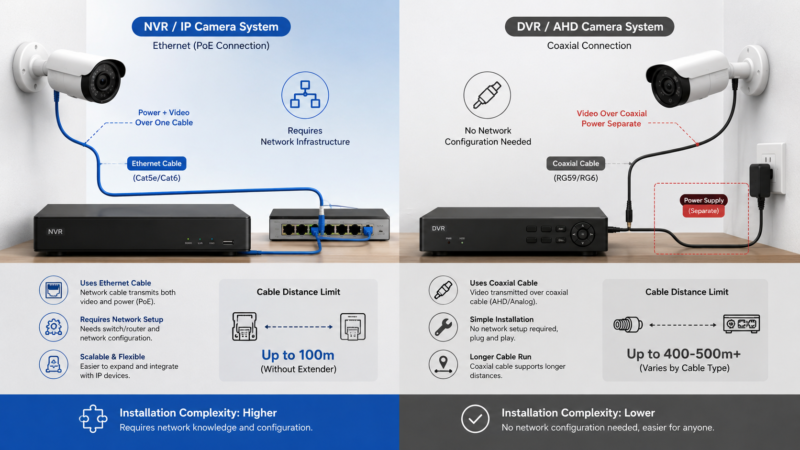
Installation Differences on nvr and dvr
DVR vs Cloud Recording
Local storage vs cloud storage: a DVR keeps footage on-site, on its own hard drive; cloud recording stores footage on remote servers instead.
Internet requirements: a DVR records and plays back locally without needing an internet connection at all; cloud recording depends entirely on connectivity to both record and retrieve footage.
Security: local storage on a DVR is vulnerable if the physical unit is stolen or damaged; cloud storage protects footage even if on-site hardware is compromised, at the cost of depending on a third-party server’s own security.
Cost: a DVR is a one-time hardware cost; cloud recording is typically an ongoing subscription.
Backup: DVR footage can be exported locally via USB; cloud recording is inherently backed up off-site by design.
Advantages and Disadvantages of DVR Systems
Advantages:
Lower cost than an equivalent NVR/IP setup, simpler installation with no networking knowledge required, works over existing coaxial infrastructure many older buildings already have, and a more straightforward, fewer-points-of-failure system overall.
Disadvantages:
Lower video quality ceiling than IP/NVR systems at comparable price points, limited or absent AI features, more restricted remote viewing capability, and less flexibility for future expansion compared to a network-based recording system.
Where Are DVR Systems Commonly Used?
Homes in Al Wakra, apartments in Lusail, retail shops, restaurants, warehouses in the industrial area (Sana’iya), offices in Doha, and factories- the common thread across all of these is either existing coaxial cabling already in place, or a straightforward budget-conscious installation where a DVR’s lower cost and simpler setup outweigh the smart features an NVR system would add.
Are DVR Systems Still Worth Buying?
When a DVR is the right choice
existing coaxial cabling is already in place, budget is the primary constraint, the installation is small, and AI or advanced remote-monitoring features aren’t a real priority for how the system will actually get used.
When an NVR is a better investment
Starting a genuinely new installation from bare walls, needing 4K-or-higher resolution, wanting AI-driven detection features, or planning significant future expansion, all covered in more depth in the guide to how NVR systems work.
Future-proofing considerations
A hybrid DVR supporting both AHD and IP inputs offers a middle path, keeping existing AHD cameras working while adding IP cameras incrementally, rather than forcing an all-or-nothing switch between the two recording systems.
Frequently Asked Questions
What is the difference between a DVR and an NVR?
A DVR works with AHD or analog cameras and processes the video signal itself, receiving footage through coaxial cable. An NVR works with IP cameras and receives already-processed digital video over a network connection.
How long does a DVR store footage?
A DVR stores footage until the hard drive becomes full, after which most systems automatically overwrite the oldest recordings. Actual retention time depends on HDD capacity, camera resolution, compression format, recording settings, and the number of channels.
Can you view DVR footage remotely on a phone?
Yes. Most modern DVR systems support remote viewing through a companion mobile app, although remote features are generally more limited compared with many newer IP camera and NVR systems.
Are DVR systems secure?
DVR systems can be secure when properly installed. Footage is typically stored locally rather than automatically sent through the internet, but this also means there is no off-site backup unless one is configured separately. Protecting the physical recorder is important because stolen or damaged hardware can result in lost footage.
What should I do with an old DVR system?
A working older DVR can often continue operating as part of a hybrid security setup or be reused for lower-priority areas. Replacement is usually considered when the recorder fails or when advanced IP camera features are required.
What is the DVR on a TV?
A TV DVR is a consumer device used to record television broadcasts. It is different from a CCTV DVR security recorder, although both use the same acronym.
Is DVR still a thing?
Yes. DVR-based CCTV systems remain a popular and cost-effective option, especially for locations that already have AHD cameras or existing coaxial cabling installed.
Do I need a DVR to record TV shows?
No. Recording television broadcasts requires a separate consumer TV recording device. This is different from the CCTV DVR systems used for security cameras.
What is DVR mode on a trail camera?
DVR mode on a trail camera refers to a recording function built into wildlife cameras. It is unrelated to standalone CCTV DVR security recorders.
What is the DVR mode on a Stealth Cam?
DVR mode on a Stealth Cam refers to a built-in recording feature on that brand’s outdoor cameras. It is different from a dedicated CCTV DVR recording unit.
Is a DVR suitable for home security in Qatar?
Yes. A DVR-based AHD security system is a practical and cost-effective option for Qatar villas and apartments, especially where existing coaxial camera wiring is already installed.
Where can I buy a DVR recorder in Qatar?
Secuview offers DVR kits and hybrid DVR systems that support both AHD and IP cameras through its CCTV camera system category.