
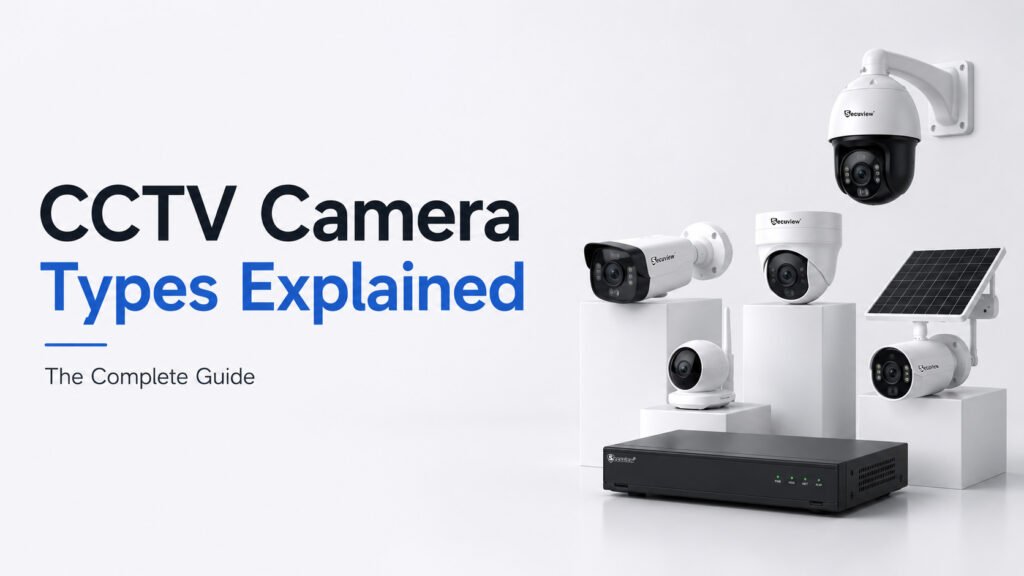
A contractor in Lusail asked three suppliers for “a good CCTV camera.” He got three quotes — an AHD kit, an IP system, and a WiFi bundle — all described as “the best.” He left with the most expensive one and later discovered it needed an NVR he did not have, Cat6 cabling he had not run, and a WiFi network that did not reach his outdoor positions.
The problem was not the camera. Nobody explained the five different technologies that share the name “CCTV camera” — each with completely different infrastructure requirements, night vision architectures, storage calculations, and legal considerations specific to Qatar. This guide covers it all, from sensor technology and AI analytics to Qatar laws governing what you can and cannot record.
The Five Core CCTV Camera Technologies – A Framework First
Before naming any product, every buyer needs this framework. Every camera in Qatar’s market belongs to one of five technology categories, and each category defines the entire infrastructure the camera requires.
| Technology | Cable | Recorder | Internet? | Best Application |
|---|---|---|---|---|
| AHD | Coaxial RG59/RG6 | DVR | No | Retrofit of existing coaxial wiring · budget residential |
| IP / PoE | Cat6 / Cat5e | NVR | Optional | New installations · smart AI detection · 5MP–12MP resolution · enterprise |
| WiFi | None | Cloud / NVR / SD | Yes — router required | Apartments · rental units · finished interiors · baby monitors |
| 4G Solar | None | Cloud / SD card | No — SIM card | Remote land · construction sites · gated access roads · off-grid positions |
| PTZ | Cat6 (IP) / Coaxial (AHD) | NVR / DVR | Optional | Compounds · warehouses · perimeters · large outdoor areas |
AHD Cameras – Analogue HD Over Coaxial Cable
AHD (Analogue High Definition) transmits video over coaxial cable (RG59 or RG6) to a DVR. The coaxial cable carries video only — power is supplied separately via a 12V DC power supply or multi-camera power distribution unit. AHD cameras are available from 1.3MP to 8MP (4K), with Secuview’s AHD range covering 1.3MP, 2MP, and 5MP indoor and outdoor models.
When AHD is the right choice: properties with existing coaxial cable runs from a previous system. Converting to IP would require complete re-cabling — AHD reuses existing coaxial infrastructure at a fraction of the cost. DVR units are also typically lower cost than NVR units at equivalent channel counts.
AHD limitations vs IP: no native two-way audio, no AI smart detection, no auto-tracking, and no PoE power delivery. Motion detection on AHD systems is basic pixel-change detection — not AI-based person or vehicle classification. AHD cable runs are limited to approximately 500 metres at standard RG59 coaxial before signal degradation occurs — longer than IP (100-metre Cat6 limit without a PoE extender).
IP Cameras – Digital, PoE-Powered, AI-Capable
IP cameras transmit digital video over Cat6 or Cat5e to an NVR. A PoE NVR or PoE switch powers the camera through the same Cat6 cable that carries video data — one cable handles both power and data simultaneously, eliminating the need for a separate power supply at each camera position.
Resolution in Secuview’s IP range starts at 5MP and extends to 12MP. Video compression standard across the range is H.265 (HEVC), which delivers approximately 50% smaller file sizes than H.264 at equivalent visual quality — cutting storage and bandwidth requirements in half for the same camera count and recording duration.
Smart features native to IP cameras: AI-based person and vehicle detection (distinguishing a human from a moving branch or passing car), auto-tracking (AI follows a moving subject within the camera’s field of view without mechanical movement), two-way audio (microphone and speaker built into the camera for real-time voice communication), and ONVIF protocol for cross-brand NVR compatibility.
WiFi Cameras – Wireless, App-Controlled, Zero Cable
WiFi cameras connect to a 2.4GHz or 5GHz wireless network — no cable run required. Video streams to a mobile app, a cloud server, a local NVR, or an SD card, depending on the model. For Qatar buyers, WiFi cameras are the most practical choice for completed interiors, rental properties, and baby monitoring positions where drilling cable routes is not feasible.
WiFi limitation in Qatar’s larger properties: signal strength drops significantly over distance and through thick concrete walls — common in Qatar’s villa construction standards. A camera showing “1 bar” of WiFi signal will produce intermittent recording and unreliable motion alerts. Measure the actual WiFi signal strength at the intended camera position before purchasing. Where WiFi does not reach, a 4G camera is the alternative.
4G Solar Cameras – SIM Card, Solar Power, Fully Off-Grid
A 4G solar camera uses a cellular SIM card for data transmission and a built-in solar panel for power, completely independent of any property infrastructure. No WiFi router, no Ethernet cable, no mains power socket. Qatar’s sun intensity provides reliable solar charging year-round, including winter months when ambient temperature drops but solar irradiance remains high.
Secuview’s 4G range includes a single-lens model, a dual-lens model (simultaneous wide-angle and telephoto from one mounting point), and a standard solar-powered 4G outdoor camera. All three use Qatar-compatible 4G LTE bands (B1, B3, B7 — compatible with Ooredoo and Vodafone Qatar networks). A SIM data plan from a Qatar operator is required — typical 4G CCTV data consumption is 2–5GB per month per camera on motion-triggered recording.
PTZ Cameras – Pan, Tilt, Zoom, One Camera Replacing Many
PTZ (Pan-Tilt-Zoom) cameras contain a motorised mount allowing remote-controlled horizontal rotation (0°–360° pan), vertical rotation (tilt), and optical zoom. A single PTZ camera at a compound gate can rotate to cover the full perimeter, tilt to monitor a vehicle undercarriage, and optically zoom to read a licence plate at 50 metres — replacing four to five fixed cameras at a comparable total installation cost.
Secuview’s 6MP outdoor PTZ camera carries an auto-focus varifocal lens, IP66 weatherproofing, and a -20°C to +60°C operating range for Qatar outdoor conditions across all seasons. Auto-focus means the lens sharpens automatically when zoomed — no manual focus adjustment required after zoom.
PTZ vs auto-tracking fixed camera: A PTZ physically repositions the camera body. An auto-tracking fixed camera (like Secuview’s 5MP and 6MP fixed-lens IP cameras with AI auto-tracking) follows a moving subject digitally within its existing field of view — no mechanical movement. Auto-tracking fixed cameras suit indoor and constrained-space positions. PTZ cameras suit large outdoor areas requiring genuine physical repositioning across wide angles.
Battery-Powered Cameras – No Power Cable, Fast Installation
Battery cameras store power in a rechargeable internal battery — no mains connection or PoE cable needed. Installation is mount-and-connect: attach the camera, connect to WiFi, and configure the app. Total setup time for a single camera is typically under 30 minutes.
Qatar-specific consideration: battery cameras drain faster in high ambient temperatures. A camera rated for 6 months on a single charge in a European climate may require recharging every 8–12 weeks in Qatar’s summer conditions. Cameras mounted in direct sun exposure drain faster still. Secuview’s battery camera carries IP67 weatherproofing — fully dust-tight and immersion-rated to 1 metre — which exceeds the IP66 minimum for Qatar outdoor positions.
Night Vision Technologies – IR, Starlight and Colour Night Vision
Night vision capability is one of the most misrepresented specifications in the CCTV market. Three fundamentally different technologies are sold under the label “night vision,” — and each performs completely differently in Qatar’s specific lighting conditions.
Infrared (IR) Night Vision — Most Common
IR night vision uses infrared LEDs built into the camera housing to illuminate the scene with light invisible to the human eye. The camera’s sensor captures this infrared illumination and produces a black-and-white image in darkness. IR range is stated in metres — Secuview’s outdoor IP cameras carry IR ranges from 30 metres to 60 metres, depending on the model.
Qatar-specific IR consideration: IR illumination reflects off rain, dust, and fog — all of which occur in Qatar’s winter months and shamal events. During a shamal dust event, an IR camera at a 60-metre range may effectively “see” only 10–15 metres through the suspended dust before the IR reflection from dust particles saturates the image. Plan IR cameras for the worst-visibility conditions, not average conditions.
Starlight -Enhanced Low-Light Colour
Starlight cameras use a larger image sensor (lower f-number aperture) to capture more ambient light at dusk and in artificially lit environments, producing a colour image where a standard IR camera would switch to black-and-white. In Qatar’s urban areas — where street lighting, decorative lighting, and commercial signage create constant ambient light — a Starlight camera maintains colour footage through the night without any IR illumination. This is particularly valuable for facial and clothing identification, where colour detail matters for investigation.
Colour Night Vision (Full Colour / ColorVu-style)
Full-colour night vision cameras use a combination of a large aperture lens, a highly sensitive sensor, and a built-in white light LED that provides colour illumination — similar to a motion-triggered security light, but integrated into the camera. The result is full-colour footage in complete darkness. The white light activates when motion is detected or continuously, depending on configuration.
Qatar application: full-colour night vision is valuable at property entrances, gates, and parking areas in Qatar’s perimeter security context — where colour identification of vehicles and clothing is required. The white light also functions as a deterrent when triggered by motion at night.
Lens Sizes and Field of View – What the Millimetre Number Means
The lens focal length, measured in millimetres (mm), determines the camera’s field of view (FOV) and effective monitoring distance. A smaller focal length produces a wider field of view at shorter distances. A larger focal length produces a narrower field of view at greater distances. This is the fundamental trade-off every CCTV installation decision involves.
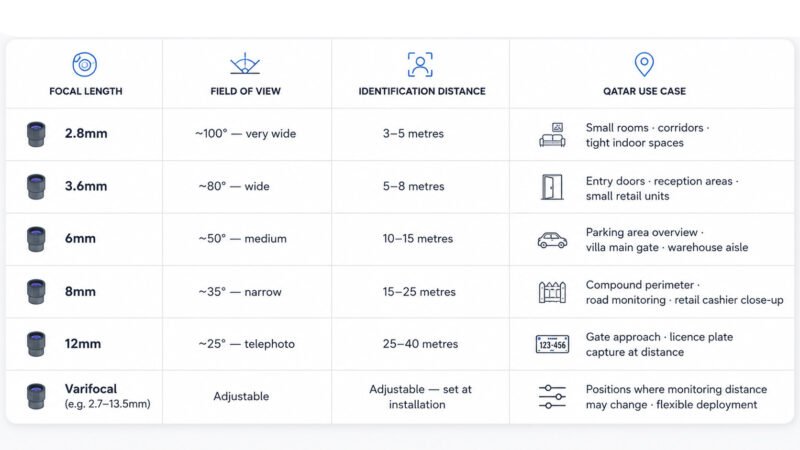
Lens Sizes and Field of View – What the Millimetre Number Means
Varifocal lenses allow the installer to set the focal length at installation time — useful when the exact monitoring distance is uncertain before installation. Secuview’s 8MP varifocal lens outdoor IP camera covers a typical varifocal range, allowing adjustment between wide-area overview and telephoto identification without changing the camera hardware.
Frame Rate, Bitrate and Storage – The Numbers That Determine Your Hard Drive Size
Three interconnected values determine how much storage a CCTV system consumes per day. Understanding all three before purchasing an NVR or hard drive prevents one of the most common and expensive mistakes in CCTV system planning.
Frame Rate
Frame rate is the number of images captured per second, measured in fps (frames per second). CCTV cameras typically record at 15fps or 25/30fps. At 15fps, fast-moving subjects (a running person, a moving vehicle) produce slight motion blur between frames — adequate for most monitoring purposes. At 25fps or 30fps, motion is captured more smoothly, which is important for licence plate capture where a vehicle moving through the frame must be legible in at least one frame.
Reducing frame rate from 30fps to 15fps reduces storage consumption by approximately 50% with minimal impact on footage usability for most Qatar residential and commercial monitoring purposes. For perimeter cameras covering vehicle entry points, maintain 25fps minimum.
Bitrate and H.265 Compression
Bitrate is the volume of data the camera produces per second, measured in Kbps or Mbps. Higher bitrate produces more detail at the cost of more storage. H.265 compression reduces the bitrate required to achieve the same visual quality as H.264 by approximately 50% — cutting storage requirements in half for identical footage quality.
Storage Calculation for Qatar CCTV Systems
Practical formula: (Bitrate in Mbps × 3600 seconds × hours per day × camera count × days retention) ÷ 8 ÷ 1,024 = storage required in GB.
| System | Resolution | Compression | Storage per 30 days |
|---|---|---|---|
| 4-camera home system | 5MP | H.265 | ~500GB → 1TB hard drive covers 30 days |
| 8-camera villa/office | 5MP | H.265 | ~1TB → 2TB hard drive covers 30 days |
| 16-camera commercial | 5MP | H.265 | ~2TB → 4TB hard drive covers 30 days |
| 8-camera high-res | 8MP / 4K | H.265 | ~2TB → 4TB hard drive covers 30 days |
Motion-triggered recording reduces storage by 60–80% compared to continuous 24/7 recording — most Qatar properties do not require continuous recording at all camera positions, and motion-triggered recording is the default recommended setting for residential systems.
Recording Systems – NVR vs DVR, Channels and Hard Drive Planning
The recording unit connects all cameras to central storage. DVR (Digital Video Recorder) serves AHD cameras. NVR (Network Video Recorder) serves IP cameras. Choosing the wrong recording unit for your camera technology is one of the most common and costly mistakes in CCTV purchases — verify compatibility before buying.
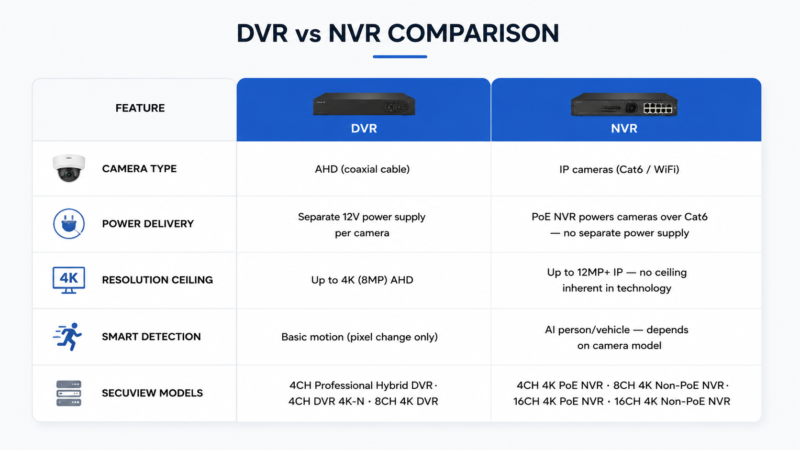
AI Analytics – Smart Detection Beyond Basic Motion
AI analytics transform a CCTV system from a recording archive into an active security tool. Where basic motion detection triggers on any pixel change — a passing shadow, a blowing leaf, a change in lighting — AI analytics classify what the camera sees and trigger alerts only for events that match specific criteria.
Person Detection and Vehicle Detection
AI-based person and vehicle detection distinguishes a human body from other motion sources. Secuview’s 8MP indoor smart detection camera and 12MP outdoor smart detection camera carry built-in person and vehicle classification AI. In practice, this reduces false motion alerts from dozens per day (with basic motion detection) to 3–5 genuine events per day on a typical Qatar residential property — making motion alerts actionable rather than ignorable.
Line Crossing and Intrusion Detection
Line crossing detection triggers an alert when a moving subject crosses a defined virtual boundary in the camera’s field of view. Intrusion detection triggers when a subject enters a defined virtual zone. Both are configured through the NVR interface — draw the line or zone on the camera’s live view, set the direction (one-way or two-way crossing), and define the alert type (push notification, recording start, siren trigger). For Qatar property perimeters, line crossing on the camera covering the compound wall or gate approach provides effective early detection without requiring physical access control at that point.
Licence Plate Recognition (LPR)
LPR cameras use AI to read and record vehicle number plates as vehicles pass through the camera’s field of view. For LPR to function reliably, three conditions must be met: the camera must be positioned to capture the plate head-on (not at an angle greater than 30°), the frame rate must be sufficient to capture a legible plate on a moving vehicle (minimum 25fps), and the camera resolution must provide at least 40 pixels per plate character at the capture point. Qatar’s standard plates are well-suited to LPR — high contrast background and consistent format. A dedicated 8mm or 12mm telephoto camera at a gate approach is the recommended LPR configuration.
People Counting
People counting cameras use AI to count individuals passing through a defined line in the camera’s field of view — generating entry/exit counts over time periods. For Qatar retail, hospitality, and commercial environments, people counting enables occupancy monitoring, peak traffic analysis, and compliance with capacity limits. An overhead camera position (camera looking straight down at the entry point) produces the most accurate count by separating individuals clearly in the top-down view.
Network Design Basics – PoE Switches, VLANs, UPS and Surge Protection
An IP camera system is a network — and like any network, its reliability depends on the hardware connecting it. Cutting corners on network infrastructure is the most common cause of IP CCTV systems that work on day one and degrade over months.
PoE Switches
A PoE switch powers IP cameras over Cat6 cable from a central point — eliminating the need for individual power supplies at each camera position. Select a PoE switch with a total power budget exceeding the combined wattage of all connected cameras. A typical 5MP IP camera draws 8–12 watts. An 8-camera system requires a minimum 96–120W PoE budget from the switch — not just 8 PoE ports. Switches specifying “8-port PoE” without stating the total watt budget may only support 3–4 cameras simultaneously under full load.
VLANs – Isolating Camera Traffic
A VLAN (Virtual Local Area Network) separates camera network traffic from general property network traffic — both for security and performance. CCTV cameras on a dedicated VLAN cannot be accessed from the general property WiFi network — reducing the attack surface if a camera’s firmware is ever compromised. Managed PoE switches support VLAN configuration. For Qatar commercial properties connecting CCTV to an enterprise network, VLAN isolation is a security best practice aligned with CISA’s video surveillance security framework.
UPS – Uninterruptible Power Supply
Qatar’s power grid is stable, but brief outages during peak summer demand (particularly during shamal events when air conditioning load peaks) can interrupt recording. A UPS (Uninterruptible Power Supply) provides battery backup to the NVR and PoE switch during power interruptions, maintaining recording continuity. Size the UPS to power the NVR and switch combined — a typical 4–8 camera NVR system draws 50–80W, requiring a UPS rated at a minimum of 300VA for 30 minutes of backup time.
Surge Protection for Qatar Outdoor Cameras
Qatar’s outdoor cameras are connected by 100-metre Cat6 runs from NVR to camera position — creating a significant vulnerability to electrical surges during the lightning events that accompany Qatar’s winter rainfall. A lightning surge travelling down a Cat6 cable can destroy both the camera and the NVR port it connects to. Install RJ45 PoE surge protectors at both ends of each outdoor camera cable run — one at the NVR patch panel and one at the camera mounting point. The QAR 30–60 cost per surge protector is negligible against the cost of replacing a damaged camera and NVR port.
Camera Maintenance in Qatar’s Dust and Heat – A Practical Schedule
Qatar’s environment creates two distinct maintenance challenges that do not exist in temperate climates: accumulated dust from shamal events coating lenses, and thermal stress on camera housings and cable runs from temperature extremes.
Lens Cleaning – Quarterly Minimum
Dust accumulation on an outdoor camera lens reduces image clarity gradually — not suddenly. A camera that looked sharp in October will appear foggy by March if unmaintained through the shamal season. Clean outdoor camera lenses every three months at minimum, or immediately after a significant shamal event. Use a lens-safe cleaning cloth — not paper towels, which scratch optical coatings. Remove the lens cover if the camera design allows access; clean behind it as well as on the exterior surface.
Housing Inspection -After Each Season
Inspect every outdoor camera housing seal once per year — ideally in April, before summer begins, when replacing a compromised housing seal is practical before peak heat. Check that the IP-rated seal around the cable entry point has not dried out or cracked. Qatar’s UV exposure and temperature cycling degrade rubber seals faster than in cooler climates. A cracked cable-entry seal allows dust and condensation to enter the housing and destroy the sensor over time, even on a camera rated IP66 from the factory.
Hard Drive Health – Annual Check
CCTV hard drives run continuously — typically 24 hours per day, 365 days per year — at higher internal temperatures than desktop computers due to NVR housing heat. Check hard drive health annually using the NVR’s built-in drive status tool (all Secuview NVR models include SMART drive monitoring). Replace any drive showing bad sector counts or read error rates above zero. Hard drives in continuously-running NVR units typically have a practical lifespan of 3–5 years under Qatar conditions — plan replacement budgets accordingly.
Common CCTV Installation Mistakes in Qatar – and How to Avoid Them
Pointing Cameras Into Direct Sunlight
A camera pointing east in the morning or west in the evening will be blinded by direct solar glare during the sun’s lowest angles. In Qatar’s winter months, the sun angle is low enough to cause glare directly into eastward and westward-facing cameras from 7–9 am and 3–5 pm. Position cameras so the sun is behind the camera’s field of view, not within it. Use the camera manufacturer’s day/night auto-iris specification to assess its glare tolerance — a wide dynamic range (WDR) rating of 120dB or above handles high-contrast scenes significantly better than standard cameras.
Mounting Too High
Mounting outdoor cameras above 4 metres reduces facial identification quality significantly for standard-resolution cameras. A 5MP camera mounted at 5 metres looking down at a 45° angle covers a large area, but cannot produce reliable facial identification at that angle and resolution. For identification quality, mount cameras at 2.5–3.5 metres where faces fall within the camera’s horizontal field, rather than looking down at the top of subjects’ heads.
Ignoring Cable Management in Qatar’s Heat
Outdoor Cat6 and coaxial cable exposed to direct Qatar sun without UV-rated conduit will become brittle and crack within 2–3 years. Use UV-rated outdoor conduit or trunking for all exposed cable runs. Where cables run on rooftops or along sun-facing walls, use conduit rated for temperatures exceeding 80°C — standard grey PVC conduit is typically rated to only 60°C, which is insufficient for Qatar rooftop exposure in summer.
Under-Specifying the NVR Channel Count
Buying a 4-channel NVR for a 4-camera installation leaves zero room for expansion. Always purchase an NVR with at least 50% more channels than your current camera count. A property installing 4 cameras today typically adds 2–4 more cameras within two years as coverage gaps become apparent after the system is live. An 8-channel NVR costs marginally more than a 4-channel NVR and eliminates the need to replace the entire recording unit to add cameras.
CCTV Privacy and Legal Considerations in Qatar
Qatar does not have a single unified CCTV surveillance law equivalent to the UK’s GDPR-derived CCTV Code of Practice. However, several legal frameworks govern what Qatar property owners and businesses can and cannot record — and the consequences of non-compliance are significant.
What You Can Record — Private Property
CCTV cameras on private property in Qatar may record the exterior and interior of that property, including approaches, gates, parking areas, and shared-access points that the property owner controls. Cameras covering a property’s own premises are generally lawful under Qatar’s property rights framework. This is the standard for residential villas, compounds, and commercial buildings.
What Requires Care — Neighbouring Property and Public Space
Cameras that capture neighbouring properties, public footpaths, or public roads raise legal exposure under Qatar’s privacy protection provisions within Law No. 13 of 2016 on Personal Data Protection. A camera positioned to monitor your own gate that incidentally captures a portion of the public road is generally acceptable. A camera positioned specifically to monitor a neighbour’s property or a public space raises legal risk. Angle cameras to monitor your own property specifically — not the street or neighbouring land beyond what is incidentally captured.
Commercial Surveillance Requirements
Commercial properties in Qatar operating CCTV for security — retail stores, hospitality, logistics — are subject to commercial licence conditions that may include surveillance system requirements specified by the Ministry of Interior. For regulated environments (hotels, banks, government-adjacent commercial premises), consult the relevant authority on surveillance requirements before finalising a CCTV system specification. Documented security policies and surveillance procedures are a fundamental component of defensible commercial security operations in any GCC jurisdiction.
Notification and Signage
While Qatar law does not explicitly mandate CCTV notification signage in the way European GDPR does, best practice — and the standard for commercial and hospitality operations — is to post visible CCTV notification signage at property entrances. This reduces legal exposure, manages visitor expectations, and is increasingly expected by Qatar’s commercial property standards, even where not strictly required by law.
Business – Specific CCTV Recommendations — Retail, Warehouses, Offices, Schools
Different business types in Qatar have different surveillance priorities — identification distance, AI analytics, channel count, and recording retention requirements vary significantly by industry.
Retail Stores
Priority: cashier area identification (close-up, 3.6mm or 6mm lens, 5MP minimum), entrance/exit overview for people counting and licence plate coverage of the car park, and stock room access control monitoring.
- Recommended camera types: 5MP indoor IP cameras for internal positions, 8MP outdoor IP cameras for car park and entrance, overhead AI people-counting camera at entrance
- AI analytics: people counting at the entrance, line crossing at the cashier area, intrusion detection in the stock room after hours
- Recording retention: minimum 30 days for insurance and incident investigation purposes
Warehouses and Logistics
Priority: wide-area coverage of floor space, perimeter security, vehicle movement at loading bays, and 24/7 recording continuity.
- Recommended camera types: 8MP or 12MP wide-angle IP cameras at elevated positions for floor overview, PTZ camera at main vehicle gate, IR cameras rated for warehouse operating temperature range
- AI analytics: intrusion detection for after-hours perimeter, line crossing at loading bay vehicle entry
- Network: UPS is essential for warehouses where recording continuity is required for cargo liability purposes
Offices and Corporate Premises
Priority: access control at entry points, reception and common areas, server room monitoring, and discreet camera placement appropriate for a professional environment.
- Recommended camera types: 5MP dome cameras (lower visual profile than bullet cameras) at reception and corridors, 8MP indoor smart detection for server room, VLAN-isolated network for camera traffic
- Privacy consideration: avoid cameras pointing directly at individual workstations — Qatar’s commercial privacy norms treat this as intrusive; monitoring common areas and access points is standard practice
Schools and Educational Facilities
Priority: perimeter security, main entrances, car drop-off areas, and common areas — with specific exclusion of private student spaces.
- Recommended camera types: outdoor weatherproof IP cameras at perimeter and entrance, people-counting cameras at gates for occupancy monitoring during events
- Legal consideration: cameras monitoring areas used by minors require particular sensitivity in Qatar’s legal framework — consult the Ministry of Education and Higher Education requirements for school surveillance before installation
- Recording retention: minimum 14 days for incident investigation; some school insurance requirements specify 30 days
Secuview’s Complete CCTV Range Available in Qatar
Now that you’ve seen how each CCTV technology works, the next step is choosing equipment that matches your property, budget, and installation requirements. Secuview stocks every major CCTV camera technology covered in this guide, allowing you to build anything from a simple home security system to a multi-camera commercial surveillance network. Rather than choosing products by resolution alone, start with the technology that best fits your installation.
AHD Camera Systems for Existing Properties
If your property already has coaxial cable installed, there’s usually no need to replace the entire infrastructure. Secuview’s AHD camera range includes a 1.3MP compact indoor AHD camera, a 2MP indoor AHD camera, a 5MP indoor AHD high-performance model, and a 5MP outdoor AHD camera with IP66 weatherproof housing — all designed to work with existing coaxial cabling and compatible DVR systems. For renovation projects and CCTV upgrades in Qatar, this is often the most cost-effective solution.
IP Cameras for New Installations and Smart Surveillance
For new homes, villas, offices, and commercial buildings, IP cameras provide the highest level of image quality and intelligent monitoring. Secuview’s IP camera range includes a 5MP indoor IP camera with two-way audio and auto-tracking, a 6MP fixed-lens outdoor IP camera with auto-tracking, an 8MP indoor IP camera with smart detection, an 8MP outdoor waterproof full HD IP camera, an 8MP varifocal lens outdoor IP camera, a 12MP indoor PoE camera with auto-tracking, and a 12MP weatherproof outdoor IP camera with smart detection — for applications requiring maximum detail and AI-powered analytics. These cameras integrate with PoE NVR systems using a single Cat6 cable for both power and data.
Wireless Solutions for Apartments and Cable-Free Installations
Where running network cable isn’t practical, Secuview offers several wireless options. The WiFi outdoor weatherproof security camera provides app-based monitoring for apartments, rental properties, and completed interiors without requiring Ethernet cabling. For locations without electricity or internet access, the solar-powered 4G CCTV camera and wireless IP outdoor solar 4G camera use a SIM card and integrated solar charging to provide completely independent surveillance — compatible with Ooredoo and Vodafone Qatar 4G LTE networks. Customers monitoring farms, construction sites, remote gates, or off-grid properties can also choose the solar 4G dual-lens camera for simultaneous wide-angle and zoom monitoring from a single installation point.
PTZ and Specialised Cameras
Large outdoor areas often require flexible coverage rather than multiple fixed cameras. Secuview’s 6MP outdoor IP PTZ camera with auto-focus varifocal lens combines motorised pan, tilt, zoom, and autofocus for compounds, warehouses, parking areas, and industrial sites — IP66 rated, operating from -20°C to +60°C.
For homeowners looking for quick installation without power cables, the wireless IP outdoor weatherproof battery camera provides IP67 weather protection and mobile app monitoring. Families requiring indoor monitoring can choose between the 2K PTZ baby monitor camera and the 5MP PT baby monitor camera, both offering two-way audio and remote viewing through a smartphone.
Recording Systems
Every CCTV installation requires a recording solution matched to the camera technology. Secuview supplies a 4CH professional hybrid DVR with 4K-N output, a 4CH DVR with 4K-N output, an 8CH 4K PoE NVR, an 8CH 4K non-PoE NVR, a 16CH 4K PoE hybrid NVR, and a 16CH 4K non-PoE hybrid NVR — making it straightforward to build systems ranging from small residential installations to large commercial deployments.
CCTV Accessories and Network Equipment
A reliable surveillance system depends on more than cameras alone. Secuview also supplies PoE switches for managed and unmanaged IP camera installations, and a full range of CCTV accessories, including Cat6 cable, coaxial cable, BNC connectors, power supplies, and mounting brackets needed to complete a professional installation. Choosing compatible accessories from the same supplier helps simplify installation and long-term maintenance.
Whether you’re upgrading an existing analogue system, installing a new AI-powered IP surveillance network, or building a completely wireless security solution, you’ll find compatible cameras, recording systems, and installation accessories throughout the Secuview product range.
Frequently Asked Questions
Which CCTV camera type is best for a Qatar villa?
For a new Qatar villa build, a 5MP or 8MP IP PoE system with Cat6 cabling and an NVR delivers the best combination of resolution, smart detection, and remote access. For a villa with existing coaxial cable from an older system, AHD reuses that cabling cost-effectively. For positions beyond WiFi and cable reach — remote outbuildings, garden perimeters, pool equipment areas — a 4G solar or battery camera fills those positions without cable installation.
Can I mix AHD and IP cameras on the same recording system?
Not on a standard DVR or NVR. AHD cameras require a DVR; IP cameras require an NVR. Secuview’s hybrid DVR models support both AHD and IP inputs simultaneously on a single recording unit — the practical solution for properties that have existing AHD cameras they want to keep while adding IP cameras for new positions requiring smart detection or higher resolution.
What night vision technology is best for Qatar’s outdoor conditions?
For positions with ambient artificial lighting (street lights, property lighting), a Starlight-sensor camera maintains colour night vision without activating IR LEDs. For positions in complete darkness (remote land, unlit perimeters), IR night vision with a minimum 30-metre range is the standard choice. For vehicle gate positions where colour identification matters at night, a full-colour night vision camera with built-in white light provides the most usable footage for identification purposes.
How long should I retain CCTV footage in Qatar?
For residential properties, 14–30 days is the standard retention recommendation — long enough to identify incidents that are not noticed immediately. For commercial properties, insurance requirements typically specify a minimum of 30 days. For regulated environments (hospitality, retail), consult your insurance provider’s specific requirements. Secuview’s 16-channel NVR models support up to 8TB of hard drive storage — providing 30+ days of retention for a 16-camera system at 5MP with H.265 compression and motion-triggered recording.
Does a 4G camera work everywhere in Qatar?
4G cameras work wherever Ooredoo or Vodafone Qatar’s 4G LTE network has coverage, which covers the vast majority of Qatar’s populated areas and major roads. Remote desert land and areas far from populated zones may have limited or no 4G coverage. Check the operator’s coverage map for the specific installation location before purchasing. In areas with a weak 4G signal, video quality will be reduced, and motion alert delivery may be delayed.
What is the minimum camera specification for licence plate capture in Qatar?
Minimum recommended specification for LPR at a Qatar property gate: 8MP resolution, 25fps frame rate, 8mm or longer focal length, positioned head-on to the vehicle approach at no more than 30° horizontal angle from the plate face. IR illumination should cover at least 15 metres for night-time capture at the gate stop line. For moving vehicle LPR at road speed, a dedicated LPR camera with 120dB WDR and 50fps minimum frame rate is required — standard CCTV cameras are not optimised for moving vehicle plate capture above approximately 20km/h.












You must be logged in to post a comment.