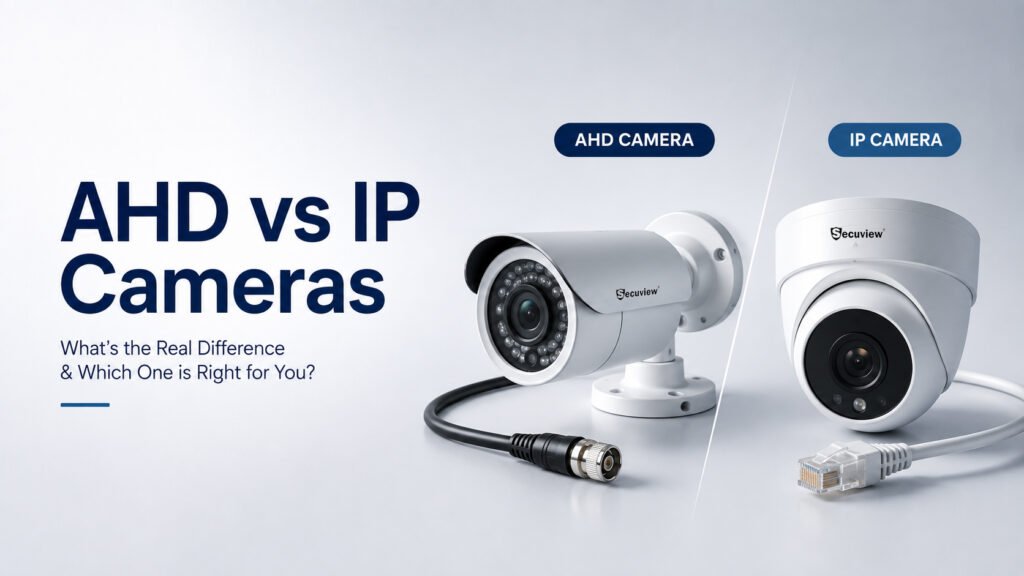
Both AHD and IP cameras can deliver genuinely sharp HD footage, which is exactly why the choice between them isn’t actually about which one “looks better” on a spec sheet; it’s about cabling, how the recorder works, power delivery, networking, storage, installation, scalability, and total cost. If both can provide HD surveillance, what actually changes underneath that? This guide walks through the real, system-level differences and helps match the right technology to an actual property and installation situation, including what that looks like in practice across Qatar.
AHD vs IP Cameras: Quick Answer
The main difference: AHD is HD CCTV technology built around coaxial cable and a DVR. IP is network-based camera technology built around Ethernet, PoE, and an NVR.
When AHD may make sense: existing coaxial infrastructure, an existing DVR system, a straightforward upgrade, or reusing infrastructure that’s already in place.
When IP may make sense: a genuinely new installation, Ethernet infrastructure already planned, PoE, deeper network integration, or real future expansion plans.
The simple starting rule: existing coaxial CCTV → investigate AHD. New network-based CCTV → investigate IP. This is a starting point for the conversation, not an absolute rule — the sections below cover the real exceptions.
What Is an AHD Camera?
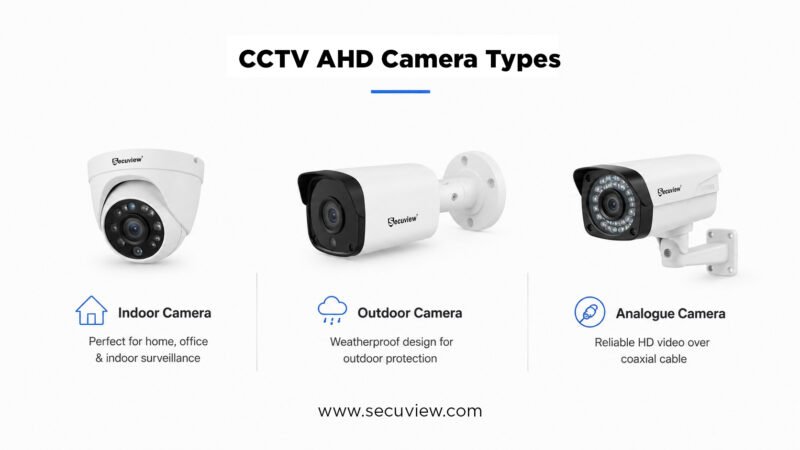
What Is an AHD Camera? How It Works and When to Use One
AHD (Analog High Definition) sends HD video over standard coaxial cable to a DVR, encoding the signal differently than old analog CVBS to carry HD resolution down the same cable type. It connects to a DVR — which processes the incoming analog signal itself — over coaxial cable, and typically receives power separately rather than over that same cable. Its real advantage is reusing existing coaxial wiring; its real limitation is the ceiling on smart features a wired analog signal structurally can’t support. For the full mechanics — how the encoding actually works, transmission distance, resolution tiers — what an AHD camera is and how it works covers that in complete depth; this section stays at the level needed for the comparison ahead.
What Is an IP Camera?
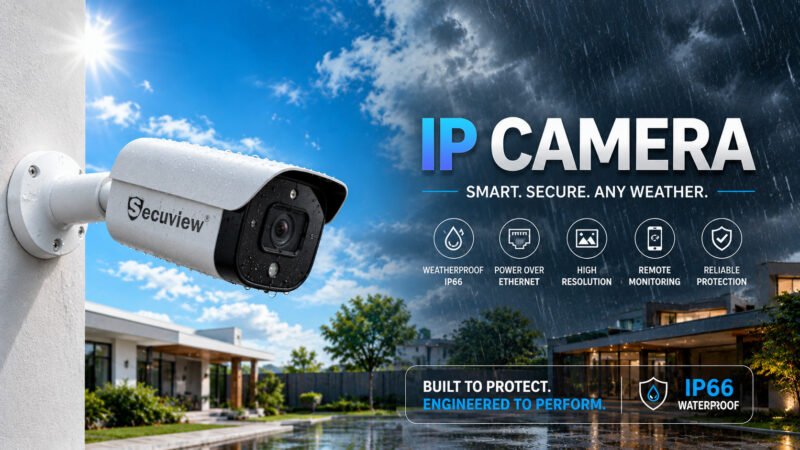
what-is-an-ip-camera-how-it-works-and-when-to-use-one
An IP camera encodes and compresses its own video before it ever reaches a cable, then transmits that digital stream over Ethernet to an NVR. PoE — Power over Ethernet — lets that same cable carry power alongside the data, removing the need for a separate power run to each camera. Its real advantage is the smart-feature ceiling AHD can’t reach: motion-zone alerts, native mobile app access, two-way audio, all over one cable. For the full mechanics of encoding, PoE, and NVR communication, what an IP camera is and how it works covers that in complete depth; this section stays scoped to what the comparison below actually needs.
AHD vs IP Cameras: What Actually Changes?
Video transmission. AHD sends an encoded analog signal over coaxial cable; IP sends already-digitized data over a network cable — the core architectural split that everything else in this comparison follows from.
DVR vs NVR. A DVR processes the incoming analog/AHD signal itself, at the recorder. An NVR receives an already-processed digital stream and focuses on storage, management, and playback — the full difference is covered in how NVR systems record and manage footage.
Cabling. Coaxial for AHD, Ethernet (Cat5e/Cat6) for IP — and whichever already exists on a property is usually the deciding factor before any other spec even matters.
Power delivery. AHD cameras are typically powered separately from the video cable. IP cameras commonly use PoE, carrying power and data over the same cable — the mechanics of which are covered in why PoE matters for IP camera installations.
Network requirements. AHD needs no network knowledge to install. IP requires actual network planning — IP addressing, switch capacity, sometimes VLANs on larger systems.
Installation architecture. AHD: camera → coaxial → DVR. IP: camera → Ethernet/PoE → network → NVR.
Recording and storage. Both scale storage needs with resolution, bitrate, compression, camera count, recording mode, and retention period — the same underlying math, worked through with real numbers, in the NVR storage guide linked above. IP systems generally support higher resolutions and benefit more from H.265 compression.
Remote viewing. Both can support it, depending entirely on the specific recorder and network configuration — this isn’t an automatic IP advantage the way it’s sometimes assumed to be.
Scalability. AHD expansion is tied to physical coaxial runs already in place. IP expansion is generally more flexible, tied to network capacity rather than cable routing alone.
AHD vs IP Camera Image Quality
Does IP always mean better image quality? Not automatically — resolution and megapixels (2MP through 8MP, and 4K specifically, covered in full in 4K vs 8MP resolution explained) matter more than the AHD/IP label itself. Image sensor quality, lens quality, bitrate, and compression (H.264 vs H.265) affect real-world image quality on both technologies. Night vision and WDR performance depend on the specific model, not the underlying transmission method. The honest takeaway: camera specifications matter more than which architecture a given model happens to use — a well-specified AHD camera can outperform a poorly-specified IP camera at a similar price, and vice versa.
AHD vs IP Camera Installation
AHD installation is generally simpler — no network configuration, just coaxial runs to a DVR, making cable distance and existing infrastructure condition the main variables. IP installation adds network planning on top of the physical cable run: PoE budget, switch capacity, and NVR placement all need consideration before the first camera goes up. Cable distance limits differ meaningfully — AHD’s coaxial runs can typically go farther than standard Ethernet’s roughly 100-meter limit without an extender. Maintenance and troubleshooting on AHD tends to be more straightforward given fewer points of failure; IP systems have more components (switch, network config, PoE budget) that can individually need attention, in exchange for the flexibility that added complexity buys.
AHD and IP Cameras in Qatar: What We Actually See
Rather than a generic “AHD fits here, IP fits there” framing, this is what actually shows up across real installations and upgrade conversations in Qatar.
Existing installations are frequently older coaxial CCTV systems already running on a DVR — properties where customers want higher resolution or better remote access without tearing out infrastructure that still works. Upgrading a DVR-based system for better performance, without a full rebuild, is a genuinely common conversation.
New installations — new villas, homes, offices, retail stores, warehouses, and commercial properties — are increasingly built around Ethernet from the start, with PoE-based IP systems as the default rather than the exception, simply because running Cat6 during construction costs about the same as running coaxial at that stage.
Villas and homes in Doha split cleanly along this same line: existing coaxial CCTV at gates, entrances, driveways, and garages is a reasonable AHD upgrade candidate; a genuinely new installation on a property being built or fully renovated is a strong IP candidate instead.
Offices and retail stores decide based on camera count, existing cabling, and how much future expansion is actually planned — a small shop with a handful of fixed positions doesn’t need IP’s network complexity; a growing retail chain planning centralized multi-location monitoring benefits from it directly.
Warehouses covering wide areas, loading docks, storage zones, and long perimeter runs often favor IP specifically for the cable-distance and camera-count flexibility a network architecture provides over coaxial’s more rigid physical limits.
Commercial and multi-building properties — larger deployments needing centralized recording across several structures — lean IP almost by default, since distributed cameras, external switches, and centralized NVR/VMS management are exactly what network-based architecture is built for.
What changes when CCTV already exists: the practical question becomes whether existing coaxial cabling, a working DVR, and existing network equipment justify a straightforward AHD upgrade, or whether the customer specifically wants IP’s smart features enough to justify new infrastructure alongside the old.
What changes when building from scratch: cable planning, Ethernet routing, PoE budget, NVR placement, and storage all get decided together rather than around existing constraints — which is exactly why new builds lean IP so consistently.
Outdoor CCTV in Qatar adds heat, dust, and weather exposure into the decision regardless of AHD or IP — IP rating, camera housing quality, cable and connector protection, night vision, and WDR performance all matter the same way on both architectures, covered in full in the outdoor camera climate guide.
Qatar compliance: applicable CCTV requirements can depend on the specific property, business type, and sector — this varies enough that neither AHD nor IP should be assumed to be universally required or preferred. Qatar’s Ministry of Interior is the relevant authority for security system approval where applicable, and verifying current requirements directly before installation is worth doing rather than assuming either technology satisfies every situation by default.
AHD vs IP Camera Cost
| Cost Factor | AHD | IP |
| Camera cost | Generally lower | Generally higher |
| Recorder (DVR/NVR) | Lower | Higher, especially at higher channel counts |
| Cabling | Coaxial, often cheaper per meter | Ethernet, comparable cost on new builds |
| Power equipment | Separate power supply per camera | Often included via PoE |
| PoE switch | Not applicable | Required unless the NVR has built-in PoE |
| Storage | Generally lower capacity need | Higher, especially at 4K |
| Installation | Simpler, generally lower labor cost | More involved, higher labor cost |
| Maintenance | Fewer components | More components, more potential points of failure |
| Future upgrades | Limited by existing coaxial infrastructure | Generally more flexible |
The single most important point here: compare the complete system cost, not the camera price alone. An IP camera that looks more expensive per unit can still come out ahead or behind AHD once cabling, recorder, PoE switch, and storage are all counted — and the same is true in reverse for an AHD system that looks cheap until the DVR, separate power supplies, and coaxial cabling are added up.
AHD vs IP Cameras for 4K Surveillance
AHD can support 4K on specific models, though 4K IP cameras and 8MP-class sensors are more commonly available and more consistently paired with the network bandwidth and NVR compatibility 4K actually needs — the full technical breakdown of what “4K” and “8MP” mean and how they relate is covered in 4K vs 8MP security cameras explained. Whichever architecture is chosen, DVR/NVR compatibility with the camera’s actual resolution, sufficient storage, adequate network bandwidth (IP specifically), and night vision performance at that resolution all need checking together — a “4K-capable” recorder doesn’t guarantee every connected camera actually records at 4K, the same caution covered in the NVR guide.
AHD vs IP Cameras for AI and Smart Detection
Motion detection, person detection, vehicle detection, intrusion detection, line crossing, and face detection where supported are all available on both AHD and IP systems in principle — but AI capability depends entirely on the specific camera or recorder model, not the underlying architecture. Some processing happens at the camera itself, some at the recorder, depending on how a given system is designed. The important thing to avoid assuming: “IP means AI.” It doesn’t — a specific IP camera or NVR either supports a given AI feature or it doesn’t, the same way a specific AHD/DVR combination might or might not, and checking the actual model’s stated capabilities is the only reliable way to know.
Can You Upgrade From AHD to IP Cameras?
Existing coaxial cable generally can’t carry an IP camera’s digital signal, so upgrading typically means new Ethernet cabling rather than reusing the coaxial runs already in place — reusing existing infrastructure makes sense when the coaxial wiring is in good condition, and a full AHD-to-IP switch isn’t actually necessary yet; re-cabling makes more sense when the property is already undergoing other renovation work anyway. Replacing a DVR with an NVR, and moving to PoE, are both part of the same transition rather than separate decisions. A gradual migration — adding IP cameras alongside an existing AHD system via a hybrid recorder — is often more practical than a full rip-and-replace, covered next.
Can AHD and IP Cameras Work Together?
Yes, through a hybrid DVR/NVR built specifically to accept both AHD/analog and IP camera inputs on one recording unit — covered in more detail in the DVR guide. Recorder compatibility, resolution compatibility, and codec compatibility all need confirming for the specific hybrid model in question, and ONVIF/RTSP support where available is what actually enables cross-brand IP camera flexibility on the IP side of a hybrid system. Checking exact product specifications before assuming compatibility is the one habit worth carrying through every part of this decision, not just this section.
AHD vs IP Cameras — Side-by-Side Comparison
| Feature | AHD Camera | IP Camera |
| Core technology | HD CCTV / analog transmission | Network / IP |
| Typical recorder | DVR | NVR |
| Common cabling | Coaxial | Ethernet |
| PoE | Not typical | Common option |
| Network dependency | Lower | Higher |
| Existing coax reuse | Strong advantage | Usually different architecture |
| New Ethernet installation | Less network-centric | Strong fit |
| Scalability | System-dependent | Generally flexible |
| Remote viewing | DVR/network dependent | Network-based |
| AI features | Model-dependent | Model-dependent |
| 4K availability | Model-dependent | Model-dependent |
| Best fit | Existing CCTV upgrades | New or network-based systems |
This isn’t a “winner” table — product specifications for the exact models under consideration always take priority over the general pattern above.
Common Mistakes When Choosing AHD or IP Cameras
Assuming IP is always better, choosing by megapixels alone, ignoring existing cabling, forgetting DVR/NVR compatibility, ignoring storage and network bandwidth planning, ignoring night vision performance, assuming every IP camera supports PoE, assuming every camera has AI, ignoring future expansion needs, choosing purely on camera price rather than total system cost, and ignoring Qatar-specific installation and compliance requirements.
AHD vs IP Camera Buying Guide
Working through this in order avoids most of the mistakes above: confirm what cabling already exists, decide whether this is a new installation or an upgrade, identify every camera location (indoor, outdoor, entrance, gate, driveway, perimeter, warehouse, loading area), determine how many cameras are actually needed, decide whether PoE matters for this installation, choose resolution based on what each position needs to achieve (not the highest number available), check night vision and WDR requirements, calculate storage using camera count, resolution, bitrate, compression, and retention period together, consider what AI features actually matter versus which ones just sound good on a spec sheet, confirm DVR/NVR compatibility, check network requirements for an IP system, calculate the complete system cost rather than camera price alone, verify Qatar-specific requirements where applicable, and plan deliberately for future expansion rather than sizing exactly to the current camera count.
AHD vs IP Camera Decision Tree
Already have coaxial CCTV? Yes → investigate AHD. No → keep comparing both.
Building a new network-based system? Yes → evaluate IP.
Need PoE specifically? Yes → evaluate IP cameras with PoE.
Need significant future expansion? Yes → weigh network architecture carefully — this favors IP in most cases.
Mainly want to reuse existing infrastructure? Yes → AHD is worth serious consideration.
Which Is Better: AHD or IP Camera?
AHD may be the better choice when existing coaxial infrastructure and a working DVR are already in place; this is a straightforward upgrade, infrastructure reuse matters, and the requirements are genuinely simple.
IP may be the better choice when this is a new installation, Ethernet infrastructure is already planned, PoE and deeper network integration matter, real expansion is anticipated, or cameras will be distributed across a larger, more complex property.
Why there’s no universal winner: the actual answer depends on infrastructure, property type, camera requirements, network capacity, storage needs, budget, and plans together — not any single factor in isolation.
Where to Buy AHD and IP Cameras in Qatar
For AHD cameras, confirming DVR compatibility and the condition of the coaxial cable before buying helps avoid the most common upgrade mistake. For IP cameras, NVR compatibility, PoE requirements, Ethernet cabling, network bandwidth, and storage all need to be factored into the purchase, not just the camera itself. Both are available on Secuview, an online CCTV store, covering homes, villas, and businesses across Doha with local stock and MOI-compliant options where relevant.
Conclusion
AHD can be a practical choice for upgrading an existing coaxial CCTV system, while IP cameras can be a strong choice for new network-based installations where PoE, network integration, and future expansion matter. The right technology depends on the actual property, infrastructure, and surveillance requirements — not a fixed rule that one architecture is universally better than the other. Existing cabling, installation type, camera locations, count, resolution needs, network requirements, storage, total cost, and expansion plans are the real decision factors, in roughly that order of importance.
Frequently Asked Questions
What is the difference between AHD and IP cameras?
AHD sends an encoded analog signal over coaxial cable to a DVR. IP sends a digitized signal over Ethernet to an NVR. The two technologies use different approaches to transmitting, processing, and recording video.
Is an IP camera better than an AHD camera?
Not automatically. IP cameras offer more smart-feature potential and scalability, while AHD cameras are often a more cost-effective and simpler choice where existing coaxial infrastructure is already available.
Which is better for home CCTV, AHD or IP?
It depends on the existing infrastructure. A home with working coaxial wiring and a DVR can be a good candidate for an AHD upgrade, while a new installation or new build is often a strong candidate for IP cameras from the start.
Which is better for a villa in Qatar?
The same principle applies. Existing coaxial CCTV infrastructure generally favors an AHD upgrade, while new construction or a completely new CCTV installation generally favors IP cameras.
Is AHD cheaper than IP CCTV?
Usually at the camera level, but the more useful comparison is the total system cost. Cabling, recorder, power equipment, storage, installation, and other infrastructure should all be considered rather than comparing camera prices alone.
Can AHD cameras use existing coaxial cable?
Yes, provided the existing coaxial cable and connectors are in good condition. This is one of the main advantages of AHD cameras and makes them a practical upgrade path for many older CCTV systems.
Can IP cameras use Ethernet cables?
Yes. Cat5e or Cat6 Ethernet cable is commonly used for IP camera installations.
Can IP cameras use PoE?
Many IP cameras can use PoE, but not all IP cameras support it. PoE capability depends on the specific camera model, so the product specifications should be checked before assuming PoE is included.
Can AHD and IP cameras work together?
Yes. AHD and IP cameras can work together when connected to a compatible hybrid DVR/NVR that is designed to accept both camera types on the same recording system.
Can I upgrade an AHD system to IP cameras?
Yes, although an IP upgrade typically requires Ethernet cabling rather than reusing existing coaxial runs. AHD and IP cameras use fundamentally different transmission methods and cable infrastructure.
Is AHD good for 4K surveillance?
Some AHD cameras support 4K resolution. However, 4K IP cameras are more widely available and are commonly paired with network infrastructure and NVRs designed specifically for high-resolution IP video.
Are IP cameras better for AI detection?
Not automatically. AI detection capability depends on the specific camera and recorder model rather than simply whether the system uses AHD or IP technology.
Do IP cameras need an NVR?
Generally, an NVR is the standard companion device for local recording and centralized management of an IP camera system. Some IP cameras can also record to local storage or other systems depending on their features.
Do AHD cameras need a DVR?
Yes, a DVR is the standard recorder used to process and record the analog video signal from AHD cameras.
Which is better for a warehouse, AHD or IP?
IP is often the better choice for warehouses, particularly where cable-distance flexibility, larger camera counts, and scalable network architecture are important. The best option still depends on the site’s existing infrastructure and installation requirements.
Which is better for outdoor CCTV in Qatar?
Neither architecture has an inherent outdoor advantage. IP rating, camera housing quality, weather resistance, and night vision performance matter for both AHD and IP cameras. These factors should be evaluated based on the specific outdoor installation.
What should I check before buying CCTV cameras in Qatar?
Check the camera type, resolution, DVR or NVR compatibility, cabling, power requirements, storage capacity, network capacity, night vision, AI features, cross-brand compatibility, installation requirements, and any applicable Qatar-specific requirements for the property or business type.
“`